
If you are searching for Moringa Powder Online, you likely want two things: a trustworthy product and clarity about how it is actually made. Most pages tell you what Moringa powder is. Fewer tell you where the leaves were grown, how they were dried, and who processed them. That gap is exactly where Bundelkhand’s Famous operates. You can also explore the brand’s food and agriculture blog for related guides.
We work with farmers across Bundelkhand, grow and source Moringa leaves, process them into fine powder, and bring the final product to your kitchen. This article explains the entire journey — from the field to the pack — so you can make an informed decision about the Sahjan Powder you buy.
Whether you are comparing Moringa Powder Price, checking pack sizes like Moringa Powder 1kg, or simply want to understand what makes our farm-to-powder approach different, this guide covers it in plain language. We have written this as a complete resource — covering everything from the botany of the Moringa tree to the practical question of how much powder to add to your dal tonight.
Our goal is simple: by the time you finish reading, you should understand what Moringa Powder is, how our farm-to-food process works, what the product can be used for in everyday cooking, and what information you should check before you buy.
What Is Moringa Leaf Powder?
Moringa leaf powder is a food ingredient made by drying fresh Moringa leaves and grinding them into a fine powder. It can be added to dal, vegetables, atta, chutney, smoothies, and many other everyday foods.
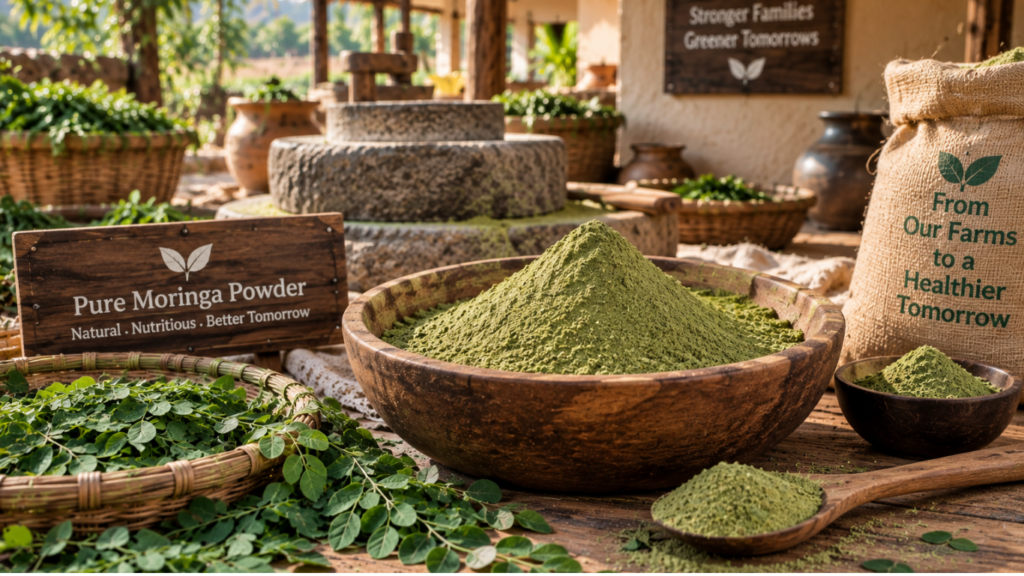
Moringa (Moringa oleifera) is commonly known in India by regional names such as Sahjan or drumstick tree. ICAR describes drumstick/Moringa as an important crop in India, and the leaves are widely used as food. For readers who want a technical agricultural reference, see ICAR’s information on drumstick varieties and cultivation.
When fresh leaves are not available or convenient, the powdered form offers a practical alternative that stores well and mixes easily into cooked dishes. The powder retains the green color and earthy, slightly spinach-like taste of the leaves. It is not a medicine or supplement in the regulatory sense — it is a minimally processed plant food used as an ingredient in regular meals.
The key word here is “ingredient.” Moringa powder is not a standalone food, and it is not a replacement for a balanced diet. It is something you add to food you are already eating — a spoonful in dal, a teaspoon in atta, a pinch in chutney. That is how it is traditionally used in Indian households, and that is how we recommend using it.
What Is Sahjan Powder?
Sahjan Powder is simply the Hindi name for Moringa Leaf Powder. In many parts of North India, especially Uttar Pradesh and Madhya Pradesh, the tree is called Sahjan and the leaves are called Sahjan ki patti. The powder made from these leaves is Sahjan Leaf Powder.
There is no difference between Sahjan Powder and Moringa Powder. The same product is sold under different regional names: Moringa Powder, Drumstick Leaf Powder, Sahjan Powder, Shigru Powder, and Moringa Leaf Powder. If you are searching for “सहजन पाउडर” or “मोरिंगा पाउडर”, you are looking for the same product.
At Bundelkhand’s Famous, we use the name Sahjan Powder because that is what our farmers and local customers call it. When you buy Moringa Leaf Powder from us, you are buying Sahjan Powder — the same product, the same process, the same source.
The naming confusion is worth understanding because it affects how you search. If you search only for “Moringa Powder” you may miss products labeled “Sahjan Powder” and vice versa. Both names refer to the same thing.
The Moringa Tree – A Brief Botanical Background
Understanding the tree helps you understand the powder. ICAR’s current information on drumstick varieties provides useful agricultural context, while FAO’s food compendium provides food-composition information for Moringa leaves.
Moringa oleifera is a deciduous tree that can grow up to 10–12 meters in height. It has a soft, light wood and compound leaves with small, oval leaflets. The tree produces long, triangular seed pods — these are the “drumsticks” used in sambar and other South Indian dishes. The leaves, pods, seeds, and flowers are all edible.
Moringa is well adapted to warm conditions and is valued for its foliage, pods and multiple uses. Its ability to grow in a range of environments makes it relevant to diversified farming systems, although actual performance depends on cultivar, soil, water availability and farm management.
ICAR has documented Moringa cultivation under semi-arid conditions, including the development of drumstick varieties evaluated under rainfed conditions. Bundelkhand has hot and seasonally dry areas, but farm suitability still depends on local soil, water and management. We therefore describe our regional context rather than claiming that every Bundelkhand farm is identical. For broader food-composition context, the FAO compendium lists Moringa oleifera and cites Indian food-composition data for its leaves; nutritional values can vary with the plant material and processing conditions, so a packaged product’s current laboratory nutrition panel should be used for product-specific claims.
The tree’s resilience is one reason we chose Moringa as a focus crop. It does not demand intensive chemical inputs. It does not require irrigation in areas with moderate rainfall. It produces leaves multiple times a year. For small farmers in our region, it is a practical crop.
How Moringa Tree Are Grown
Moringa is a hardy tree that grows well in warm, dry climates. Bundelkhand’s semi-arid conditions — long summers, limited rainfall, and rocky soil — are actually well-suited to Moringa because the tree is drought-tolerant and does not require waterlogged soil.
Farm application of organic manure to the Moringa field.
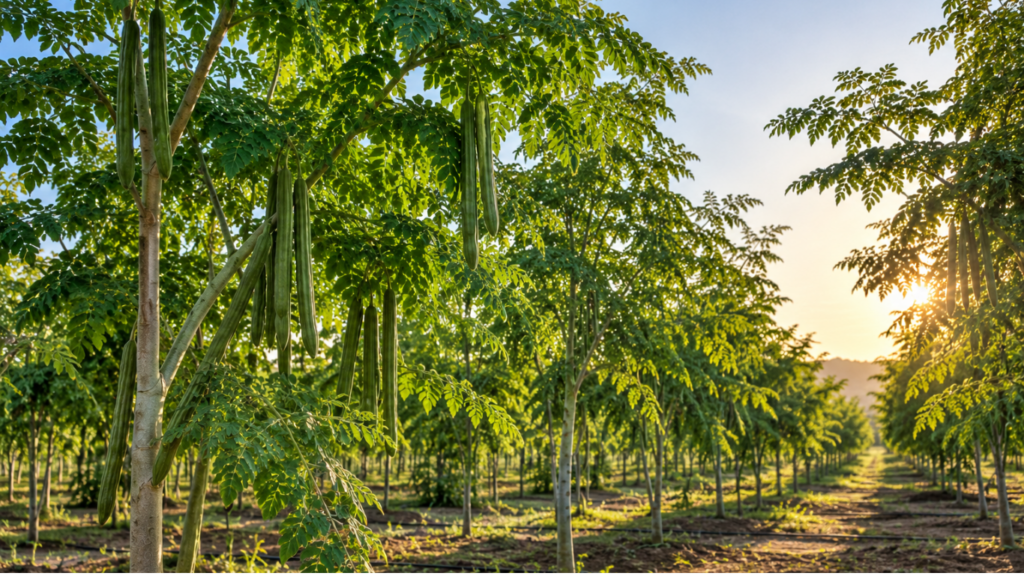
For leaf production, planting density and spacing should be selected according to the cultivar, local soil, water availability, farm objective and validated agronomic practice. ICAR has documented Moringa cultivation and improved drumstick varieties for Indian conditions, including semi-arid and rainfed contexts. Harvest timing and frequency also vary with cultivar, climate, planting density and the purpose of cultivation, so a single fixed schedule should not be treated as universal.
Our approach to cultivation is rooted in natural farming principles. We encourage farmers to use on-farm resources — compost, cow-based inputs, and minimal external interventions. This is not because we make exaggerated claims about “chemical-free” food, but because we believe in a farming system that is economically viable for small farmers and ecologically responsible. You can read more about our farmer ecosystem and how we work with local growers.
The Moringa tree itself is resilient. It does not demand intensive chemical inputs to produce leaves. That natural hardiness is one reason we chose it as a focus crop within our farm-to-food ecosystem.
Harvesting is typically done manually. Farmers cut the branches at a height that encourages new growth, then strip the leaves. The timing of harvest matters — leaves harvested in the cooler parts of the day retain better quality than those harvested in peak afternoon heat. We advise our farmers to harvest early morning or late evening when possible.
Moringa Cultivation in Bundelkhand – Our Regional Context
Bundelkhand is a region spread across Uttar Pradesh and Madhya Pradesh. It is known for its semi-arid climate, rocky terrain, and agricultural challenges. Water scarcity is a persistent issue. Many farmers depend on rain-fed agriculture.
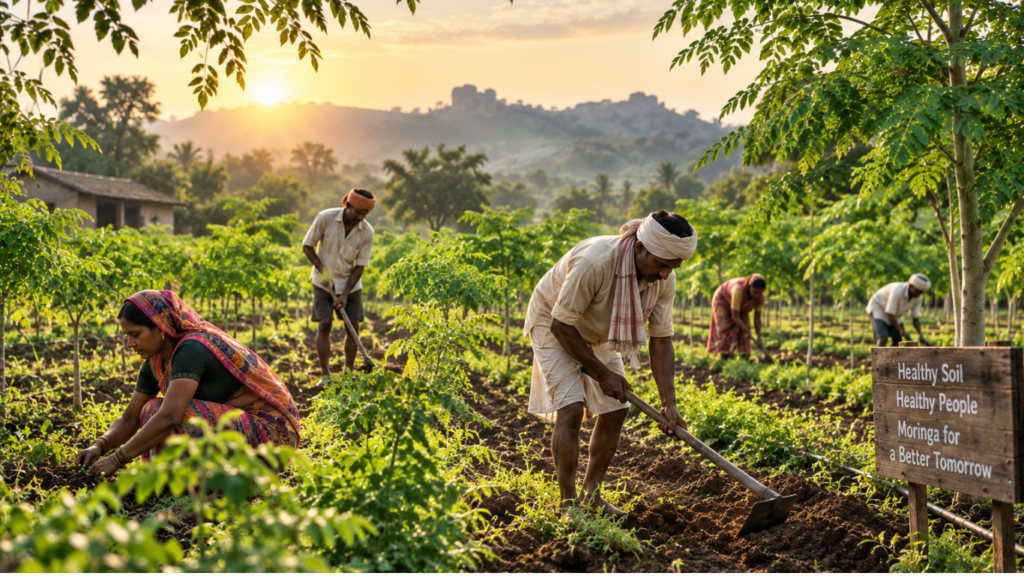
Farmers working in a Moringa cultivation field.
Moringa fits well into this context. It requires less water than many traditional crops. It can be grown on field boundaries and marginal land. It provides a source of nutrition and income without demanding the resources that water-intensive crops require.
Our work in Bundelkhand is not about replacing existing crops. It is about adding Moringa to the farming system — as a supplementary crop that uses resources efficiently and provides additional income. Farmers we work with grow Moringa alongside their regular crops. It is not an either/or choice.
This regional context matters because it shapes the product. Moringa grown in Bundelkhand’s soil and climate has its own characteristics. We do not claim it is superior to Moringa from other regions. We simply note that it is grown in a specific place by specific farmers, and that traceability is part of what we offer.
From Farm to Powder – Our Processing Journey
Processing Moringa leaves into powder is straightforward in principle but requires care at every stage. The goal is simple: dry the leaves quickly and cleanly, grind them finely, and pack them without contamination.
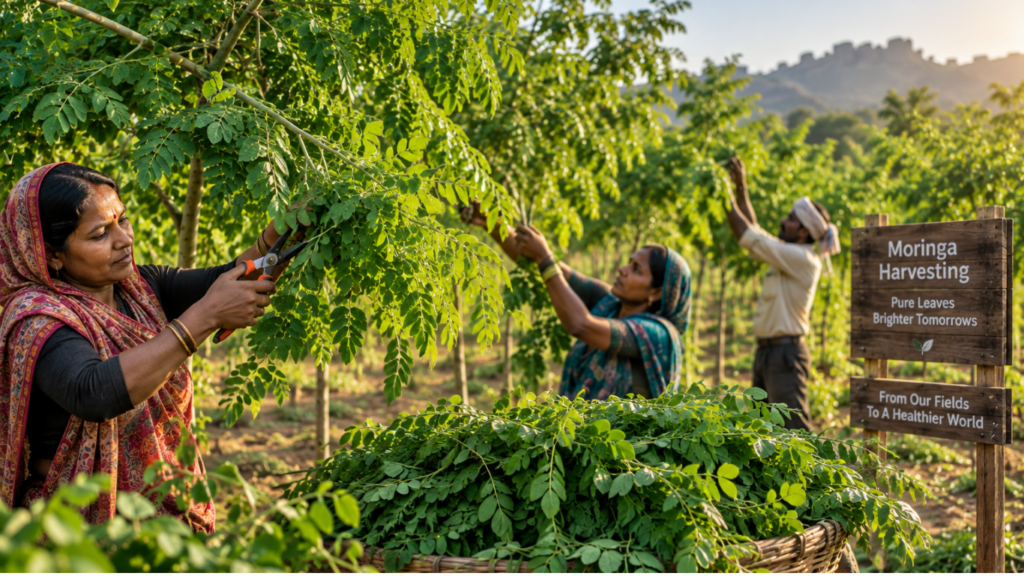
Farmer carrying freshly harvested Moringa leaves.
The basic process looks like this:
Harvest → Cleaning → Drying → Grinding → Sieving → Packing
What matters is how each step is done.
Harvesting should ideally be done in the cooler parts of the day — early morning or late evening — when leaves are not wet with dew. Wet leaves can develop mould during transport and drying. We advise farmers to harvest in the morning after dew has dried, or in the evening before dusk.
Cleaning involves removing stems, foreign matter, and any damaged leaves. This is done manually in small batches. Stems are separated because they are tougher and do not grind into fine powder. Foreign matter — small stones, insects, twigs — is removed by hand.
Drying is the most critical step. Leaves must be dried evenly and completely. Controlled drying is important because excess moisture can create storage and microbiological problems. Drying conditions should be validated for the particular process and product; we do not present one universal moisture figure for every Moringa powder.
Grinding turns dried leaves into powder. Fineness matters for texture and mixability. A coarse powder is gritty; a fine powder blends smoothly into food.
Sieving removes coarse particles to produce a consistent powder. This step ensures that every pack has the same texture.
Packing protects the powder from moisture, light, and air. Food-grade packaging with proper sealing is essential. We use packaging that limits light exposure because light degrades the green color over time.
Every step in this chain is a potential point of quality loss. That is why we keep processing close to the source — so the time between harvest and drying is short, and the leaves do not sit around losing quality. Learn more about our farm-to-food approach.
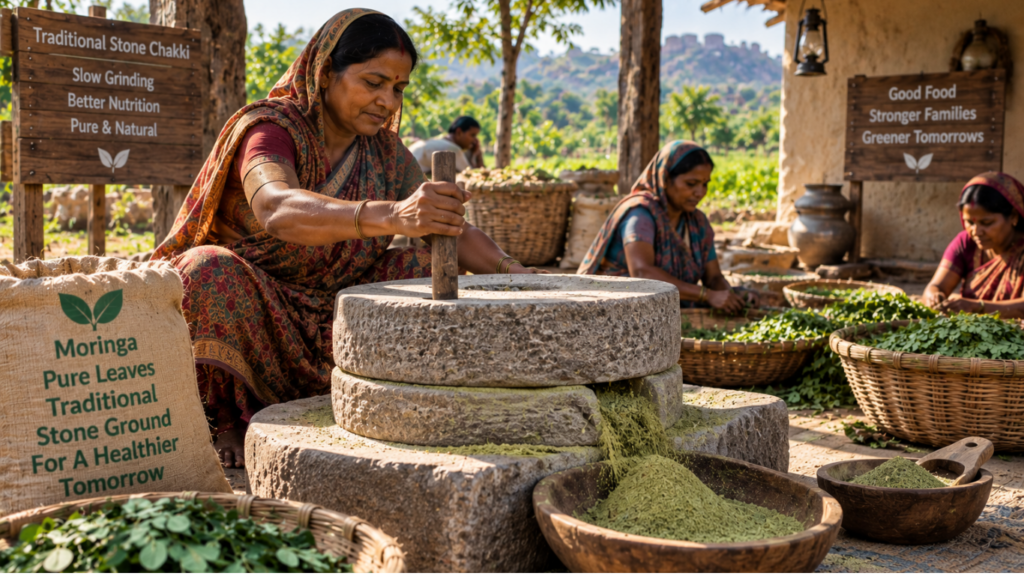
How Bundelkhand’s Famous Moringa Powder Is Made
Our process is not different from the general steps above, but the context is different.
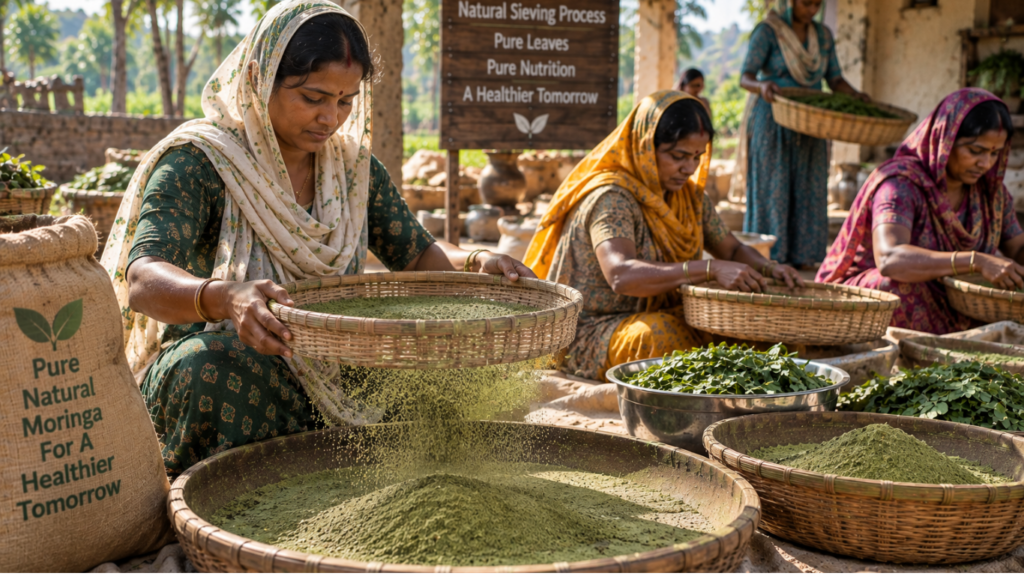
Freshly harvested Moringa leaves collected for processing.
We work with farmers and local sourcing relationships for Moringa. Where processing is carried out in small batches, the shorter handling chain can make source and batch information easier to manage. We do not claim that batch size alone guarantees superior quality.
Our product positioning is based on Moringa leaf powder as the ingredient. The current retail pack should always be treated as the authoritative source for ingredients, net quantity, batch information and other mandatory declarations.
We also do not claim certifications we do not have. If a batch is tested, we share the results. If it is not certified organic, we do not call it organic. Transparency about what we can verify is more valuable than claims we cannot support.
Our processing is done in small batches because that is what our scale allows. We are not a large factory. We are a farm-to-food initiative working with farmers in two blocks. Our processing capacity matches our sourcing capacity. We do not buy from unknown sources to fill large orders. What we process is what we can trace.
This is not a marketing position. It is a practical reality of our scale. And we believe it produces a better product — not because small is inherently better, but because traceability and short chains reduce the risk of quality loss.
How the Product Is Cleaned, Dried, Processed and Packed
Here is a stage-by-stage look at what happens to Moringa leaves before they become powder in your kitchen:
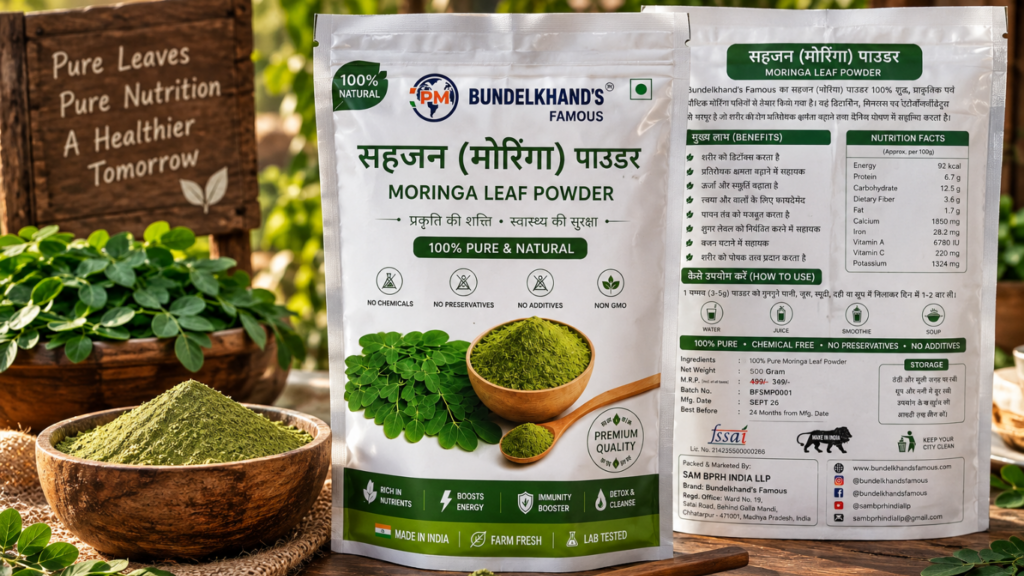
Moringa leaves arranged for drying before powder processing.
| **StageWhat HappensWhy It Matters** | ||
| Harvesting | Leaves collected in cool hours, kept ventilated | Prevents moisture buildup and mould |
| Cleaning | Stems and foreign matter removed manually | Ensures pure leaf powder, no grit |
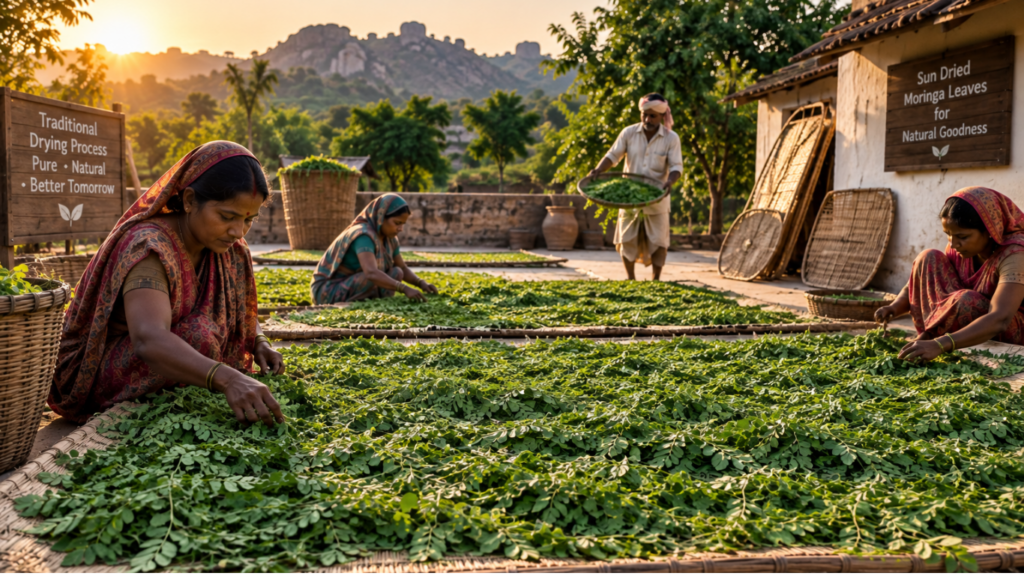
| Drying | Leaves spread in thin layers, dried to low moisture | Prevents spoilage, preserves color |
| Grinding | Dried leaves milled into fine powder | Determines texture and mixability |
| Sieving | Coarse particles separated for consistency | Ensures uniform product |
| Packing | Sealed in food-grade packaging, labeled with batch details | Protects from moisture, light, air |
The drying stage is where most small-scale Moringa processing either succeeds or fails. Under-dried leaves spoil. Over-dried or sun-bleached leaves lose color and flavor. Getting this right requires attention, not expensive machinery.
We dry in thin layers and turn the leaves periodically to ensure even drying. We do not rush the process. The goal is a uniformly dried leaf that crumbles easily and has a fresh green color.
After drying, the leaves are ground. We use a mechanical grinder. The ground powder is then sieved to remove any coarse particles. The final powder is packed immediately to minimize exposure to air and moisture.
Where batch records are maintained, they help connect processing information with the relevant raw-material and production records. Such records support traceability, but traceability itself is not a certification.
Quality Checks at Every Stage
Quality is not a single step. It is a series of small checks throughout the process.
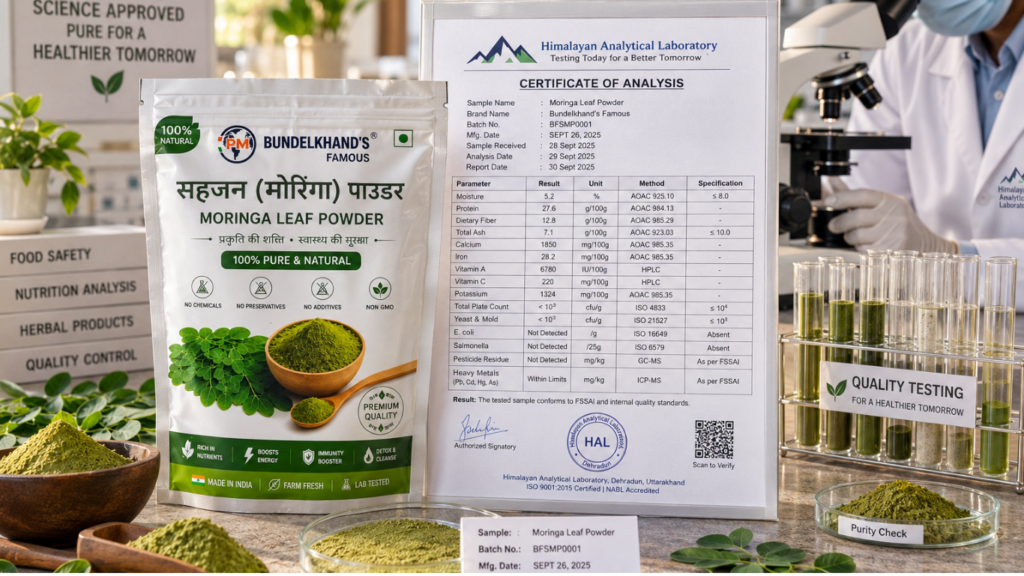
Moringa product, batch/testing documentation and laboratory-quality presentation.
At harvest: We look for leaves that are fresh, green, and free from disease or pest damage. Yellowing or spotted leaves are rejected.
After cleaning: We check that stems and foreign matter have been removed. This is a visual check.
After drying: We check moisture level by feel and appearance. Properly dried leaves are brittle and crumble easily. If they are still flexible, they need more drying time.
After grinding: We check the fineness of the powder. It should be consistent, with no large particles.
After sieving: We check that the powder is uniform and free from coarse material.
Before packing: We check color and smell. A properly processed product is expected to have the characteristic appearance and aroma described on its current product specifications; unusual odour, visible mould or moisture damage should be treated as quality concerns. Any off-smell or discoloration indicates a problem.
After packing: We check seals and labels. Every pack should be properly sealed and labeled with batch details.
These are simple checks. They do not require a laboratory. But they catch most quality issues before the product reaches the customer. For us, this is the practical meaning of quality control at a small scale.
How to Use Moringa Leaf Powder
Moringa Leaf Powder is an ingredient, not a standalone food. Its mild, earthy taste means it blends into most Indian dishes without dominating the flavor. Here is how people commonly use it:
The key principle is simple: add it to food you are already cooking. Do not try to eat it plain. Do not expect it to taste like a supplement. It is a green leafy vegetable in powder form — use it the way you would use any other green leafy vegetable.
Start with small quantities. A quarter teaspoon in a dish for two people is a reasonable starting point. Increase gradually as you get used to the taste. The flavor is earthy and slightly bitter — similar to spinach or moringa leaves themselves. In cooked dishes, it blends in. In raw applications like smoothies, it is more noticeable.
Here is a detailed guide to using Moringa Powder in different foods.
Moringa Powder for Dal
Dal is one of the easiest ways to use Moringa Powder. The powder blends into the dal, thickens it slightly, and adds a green tint. The taste is mild because the dal’s spices and texture mask the earthiness.
How to add: Cook your dal as usual. Once it is fully cooked and has reached the desired consistency, turn off the heat. Add half to one teaspoon of Moringa Powder per serving. Stir well. Cover and let it sit for a minute before serving.
Which dal works best: Moringa Powder works with all dals — moong, masoor, arhar, chana. It blends particularly well with moong dal because of the mild flavor. It also works well in mixed dal.
Practical tip: Add the powder after cooking, not during. High heat for prolonged periods can affect the color and flavor. Stirring it in at the end preserves the green color.
Quantity: For a family of four, one to two teaspoons total is usually sufficient. Start with less and adjust to taste.
Moringa Powder for Sabzi
Moringa Powder can be added to dry sabzi preparations or sprinkled over cooked vegetables. It works well with potato, cauliflower, beans, and leafy vegetable dishes.
How to add to dry sabzi: Cook your sabzi as usual. In the last two minutes of cooking, sprinkle Moringa Powder over the vegetables and mix well. The residual heat will blend it in without overcooking.
How to add to gravy sabzi: Stir in Moringa Powder after the gravy is cooked and the heat is turned off. Mix well and cover for a minute.
Which sabzi works best: Potato sabzi, cauliflower sabzi, and mixed vegetable preparations work well. Moringa Powder also complements other green leafy vegetables like spinach and fenugreek.
Practical tip: Do not add Moringa Powder at the beginning of cooking. Prolonged heat dulls the color and reduces the fresh taste. Add it at the end.
Quantity: Half to one teaspoon for a sabzi serving two to three people.
Moringa Powder for Roti/Atta
Adding Moringa Powder to atta is one of the most practical ways to include it in daily meals. The powder mixes into the flour, and the rotis have a light green color and a slightly different taste.
How to add: For every kilogram of wheat flour, add one to two teaspoons of Moringa Powder. Mix the powder into the dry flour before adding water. Knead as usual. The dough will have a light green tint.
Taste: The rotis taste slightly different from regular rotis — a mild earthy flavor. Most people find it pleasant. The color is the most noticeable change.
Practical tip: Mix the powder evenly into the dry flour before adding water. If you add it after kneading, it will not distribute evenly.
Quantity: Start with one teaspoon per kilogram of flour. Increase to two teaspoons if you like the taste.
For children: Moringa rotis are a gentle way to introduce the powder to children. The quantity per roti is small, and the taste is mild.
Moringa Powder in Chutney
Moringa Powder can be added to coriander or mint chutney. It blends well with green chutney ingredients and adds depth to the flavor.
How to add: Prepare your chutney as usual. Add half a teaspoon of Moringa Powder per serving and blend again. The powder will darken the chutney slightly and add an earthy note.
Which chutney works best: Coriander chutney, mint chutney, and mixed green chutney work well. Moringa Powder also works in coconut chutney, though the flavor combination is different.
Practical tip: Add the powder at the end of blending. If you add it at the beginning, the chutney may become too thick.
Quantity: Half a teaspoon per cup of chutney.
Moringa Powder in Milk/Buttermilk
Moringa Powder can be stirred into warm milk or chaas (buttermilk). The taste is more noticeable in milk than in buttermilk, so start with a small quantity.
In milk: Warm a cup of milk. Add a quarter teaspoon of Moringa Powder. Stir well. The powder will not fully dissolve — it will remain suspended. Drink while warm.
In buttermilk: Add a quarter to half teaspoon of Moringa Powder to a glass of chaas. Stir well. The tanginess of the buttermilk masks the earthy flavor better than milk.
Practical tip: For milk, use warm (not boiling) milk. Boiling may affect the color and flavor. For buttermilk, stir just before drinking because the powder settles.
Quantity: Quarter teaspoon in milk, half teaspoon in buttermilk. Adjust to taste.
Moringa Powder in Smoothies/Shakes
Moringa Powder can be blended into fruit smoothies and shakes. The sweetness of the fruit balances the earthy taste of the powder.
How to add: Add one teaspoon of Moringa Powder to your smoothie ingredients and blend. The powder will turn the smoothie green.
Which fruits work best: Banana, apple, mango, and pineapple work well. Banana is particularly good because its creamy texture blends well with the powder. Mango’s sweetness masks the earthy flavor effectively.
Practical tip: Add the powder along with the other ingredients so it blends evenly. If you add it at the end, it may clump.
Quantity: One teaspoon per glass. Start with half a teaspoon if you are new to the taste.
Moringa Powder in Soups and Kadhi
Moringa Powder can be added to soups and kadhi for a nutritional boost and a green color.
In soups: Add half a teaspoon of Moringa Powder to a bowl of hot soup. Stir well. It works well with tomato soup, mixed vegetable soup, and lentil soup.
In kadhi: Add half to one teaspoon of Moringa Powder to kadhi after it is cooked. Stir well. The powder blends into the yogurt-based gravy.
Practical tip: Add the powder after cooking, just before serving. This preserves the color and flavor.
Moringa Powder for Children’s Food
Moringa Powder can be added to children’s food in small quantities. The key is to start very small and increase gradually.
How to introduce: If a parent wants to include Moringa in a child’s normal food, start with a small food quantity and consider the child’s age, diet and individual needs. There is no universal child dosage in this article.
Which foods work best: Dal, khichdi, roti, and sabzi are good options. The powder blends into these foods without changing the texture significantly.
Practical tip: Do not force a child to consume it. If there are dietary, allergy or medical concerns, seek advice from a pediatrician or qualified dietitian.
Note: This is general food guidance, not medical advice. If you have concerns about your child’s diet, consult a pediatrician or dietitian.
Moringa Leaf Powder Nutrition
Moringa leaves contain protein, dietary fibre and several vitamins and minerals, but the exact composition varies with variety, maturity, growing conditions and processing. The FAO’s food compendium, drawing on Indian food-composition data, reports nutrients for fresh Moringa leaves, while recent research indexed through FAO AGRIS has also found substantial variation among dried leaf powders. For a packaged product, the most appropriate source for exact nutrition values is the product’s current laboratory-tested nutrition panel, when available.
When leaves are dried and powdered, the nutrients become more concentrated by weight because the water content is removed. However, nutrition content varies based on several factors: the variety of Moringa, the soil and climate where it is grown, the harvest timing, and the processing method. No single number applies to all Moringa powder.
What we can say factually: Moringa leaves provide protein, dietary fibre and minerals such as calcium and iron, with amounts varying by form and growing conditions. They are a food, not a medicine. The FAO’s AGRIS database maintains records of Moringa nutritional studies for those who want to explore the research further. Moringa Powder Online.
We do not make disease-treatment claims about Moringa powder. Food advertising and health claims in India are subject to FSSAI requirements; see the FSSAI Food Safety and Standards (Advertising and Claims) Regulations.
A note on nutrition numbers: You will see many different numbers for Moringa nutrition online. Some sources cite fresh leaf values, some cite dried leaf values, and some cite powder values. These are not interchangeable. Fresh leaves contain water, so their nutrient content by weight is lower than dried leaves. Powder is made from dried leaves, so its nutrient content by weight is higher. When comparing products, make sure you are comparing the same form. Moringa Powder Online.
How to Choose Quality Moringa Powder
If you are buying Moringa Leaf Powder Online, here is what to look for:
Color. Good Moringa powder is bright green. Pale or brownish powder usually means the leaves were sun-bleached, old, or poorly stored. The green color comes from chlorophyll, which degrades over time and with exposure to light and heat.
Smell. Fresh Moringa powder has a grassy, slightly earthy smell. A musty or flat smell indicates age or moisture damage. If the powder smells like hay or dust, it is old. Moringa Powder Online.
Texture. The powder should be fine and consistent. Lumps suggest moisture exposure. Grittiness suggests incomplete grinding or the presence of stem material.
Packaging. Look for sealed, food-grade packaging. Transparent packaging exposes the powder to light, which degrades color and nutrients over time. Opaque or light-protective packaging is better. Moringa Powder Online.
Source information. A brand that tells you where the Moringa was grown and how it was processed is more trustworthy than one that only makes health claims. Look for information about the region, the farmers, and the processing method.
Price realism. Moringa Powder Price varies, but extremely low prices usually mean compromise somewhere — older stock, lower-grade leaves, or fillers.
Batch information. If the pack has a batch number or processing date, that is a good sign. It means the brand tracks its production.
Ingredient list. The ingredient list should say “Moringa Leaf Powder” and nothing else. If there are anti-caking agents, fillers, or preservatives, it is not pure Moringa powder. Moringa Powder Online.
Common Mistakes When Buying Moringa Powder
Mistake 1: Assuming “organic” means certified organic. In India, “organic” is a regulated term. Only products with proper certification can legally claim to be organic. Many products use the word loosely. If a product claims to be organic, check for the certification logo or ask for the certificate.
Mistake 2: Buying based on price alone. Extremely cheap Moringa powder is usually cheap for a reason — older stock, lower-grade leaves, or fillers. A slightly higher price often reflects better sourcing and processing. Moringa Powder Online.
Mistake 3: Ignoring the packaging. Transparent packaging exposes the powder to light, which degrades color and nutrients. Look for opaque or light-protective packaging.
Mistake 4: Buying large quantities before trying. Moringa powder loses quality over time. If you are new to it, buy a small pack first. If you like it, buy larger packs later.
Mistake 5: Expecting it to taste like something else. Moringa powder tastes earthy and slightly bitter. It is not a sweet or neutral powder. Understanding this helps you use it in the right dishes. Moringa Powder Online.
Mistake 6: Not checking the ingredient list. Pure Moringa powder has one ingredient: Moringa leaf powder. If there are other ingredients, it is not pure.
Who Should Avoid Moringa Powder?
Before consuming Moringa (Sahjan) powder as part of the regular diet, certain people should take extra precautions. Pregnant women should not consume Moringa powder or Moringa supplements without consulting a doctor. Breastfeeding women, young children, and people who regularly take medications should also consult a doctor or qualified healthcare professional before adding Moringa powder to their diet. In particular, people taking medicines for diabetes, blood thinning, or other prescription medications should seek professional advice because herbal products may interact with certain medicines. If any unusual allergic reaction, stomach discomfort, or other symptoms occur after consuming Moringa powder, stop using it and seek medical advice. Moringa Powder Online.
What Makes Bundelkhand’s Famous Different?
Bundelkhand’s Famous is not a faceless brand. We are a farm-to-food initiative based in Bundelkhand, working directly with farmers since 2019.
Bundelkhand’s Famous Moringa product and information display.
Our work is not limited to selling food products. We are working toward connecting farmers, agriculture, local resources, processing, and consumers in a more responsible farm-to-food ecosystem. Moringa Powder Online.
That ecosystem includes:
- Direct farmer relationships. We know the farmers who grow the Moringa we process. We work with them on cultivation practices and buy directly from them.
- Local processing. Powder is made close to where the leaves are grown, reducing time and handling between harvest and packing. Moringa Powder Online.
- Cow-based agricultural resources. We work with gaushalas to utilize cow dung and cow urine through systems like Nadep compost, vermicompost, and enriched compost.
- Small-batch approach. We do not mass-produce. Each batch is processed with attention.
- Transparency about limitations. We do not claim certifications we do not have. We do not make health claims. We tell you what we know and what we can verify.
We started in 2019 and now work across two blocks. We are gradually building a farmer-linked ecosystem — not overnight, but step by step. You can read more about the brand on Bundelkhand’s Famous.
We are not the largest Moringa producer in India. We do not claim to be the best. We simply offer a traceable product from a region where we work directly with farmers, processed in small batches, and packed with care. Moringa Powder Online.
Our Natural Farming & Farmer Ecosystem
The foundation of our work is the relationship between farmer, land, and consumer.
Most Moringa available online comes from large aggregators who buy from multiple sources and process in centralized facilities. There is nothing inherently wrong with this model, but it creates distance — between the farmer and the final product, and between the consumer and the source. Moringa Powder Online.
Our model is different. We work with farmers in our region, encourage responsible use of local resources, and process according to the scale of our current operations.
This is not a claim of superiority. It is simply a different approach with different trade-offs. The trade-off is scale — we cannot produce unlimited quantities. The benefit is traceability and a shorter chain from farm to food. Learn more about Bundelkhand’s Famous and its farmer-linked model. Moringa Powder Online.
The farmer ecosystem we are building includes:
- Cultivation support. We advise farmers on Moringa cultivation — spacing, harvesting, and post-harvest handling.
- Buyback arrangements. We buy Moringa leaves from farmers we work with, providing a market for their produce.
- Resource sharing. We connect farmers with cow-based agricultural resources from gaushalas.
- Processing linkage. We process the leaves and bring the final product to consumers.
This is not a formal cooperative or a contract farming arrangement. It is a working relationship built over time. It is not perfect. But it is a step toward a more connected food system. Moringa Powder Online.
Gaushala-Based Agricultural Resource Utilisation
Bundelkhand has a strong tradition of gaushalas (cow shelters). Where gaushalas have recoverable cow dung, we see an opportunity to return this local biological resource to agriculture through appropriate processing.
Properly processed cow dung can become compost or a feedstock for biogas systems. Cow urine is also collected in our work and may be used as a locally available agricultural input where the farmer’s practice, formulation and crop-management guidance support that use.
Our work involves collecting cow dung from gaushalas and processing it through established methods: Moringa Powder Online.
Nadep Compost
Nadep compost is a traditional aerobic composting method developed in India. It involves layering organic matter — crop residue, cow dung, soil — in a brick tank and allowing it to decompose over several months. The result is a nutrient-rich compost that improves soil structure. Moringa Powder Online.
The Nadep method was developed by a farmer named Narayan Deotao Pandharipande in Maharashtra. It is a low-cost, low-maintenance composting system that uses locally available materials. The brick tank has perforated walls for aeration. Layers of organic matter are added in a specific ratio and left to decompose. Composting time depends on the method, materials, moisture, aeration and environmental conditions.
Vermicompost
Vermicompost is produced by earthworms breaking down organic matter. The process is faster than traditional composting and produces a finer, nutrient-dense material. Vermicompost is widely recognized as an effective organic soil amendment.
The earthworms used in vermicomposting — typically Eisenia fetida or Eudrilus eugeniae — consume organic matter and excrete nutrient-rich castings. Vermicompost is valued as an organic soil amendment; its properties depend on the feedstock, earthworm species and process conditions. Moringa Powder Online.
Enriched Compost
Enriched compost is compost that has been fortified with additional nutrients or microbial cultures. The enrichment process aims to increase the availability of specific nutrients or improve the microbial activity of the final product.
Enrichment can involve approved nutrient sources or microbial inputs selected for the intended agricultural use. The exact formulation should be documented rather than assumed. Moringa Powder Online.
Biogas
Cow dung can also be processed through biogas plants, producing methane for cooking or energy and a nutrient-rich slurry as a byproduct. The slurry can be used as fertilizer. Moringa Powder Online.
Biogas plants are a practical way to extract energy from cow dung while retaining the nutrient value in the slurry. The methane can be used for cooking, reducing dependence on LPG or firewood. The resulting digestate/slurry can be considered for agricultural use according to the biogas system and applicable agronomic guidance. Moringa Powder Online.
Cow-Based Agricultural Inputs
Cow urine (gomutra) has been used in Indian agriculture for centuries. Its traditional use includes seed treatment and as a component of organic pest management preparations. Moringa Powder Online.
The scientific basis for cow urine’s effectiveness varies depending on the specific application and concentration. We do not make claims beyond what can be reasonably supported. What we can say is that cow-based inputs are part of a broader approach to reducing dependence on synthetic inputs and making better use of on-farm resources.
Application of cow-urine-based preparations varies by formulation and crop. Where used, it should be appropriately prepared and applied according to locally validated agricultural guidance rather than treated as a universal pesticide or fertilizer.
We do not claim that cow urine replaces all synthetic inputs. We present it as one tool among many in a natural farming approach. Moringa Powder Online.
Our Journey Since 2019
We started in 2019. The early years were about learning — understanding the Moringa crop, working with farmers, figuring out processing, and building the relationships that make a farm-to-food model work.
We are now active across two blocks. We have farmers growing Moringa. We have processing capacity. We have a product that we are confident in.
The journey is not finished. We are still building. But the foundation — farmer relationships, local processing, cow-based resource utilization — is in place. Moringa Powder Online.
Some milestones along the way:
- 2019: Started field-level work in Bundelkhand
- 2019 onward: Continued field-level work and learning
- Subsequent years: Developed farmer relationships and processing practices
- Current stage: Working across two blocks and building the wider farmer-linked ecosystem
- Ongoing: Improving cultivation, processing, traceability and market access
We do not have exact production numbers to share because we are a small operation. What we can share is the approach — direct farmer relationships, local processing, and a commitment to transparency. Moringa Powder Online.
Why Farm-to-Food Traceability Matters
When you buy food online, you often know very little about where it came from. The brand may tell you the country of origin, but not the region, the farm, or the processing date. Moringa Powder Online.
Traceability matters because it creates accountability. If a farmer knows their produce is going to a specific buyer, they have an incentive to maintain quality. If a processor knows the final customer cares about how the product was handled, they pay attention.
Farm-to-food traceability does not guarantee quality. But the absence of traceability makes quality harder to verify.
For us, traceability is practical. We know which farmer grew the Moringa. We know when it was harvested. We know when it was processed. If a customer asks, we can tell them. That is traceability at our scale. Moringa Powder Online.
How to Buy Moringa Powder Online
Buying Moringa Leaf Powder online is straightforward. You place an order, it gets packed, and it is shipped to your address.
Bundelkhand’s Famous Moringa powder packaging stage.
What varies is what happens before the order reaches you.
When you buy Moringa products from Bundelkhand’s Famous, the information we provide is intended to explain the farm-to-food journey, sourcing relationships and processing approach. Availability, pack sizes and current product details should always be checked on the live store.
Our product is available through our website. You can check current availability, pack sizes, and Moringa Powder Price on our product page. Moringa Powder Online.
If you have questions about the product — the batch, the processing date, the source — you can contact us. We know the answers because we did the work.
How ordering works:
- Browse our product page. Check available pack sizes and prices.
- Place your order. Add the product to your cart and complete checkout.
- We pack your order. Your Moringa powder is packed in food-grade packaging.
- Shipping. We ship to your address. Delivery times depend on your location.
- Receive and store. Store the powder in a cool, dark place in an airtight container.
If you have any questions before or after ordering, reach out to us. We are a small team and we respond to queries personally.
Moringa Powder Price and Pack Sizes
Moringa Powder Price in India varies by source, grade, processing, packaging, certification status, pack size and seller. Rather than using one generic market price, compare the actual pack size, ingredient declaration, batch information and applicable certifications. Moringa Powder Online.
Price differences reflect real differences in cost:
- Source: Certified organic Moringa costs more to produce because certification involves inspection, documentation, and compliance costs.
- Processing: Small-batch, careful processing costs more than mass production.
- Packaging: Food-grade, light-protective packaging costs more than simple pouches.
- Testing: Lab testing for contaminants adds cost.
- Traceability: Maintaining batch records and traceability systems adds administrative cost.
We offer Moringa Powder in pack sizes that make sense for household use. For regular consumers, a smaller pack that stays fresh is better than a Moringa Powder 1kg pack that sits open for months. Moringa Powder Online.
Check the Bundelkhand’s Famous Store for the current Moringa product listing, pack options and pricing.
A note on price and value: The cheapest Moringa powder is not always the best value. If the powder is old, poorly stored, or diluted with fillers, you are paying for something that does not deliver what you expect. A slightly higher price for a traceable, well-processed product is often better value in the long run.
How to Store Moringa Powder
Proper storage is essential to maintain the quality of Moringa Powder. Here is how to store it:
Container: Use an airtight container. Glass jars with rubber gaskets work well. Plastic containers with tight-sealing lids are also fine. Moringa Powder Online.
Location: Store in a cool, dark place. A kitchen cabinet away from the stove is ideal. Avoid storing near heat sources or in direct sunlight.
Moisture: Keep the powder dry. Do not use a wet spoon to scoop it out. Moisture is the enemy of Moringa powder — it causes clumping and spoilage.
Shelf life: Properly stored Moringa powder retains quality for several months. The color may fade slightly over time, but the powder remains usable.
Signs of spoilage: If the powder smells musty, looks brown, or has visible mould, discard it. These are signs of moisture damage or age. Moringa Powder Online.
Refrigeration: Refrigeration is not necessary if the powder is stored properly. However, in very hot and humid climates, refrigeration can extend shelf life. If you refrigerate, make sure the container is airtight to prevent moisture from entering.
Frequently Asked Questions
What is Moringa Leaf Powder?
Moringa Leaf Powder is made from dried and ground Moringa oleifera leaves. It is used as a food ingredient in dal, sabzi, roti, chutney, smoothies, and other dishes. It is not a medicine or supplement. Moringa Powder Online.
What is Sahjan Powder?
Sahjan Powder is the Hindi name for Moringa Leaf Powder. Sahjan is the local name for the Moringa tree in many parts of North India. Both names refer to the same product. Moringa Powder Online.
How is Moringa Leaf Powder made?
Fresh Moringa leaves are harvested, cleaned to remove stems and foreign matter, dried to low moisture, ground into powder, sieved for consistency, and packed in food-grade packaging. Moringa Powder Online.
How should Moringa Powder be stored?
Store in an airtight container away from light, heat, and moisture. A cool, dark place is ideal. Properly stored Moringa powder retains quality for several months. Moringa Powder Online.
Can I add Moringa Powder to dal?
Yes. Add half to one teaspoon after cooking, just before serving. Stir well. The taste is mild but noticeable. Moringa Powder Online.
Can Moringa Powder be used in vegetables?
Yes. Sprinkle it over cooked vegetables or mix it into dry sabzi preparations at the end of cooking. Moringa Powder Online.
Can I mix Moringa Powder in atta for roti?
Yes. Mix one to two teaspoons per kilogram of wheat flour before kneading. The rotis will have a light green color. Moringa Powder Online.
Can Moringa Powder be used in chutney?
Yes. Add it to coriander or mint chutney. It blends well with green chutney ingredients. Moringa Powder Online.
Can I add Moringa Powder to smoothies?
Yes. Blend it with fruit smoothies. Banana, apple, and mango work well because their sweetness balances the earthy taste. Moringa Powder Online.
What is the difference between fresh Moringa leaves and powder?
Fresh leaves have high water content and must be used quickly. Powder is dried and concentrated, stores longer, and is easier to add to cooked dishes. Moringa Powder Online.
How do I choose good Moringa Powder?
Look for bright green color, fresh grassy smell, fine texture, sealed packaging, and source information. Avoid pale or brownish powder with a musty smell. Moringa Powder Online.
Where can I buy Moringa Leaf Powder online?
You can check the Bundelkhand’s Famous Store for current Moringa availability. We grow, process, and pack the Moringa ourselves. Moringa Powder Online.
What affects Moringa Powder price?
Source (organic vs. conventional), processing method, packaging quality, testing, and brand all affect price. Extremely low prices usually indicate compromise somewhere. Moringa Powder Online.
What pack sizes are available?
Pack sizes vary. Check the Bundelkhand’s Famous Store for current options. Smaller packs are better for households that use Moringa occasionally. Moringa Powder Online.
How does Bundelkhand’s Famous make its Moringa powder?
We source Moringa from farmers we work with directly, process in small batches, and pack in food-grade packaging. No fillers or additives. Moringa Powder Online.
Where does Bundelkhand’s Famous source Moringa?
From farmers in the Bundelkhand region. We work across two blocks and are gradually expanding our farmer network. Moringa Powder Online.
What does farm-to-powder mean?
It means the Moringa is grown, harvested, processed, and packed with minimal intermediaries. The chain from farm to final product is short and traceable. Moringa Powder Online.
What is Bundelkhand’s Famous natural farming approach?
We encourage farmers to use on-farm resources — compost, cow-based inputs — and minimize external interventions. The goal is a farming system that is economically and ecologically sustainable. Moringa Powder Online.
How is cow dung utilised in agriculture?
Cow dung is composted through methods like Nadep, vermicompost, and enriched compost. The resulting material improves soil structure and provides nutrients. Moringa Powder Online.
What is Nadep compost?
Nadep compost is an aerobic composting method using layered organic matter — crop residue, cow dung, soil — in a brick tank. It decomposes over several months. Moringa Powder Online.
What is vermicompost?
Vermicompost is compost produced by earthworms breaking down organic matter. It is finer and nutrient-dense compared to traditional compost. Moringa Powder Online.
What is enriched compost?
Enriched compost is compost fortified with additional nutrients or microbial cultures to increase its effectiveness. Moringa Powder Online.
How can cow-based agricultural resources support farming?
Cow dung and cow urine, when properly processed, provide locally available inputs that reduce dependence on purchased synthetic fertilizers and pesticides. Moringa Powder Online.
Since when has Bundelkhand’s Famous been working on this initiative?
Since 2019. We started with field-level work and have gradually built our farmer network and processing capacity. Moringa Powder Online.
Is Moringa Powder good for health?
Moringa leaves provide protein, dietary fibre and minerals such as calcium and iron, with amounts varying by form and growing conditions. They are a nutritious food ingredient. We do not make medical claims about curing or preventing diseases. Moringa Powder Online.
Can I use Moringa Powder every day?
Yes, Moringa Powder can be used daily as a food ingredient. Start with small quantities and increase gradually. If you have any health conditions or concerns, consult a healthcare professional. Moringa Powder Online.
Does Moringa Powder have a strong taste?
Moringa Powder has an earthy, slightly bitter taste. It is mild when mixed into cooked dishes like dal, sabzi, or roti. It is more noticeable in raw applications like smoothies. Moringa Powder Online.
Can I give Moringa Powder to children?
Moringa Powder can be added to children’s food in small quantities. Start with a pinch and increase gradually. Consult a pediatrician if you have concerns. Moringa Powder Online.
Is Bundelkhand’s Famous Moringa Powder organic?
We do not claim organic certification unless a specific batch is certified. Our approach is natural farming, but we do not use the term “organic” without certification. If you have questions about a specific batch, contact us. Moringa Powder Online.
How long does Moringa Powder last?
Properly stored Moringa powder retains quality for several months. The color may fade slightly over time, but the powder remains usable. Check for musty smell or visible mould before use. Moringa Powder Online.
Can I return Moringa Powder if I am not satisfied?
Please check our contact page or shipping and returns policy for details on returns and refunds. Moringa Powder Online.
Do you ship across India?
Please check our product page or contact us for shipping information and delivery areas. Moringa Powder Online.
What is the difference between Moringa Powder and Moringa capsules?
Moringa capsules contain Moringa powder in capsule form. Moringa powder is the loose powder. Both contain the same ingredient. Capsules are convenient for those who do not want to mix powder into food. Powder is more versatile for cooking.
Can I use Moringa Powder in tea?
Moringa Powder can be added to herbal tea or green tea. Add a quarter teaspoon to a cup of warm tea and stir. The taste is earthy. It is not a traditional use, but some people enjoy it. Moringa Powder Online.
Final Thoughts – Moringa Powder Online with a Farm-to-Food Story from Bundelkhand
If you are looking for Moringa Leaf Powder Online and want to understand how it is grown, processed, and packed, explore Bundelkhand’s Famous Moringa Leaf Powder and learn more about our farm-to-food journey.
We are not the largest Moringa producer in India. We do not make exaggerated claims about curing diseases or being “100% organic” without certification. What we offer is a traceable product from a region where we work directly with farmers, processed in small batches, and packed with care. Moringa Powder Online.
That is the honest proposition. If it aligns with what you are looking for, we would be glad to send you a pack. Check availability and pricing on our website.
If you have questions — about the product, the process, or our farming work — reach out to us. We are a small team, and we respond personally. Moringa Powder Online,
nice content