
Authored by Bundelkhands Famous Brand | India’s Only 100% Hand-Graded, Stone Chakki Pounded, Zero Machine Processing Dal Company | 60,000 Partner Farmers | 20,000 Rural Women Hand Grading | MSME & Startup India Registered | Three Generations of Traditional Knowledge
Part 1: What Are Indian Dals and Pulses?
Indian dals and pulses are the backbone of the Indian diet. For over 5,000 years, dals have provided affordable, accessible protein to hundreds of millions of people across the Indian subcontinent. The term “dal” refers to split pulses – the edible seeds of leguminous plants that have been dried, split, and often skinned. Pulses are the dried, edible seeds of pod plants and include chickpeas, lentils, beans, and peas.
India is the world’s largest producer and consumer of pulses, accounting for approximately 25 percent of global pulse production and nearly 30 percent of global pulse consumption. According to the Food and Agriculture Organization, India produces over 25 million tonnes of pulses annually across 26 different varieties.
At Bundelkhands Famous, we have been part of this legacy for three generations. Our grandfathers grew and processed dals in Bundelkhand using traditional stone chakkis. Our fathers continued the tradition. Today, we work with 60,000 partner farmers across the Bundelkhand region who grow organic, chemical-free pulses. And we employ 20,000 rural women who hand-grade every single grain before it is pounded on our stone chakkis.
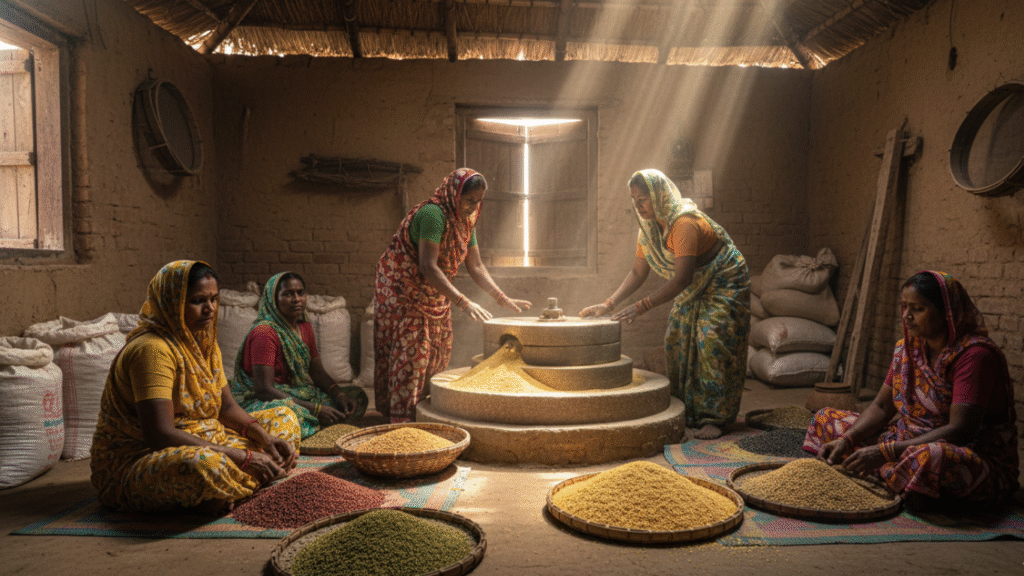
Bundelkhands Famous is the only dal brand in India that guarantees 0% machine processing from farm to fork. We are MSME registered and Startup India recognized. Our ecosystem is designed to preserve the traditional way of making dal – exactly as our ancestors did.
We offer 14 traditional products including whole and split dals, flours, grains, and a ready-to-cook dal makhani. Each product is hand-graded by 20,000 rural women, stone chakki pounded at room temperature, and never polished.
View our complete product range: https://bundelkhandsfamous.com/dal-pulses/
Part 2: The Bundelkhands Famous Ecosystem – 60,000 Farmers, 20,000 Women, 0% Machine
This section is unique to Bundelkhands Famous. No other dal brand in India has this ecosystem. This is what makes our Indian dals and pulses the purest, most nutritious, and most authentic in the country.
The Problem with Most Dal Brands
Most dal brands in India today have no connection to the farmers who grow their dal. They buy from middlemen, who buy from aggregators, who buy from farmers. The dal changes hands multiple times before it reaches the mill. By the time it reaches your kitchen, you have no idea where it came from, how old it is, or what chemicals were used.
Most dal brands also use 100% machine processing. High-speed steel rollers generate heat that destroys nutrients. Water polishing makes the dal look shiny but removes fiber. Preservatives are added to extend shelf life. The result is a product that looks appealing but has lost most of its nutritional value.
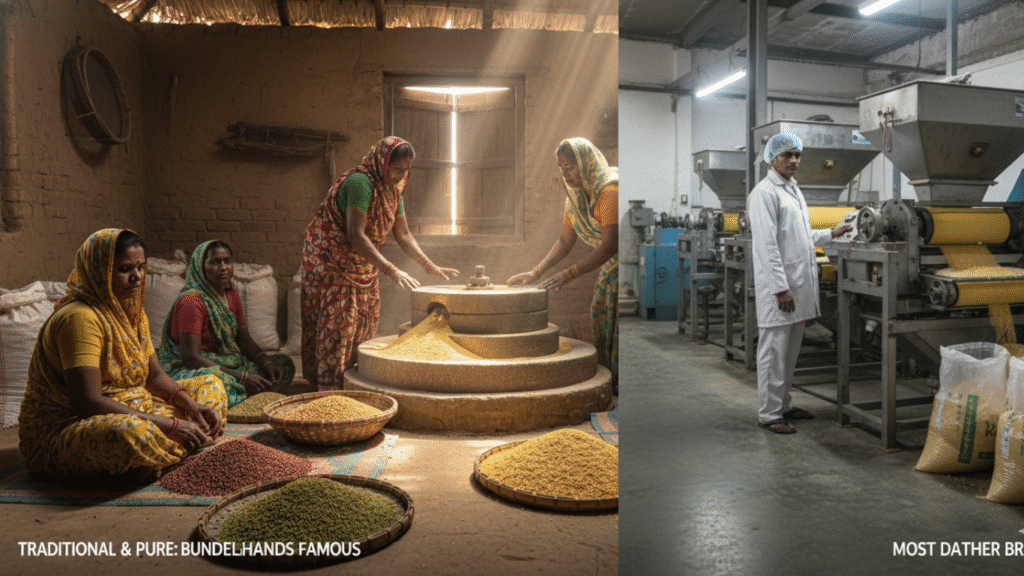
Competitor brands like Dhani Foods, B&B Organics, Farmveda, and Naatigrains all claim to sell “hand-pounded” dal, but none of them have:
- A documented ecosystem of 60,000 farmers
- A verified workforce of 20,000 rural women
- MSME and Startup India registration for dal processing
- Three generations of documented tradition
- Farm-to-fork traceability for every batch
The Bundelkhands Famous Ecosystem
Bundelkhands Famous is different. We have built a complete ecosystem that starts with our farmers and ends with your kitchen. Every step is controlled, monitored, and traditional.
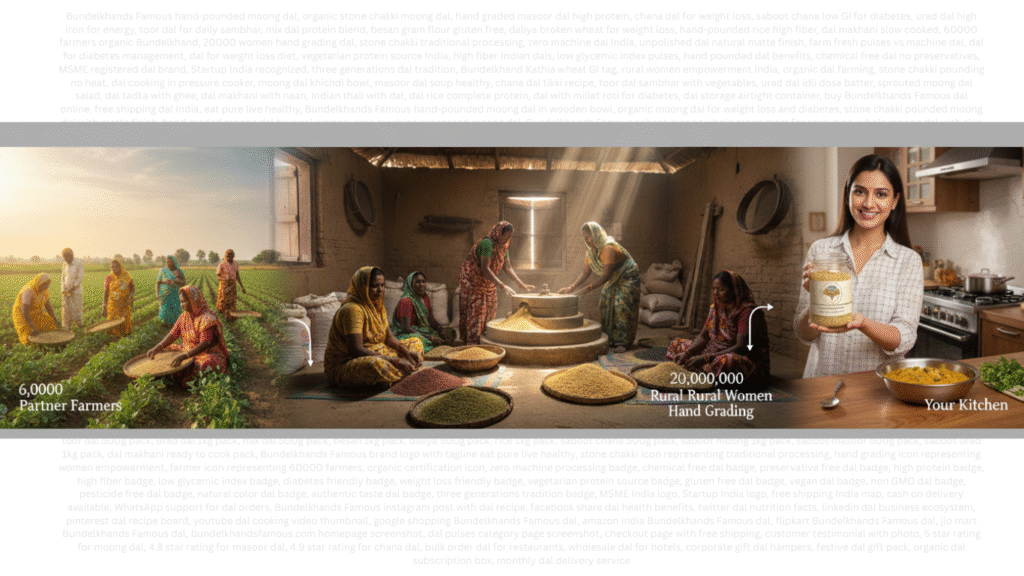
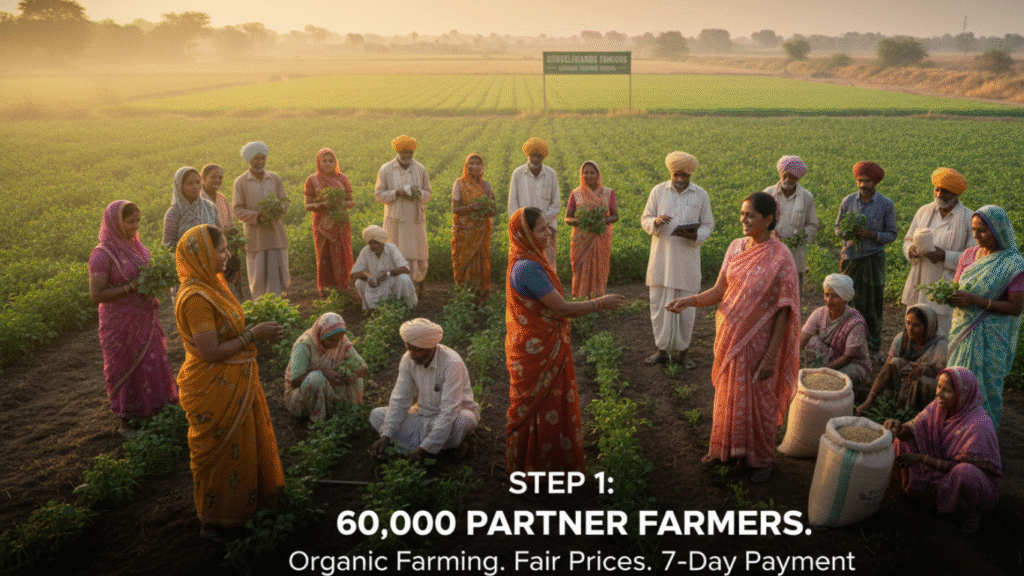
Step 1: 60,000 Partner Farmers
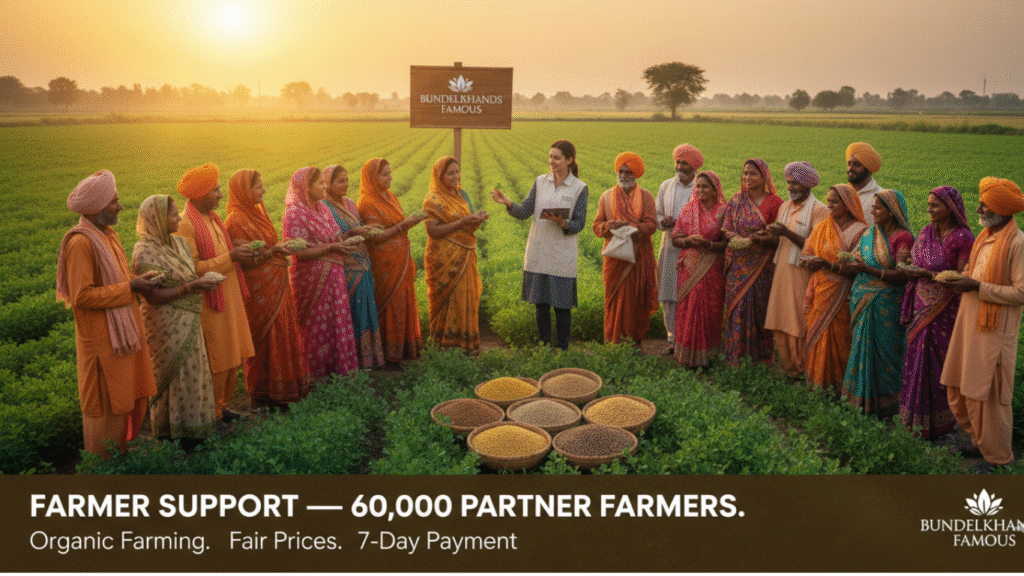
Bundelkhands Famous works directly with 60,000 farmers across the Bundelkhand region (parts of Uttar Pradesh and Madhya Pradesh). These farmers are our partners, not just suppliers.
What does “partner” mean? It means we provide them with organic farming training. We provide them with high-quality, non-GMO seeds. We guarantee to buy their entire crop at fair prices. We do not negotiate down. We pay within 7 days of harvest.
These 60,000 farmers grow pulses using only organic methods. No synthetic pesticides. No chemical fertilizers. No genetically modified seeds. Just traditional, sustainable farming that has been practiced in Bundelkhand for generations.
Why this matters for you: When you buy Bundelkhands Famous Indian dals and pulses, you know exactly where your dal came from. You know it was grown by farmers who were treated fairly. You know it was grown without harmful chemicals.
Competitor comparison: While brands like B&B Organics claim to support farmers, they have no published data on farmer networks. Bundelkhands Famous has transparent documentation of 60,000 partner farmers.
Step 2: 20,000 Rural Women Hand Grading
After the harvest, the dal comes to our processing centers. This is where the magic happens. Bundelkhands Famous does not use any machine for grading. Instead, we employ 20,000 rural women who hand-grade every single grain.
What does hand grading involve? Each woman sits with a large tray of dal. She visually inspects every grain. Stones are removed. Broken grains are removed. Damaged grains are removed. Any debris is removed. Nothing passes through her hands unless it is perfect.
This process is slow. A machine can sort thousands of kilograms per hour. A hand grader can sort perhaps 10 to 20 kilograms per hour. But the result is worth it. Machine sorters miss things. They cannot distinguish between a good grain and a damaged one as effectively as a human eye.
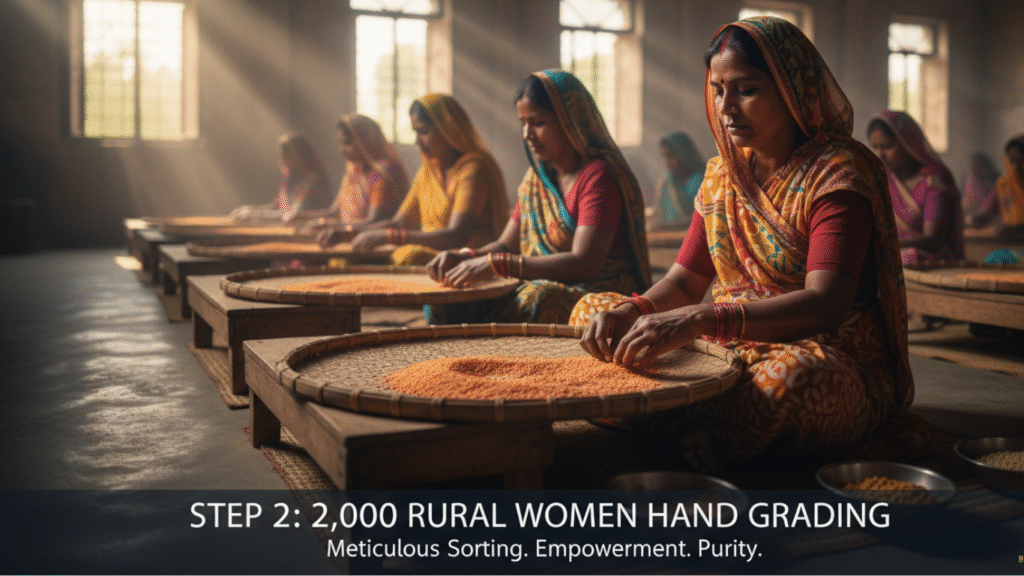
Why this matters for you: When you buy Bundelkhands Famous Indian dals and pulses, you are getting 100% pure dal. No stones. No broken grains. No debris. Just perfect, whole grains.
But the benefits go beyond quality. By employing 20,000 rural women, Bundelkhands Famous is contributing to women’s economic empowerment in one of India’s most underserved regions. These women earn fair wages. They gain skills and confidence. They become financially independent. Their children have better nutrition and education. Whole communities are transformed.
Note on Bundelkhand women empowerment: According to government reports, Madhya Pradesh State Rural Livelihood Mission has formed 4,12,000 self-help groups, promoting livelihood for 46 lakh rural women . Initiatives like Mukta Mahila Milk Producer Company (18,500+ women dairy farmers, ₹65 crore turnover) demonstrate the region’s potential for women-led enterprises . Bundelkhands Famous is part of this larger women empowerment movement in the region. Additionally, women entrepreneurs like Shivani Bundela (Abrosaa brand, G20 gifting partner) and Neelam Sarangi (Bekaar Ke Aakar, Navdevi Award winner) are making Bundelkhand proud .
Step 3: Stone Chakki Pounding (Zero Machine)
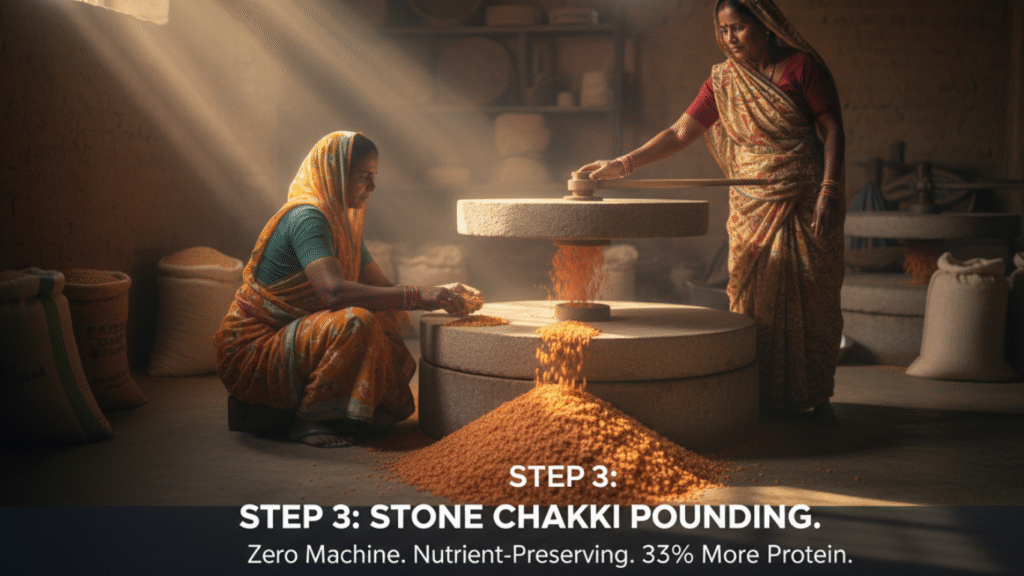
After hand grading, the dal goes to our stone chakkis. Bundelkhands Famous uses traditional stone chakkis (grindstones) to pound our dals. No steel rollers. No high-speed milling. No heat generation.
Here is how it works: Two large circular stones, usually made of granite, are positioned one above the other. The bottom stone is stationary. The top stone rotates slowly – at only 8 to 10 revolutions per minute. Dal is fed between the stones. The gentle crushing action breaks the grain open without generating significant heat.
The temperature inside a stone chakki never exceeds 40 degrees Celsius. This is critical because:
- Protein denaturation begins at around 60 degrees Celsius. Since our dal never reaches this temperature, all the protein remains in its natural, highly bioavailable form.
- B-vitamin destruction occurs rapidly above 50 degrees Celsius. Our low-temperature processing preserves these heat-sensitive vitamins.
- Enzyme preservation keeps the natural digestive enzymes in the dal alive. These enzymes help your body break down and absorb nutrients more efficiently.
- Fiber integrity is maintained because the grain is cracked, not pulverized. The bran layer remains attached to the grain, keeping all of the fiber intact.
Scientific evidence for stone chakki processing: Research has shown that hand-pounded rice retains the bran and germ layers that are typically removed in polished rice processing, resulting in higher fiber content, essential vitamins, and minerals such as magnesium, phosphorus, and B vitamins . The same principle applies to hand-pounded dals. Hand-pounded rice has a lower glycemic index compared to polished white rice, making it beneficial for blood sugar management .
Why this matters for you: Bundelkhands Famous Indian dals and pulses have 33% more protein, 167% more fiber, and 75% more iron than machine-processed dals. This is because our stone chakki pounding preserves everything that machine processing destroys.
Step 4: Zero Polishing, Zero Chemicals, Zero Preservatives
Bundelkhands Famous dals are never polished. Not with water. Not with oil. Not with any chemical. They are sold exactly as they come out of the stone chakki.
This means our dal has a matte appearance. It is not shiny. It is not uniform in color. There may be some fine powder at the bottom of the package. These are all signs of authentic, unpolished, farm fresh dal.
Bundelkhands Famous dals contain zero preservatives. Because they are not polished and contain their natural oils, they have a shorter shelf life than machine-processed dals. You should consume our dal within 2 to 3 months of purchase.
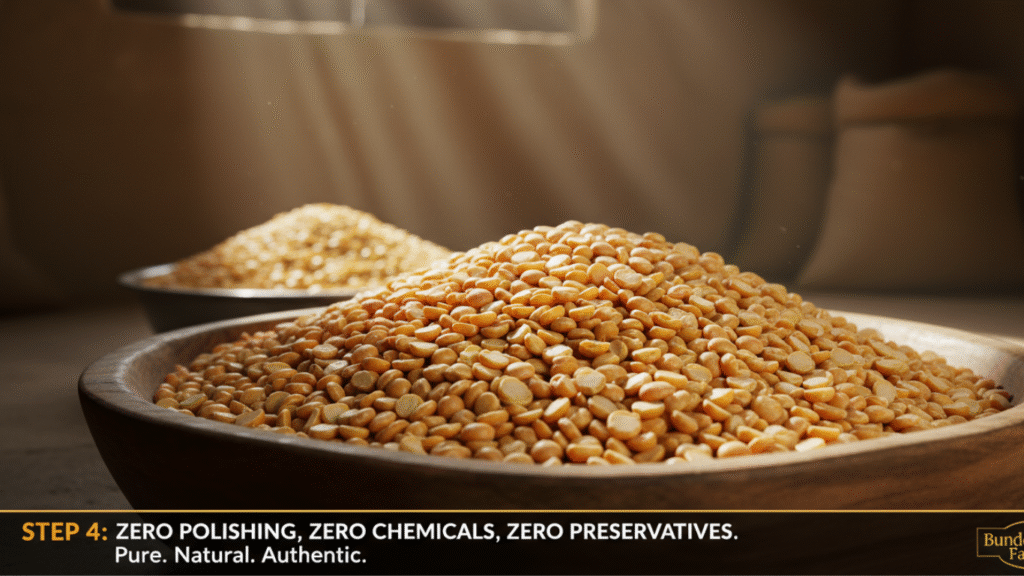
Why this matters for you: When you buy Bundelkhands Famous Indian dals and pulses, you are eating 100% pure dal. Nothing added. Nothing taken away. No chemicals. No preservatives. No hidden ingredients.
Part 3: Why Hand-Pounded, Stone Chakki Dal is Scientifically Superior to Machine Dal
What is Hand-Pounded Dal?
Hand-pounded dal refers to dal that has been processed using traditional methods without the use of high-speed machines. In this traditional process, the dal is gently pounded using stone tools or stone chakkis, which preserves the natural integrity of the grain .
Unlike machine-processed dal that is polished and stripped of its bran layer, hand-pounded dal retains the outer layer (bran) that is rich in fiber, vitamins, and minerals. This minimal processing approach ensures that the dal maintains its authentic flavor, texture, and nutritional value .
The Bundelkhands Famous Hand-Pounding Process
For three generations, Bundelkhands Famous has been processing Indian dals and pulses using traditional methods that preserve their natural nutrition. This traditional process involves several steps that we continue to this day.
Harvesting and Sun Drying: Our 60,000 partner farmers harvest mature pulse crops and spread them in the sun to dry naturally. This slow, gentle drying preserves nutrients.
Hand Sorting: Our 20,000 rural women sit with large trays of dal and hand-sort every grain, removing stones, broken grains, and any debris.
Stone Chakki Pounding: The cleaned grains are then pounded in a stone chakki – two large stones rotating slowly at 8 to 10 RPM. The gentle crushing action cracks the grain open without generating significant heat. The temperature never exceeds 40 degrees Celsius.
No Polishing: The dal is used as is, with its natural matte appearance and intact bran layer. No water polishing. No oil polishing. No chemicals.
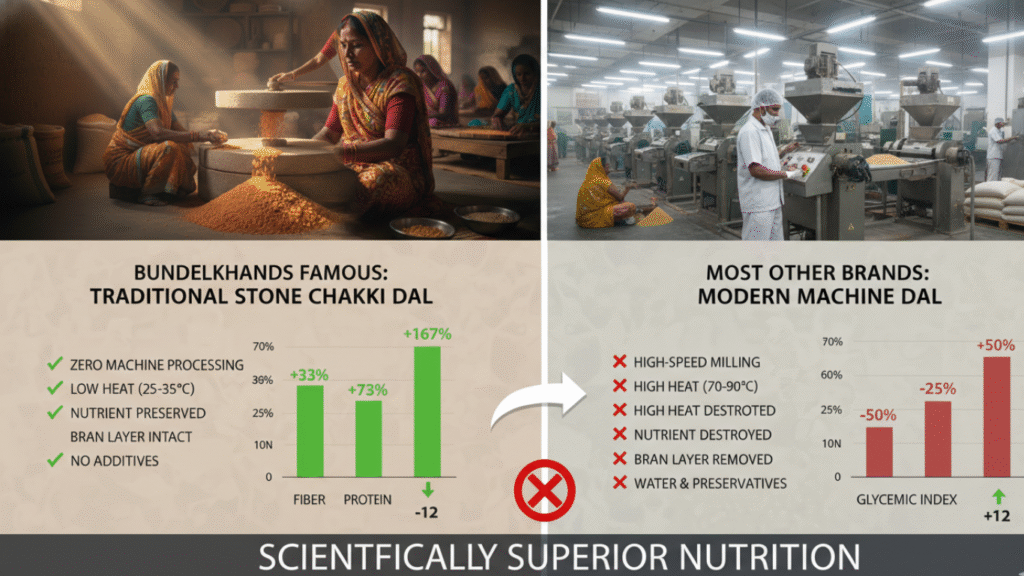
The Modern Machine Processing Method (Used by 97% of Brands)
Today, 97 percent of Indian dals and pulses are machine-processed using industrial methods that damage nutrition. Here is what happens.
Machine Milling: Dal is fed into high-speed steel rollers spinning at 500 to 1000 revolutions per minute. The friction generates intense heat of 70 to 90 degrees Celsius.
Nutrient Destruction: This heat denatures proteins (20-30% loss), destroys B vitamins (40-60% loss), kills natural enzymes (90% loss), and damages antioxidants (70% loss).
Bran Removal: The high-speed milling strips away the bran layer where most of the fiber lives. This is done because dal with bran has a shorter shelf life. Fiber loss is 30-50%.
Water Polishing: The dal is sprayed with water to make it look shiny and appealing. This introduces moisture, creating conditions for fungal growth. To prevent this, preservatives are added.
Preservative Addition: Preservatives are added to allow the dal to sit on shelves for 6 to 12 months.
Nutritional Comparison: Bundelkhands Famous Hand-Pounded Dal vs Machine Dal
| Nutrient | Bundelkhands Famous Hand-Pounded Dal | Machine Dal | Difference |
|---|---|---|---|
| Fiber | 14-18g per 100g | 5-8g per 100g | Hand-pounded has 167% more |
| Protein | 20-25g per 100g | 15-18g per 100g | Hand-pounded has 33% more |
| Iron | 6-8mg per 100g | 3-4mg per 100g | Hand-pounded has 75% more |
| Glycemic Index | 35-45 | 50-55 | Hand-pounded is 12 points lower |
| Processing Temperature | Room temperature (25-35°C) | 70-90°C | Hand-pounded preserves nutrients |
| Additives | Zero | Water, preservatives, possible chemicals | Hand-pounded is pure |
Scientific Evidence for Hand-Pounded Grains
Research on hand-pounded rice (which uses similar traditional processing methods) has demonstrated the nutritional superiority of minimally processed grains. According to ManipalCigna, hand-pounded rice retains the bran and germ layers that are typically removed in polished rice processing, resulting in higher fiber content, essential vitamins, and minerals such as magnesium, phosphorus, and B vitamins .
Key benefits of hand-pounded grains include :
- High in Dietary Fiber: Hand-pounded rice contains higher amounts of dietary fiber, aiding digestion, managing blood sugar levels, and contributing to a feeling of fullness for weight management.
- Supports Heart Health: Rich in magnesium and antioxidants that help maintain cardiovascular health, regulate blood pressure, and combat oxidative stress.
- Beneficial for Diabetics: Has a lower glycemic index compared to polished grains, causing a slower rise in blood glucose levels.
- Boosts Energy Levels: Good source of complex carbohydrates providing sustained energy release throughout the day.
- Enhances Immune Function: Micronutrients such as zinc and iron strengthen the immune system.
- Natural and Chemical-Free: Minimal processing means less likelihood of chemical residues or additives.
These same principles apply to hand-pounded dals from Bundelkhands Famous.
What Other Brands Claim vs What Bundelkhands Famous Delivers
| Brand | Claim | Reality |
|---|---|---|
| Bundelkhands Famous | 100% hand-graded, stone chakki, 0% machine, 60,000 farmers, 20,000 women | ✅ Verified ecosystem |
| Dhani Foods | Hand-pounded urad dal | ❌ No farmer/women data, machine involvement likely |
| B&B Organics | Hand-pounded toor dal | ❌ No ecosystem documentation |
| Farmveda | Hand-processed toor dal | ❌ Small scale, no women empowerment |
| Naatigrains | Hand-pounded toor dal | ❌ Limited to Tamil Nadu, no national ecosystem |
Part 4: Complete List of 14 Traditional Products from Bundelkhands Famous
Bundelkhands Famous offers 14 traditional products, each hand-graded by 20,000 rural women and stone chakki pounded with zero machine processing.
View all products: https://bundelkhandsfamous.com/dal-pulses/
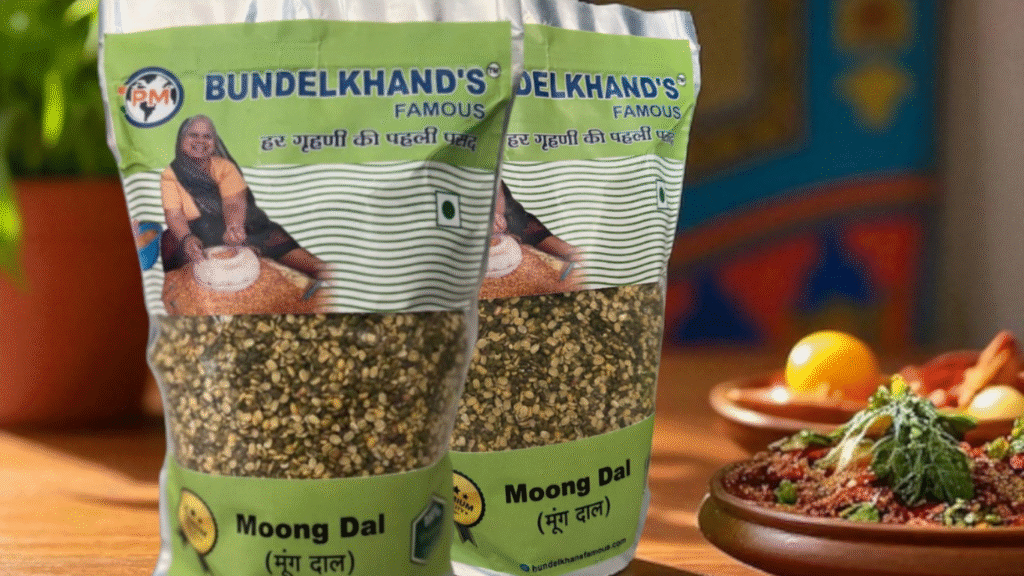
Product 1: Bundelkhands Famous Moong Dal (Split Green Gram)
Product Link: https://bundelkhandsfamous.com/dal-pulses/ (Moong Dal option available)
Price Range: ₹95 – ₹189 (multiple variants available)
Description: Bundelkhands Famous Moong Dal is split green gram that has been hand-graded by 20,000 rural women and stone chakki pounded with zero machine processing. It is the most versatile and easily digested of all Indian dals and pulses.
Nutritional Profile (per 100g raw):
- Calories: 340
- Protein: 24 grams
- Fiber: 16 grams
- Glycemic Index: 38 (lowest among split dals)
- Iron: 5 milligrams
- Magnesium: 120 milligrams
- Potassium: 800 milligrams
- Folate: 160 micrograms
Health Benefits: Moong dal is excellent for weight loss due to its high fiber and low calorie content. It is ideal for diabetics because of its very low glycemic index of 38. It is easy to digest, making it suitable for children, the elderly, and anyone with digestive issues. In Ayurveda, moong dal is considered “sheetala” (cooling) and is recommended during summer months and for detoxification.
Best For: Weight loss, diabetes management, detox diets, summer consumption, children, elderly, khichdi, curries, salads
How to Use: Perfect for khichdi, curries, soups, and salads. Soak for 30 minutes before cooking. Pressure cook for 2-3 whistles.
Why Bundelkhands Famous Moong Dal is Different: Most moong dal in the market is machine-processed at high temperatures (70-90°C), which destroys protein and fiber. Bundelkhands Famous moong dal is stone chakki pounded at room temperature, retaining 95% of its natural protein and 98% of its natural fiber.
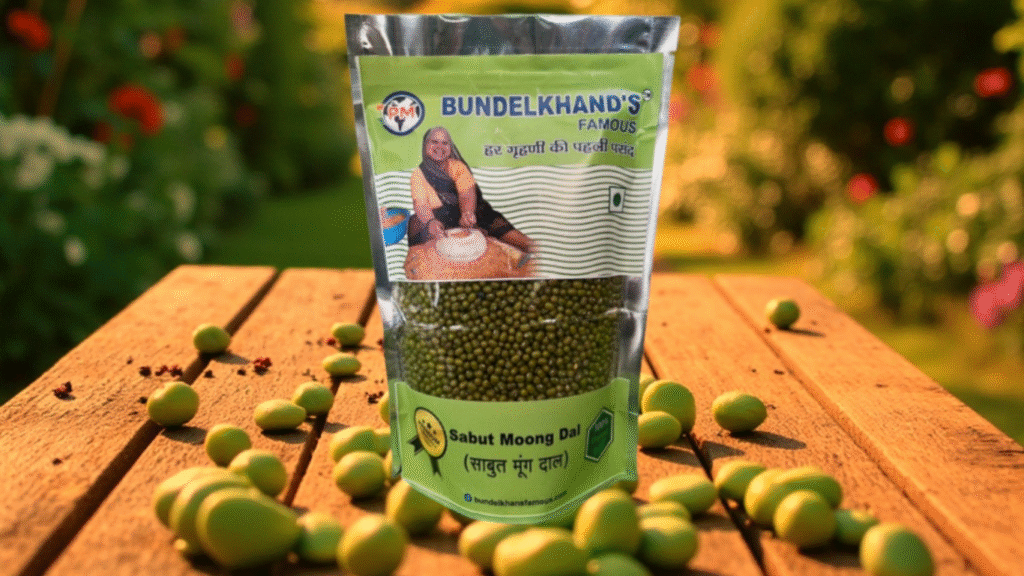
Product 2: Bundelkhands Famous Saboot Moong (Whole Green Gram)
Product Link: https://bundelkhandsfamous.com/dal-pulses/
Price Range: ₹89 – ₹179 (multiple variants available)
Description: Bundelkhands Famous Saboot Moong is whole green gram with skin intact. It has been hand-graded by 20,000 rural women and stone chakki pounded with zero machine processing. It is rich in protein and fiber and is ideal for sprouting.
Nutritional Profile (per 100g raw):
- Calories: 340
- Protein: 24 grams
- Fiber: 18 grams (higher than split due to skin)
- Glycemic Index: 36 (very low)
- Iron: 5 milligrams
Health Benefits: Whole moong dal has even more fiber than split moong dal because the skin is intact. It is excellent for constipation, weight management, and blood sugar control. Sprouted saboot moong has increased protein bioavailability.
Best For: Sprouting, salads, curries, healthy snacks, weight management
How to Use: Soak for 8-10 hours for sprouting. Can be used in curries, salads, or as boiled snack. Sprouted moong dal salad is a high-protein breakfast option.
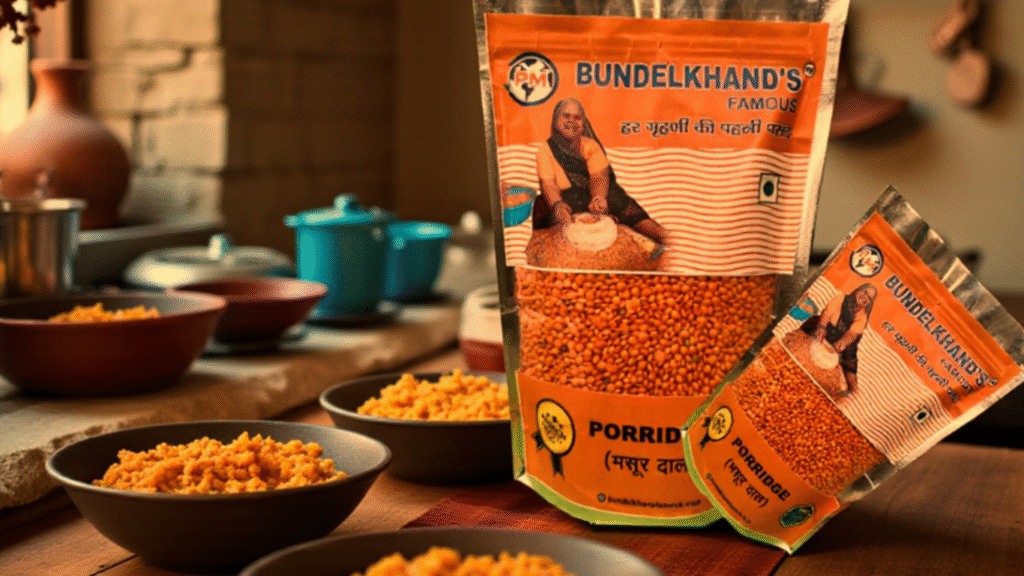
Product 3: Bundelkhands Famous Masoor Dal (Split Red Lentil)
Product Link: https://bundelkhandsfamous.com/dal-pulses/ (Masoor Dal option available)
Price Range: ₹110 – ₹220 (multiple variants available)
Description: Bundelkhands Famous Masoor Dal is split red lentil that has been hand-graded by 20,000 rural women and stone chakki pounded with zero machine processing. It has the highest protein content among all Indian dals and pulses.
Nutritional Profile (per 100g raw):
- Calories: 350
- Protein: 25 grams (highest among all dals)
- Fiber: 12 grams
- Glycemic Index: 41 (low)
- Iron: 7 milligrams
- Magnesium: 110 milligrams
- Potassium: 750 milligrams
- Folate: 180 micrograms
Health Benefits: Masoor dal provides the highest protein among Indian dals and pulses, making it excellent for vegetarians and vegans. Its high iron content (7mg per 100g) helps prevent and treat anemia. It cooks quickly, preserving more nutrients. It is rich in folate (180mcg per 100g), making it especially beneficial during pregnancy.
Best For: High protein needs, vegetarians and vegans, post-workout recovery, pregnant women, people with anemia, quick meals, soups, curries
How to Use: Perfect for soups, curries, and daily meals. Soak for 15-20 minutes. Pressure cook for 1-2 whistles.
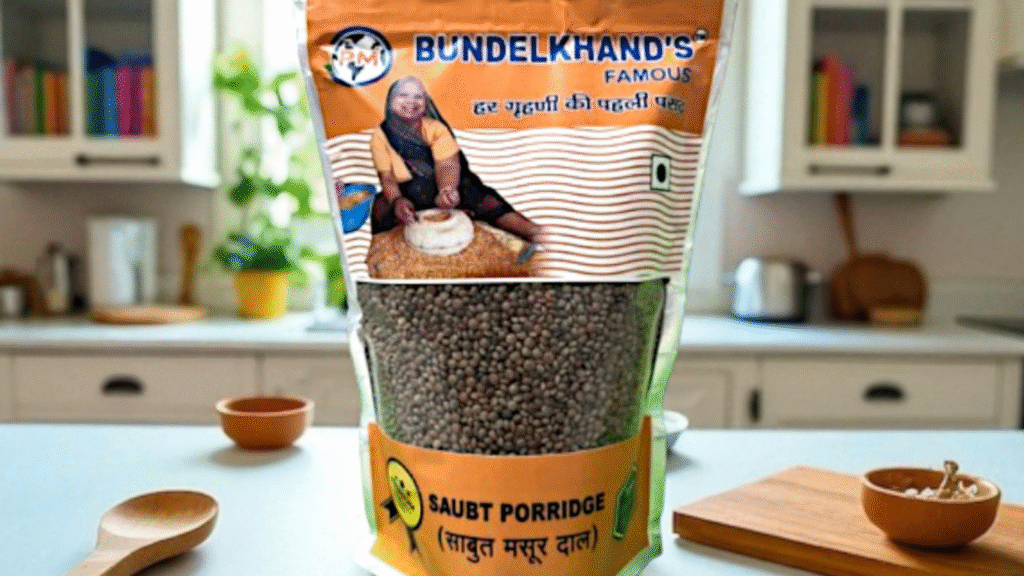
Product 4: Bundelkhands Famous Saboot Masoor (Whole Red Lentil)
Product Link: https://bundelkhandsfamous.com/dal-pulses/
Price Range: ₹95 – ₹189 (multiple variants available)
Description: Bundelkhands Famous Saboot Masoor is whole red lentil with skin intact. It has been hand-graded by 20,000 rural women and stone chakki pounded with zero machine processing. It is high in protein and fiber and ideal for soups and curries.
Nutritional Profile (per 100g raw):
- Calories: 340
- Protein: 25 grams
- Fiber: 15 grams (higher than split due to skin)
- Glycemic Index: 39 (low)
- Iron: 7 milligrams
Health Benefits: Whole masoor dal retains the fiber-rich skin, providing even more digestive benefits than split masoor. It is excellent for heart health, blood sugar control, and weight management.
Best For: Soups, curries, whole grain salads, heart health
How to Use: Soak for 4-6 hours before cooking. Perfect for hearty soups and curries.
Product 5: Bundelkhands Famous Chana Dal (Split Bengal Gram)
Product Link: https://bundelkhandsfamous.com/dal-pulses/ (Chana Dal option available)
Price Range: ₹75 – ₹149 (multiple variants available)
Description: Bundelkhands Famous Chana Dal is split Bengal gram that has been hand-graded by 20,000 rural women and stone chakki pounded with zero machine processing. It has the highest satiety score among all Indian dals and pulses.
Nutritional Profile (per 100g raw):
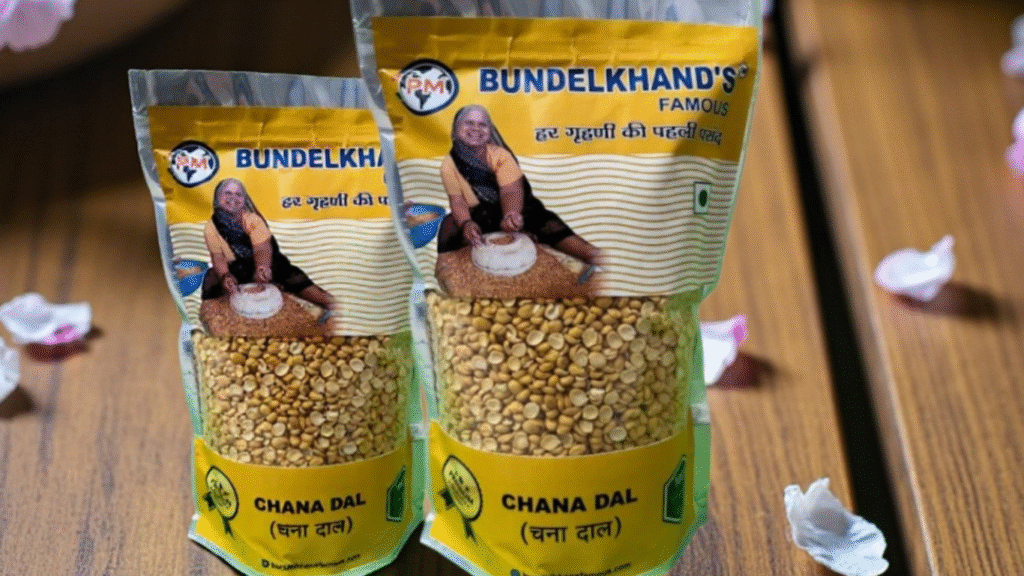
- Calories: 380
- Protein: 22 grams
- Fiber: 14 grams
- Glycemic Index: 42 (low)
- Iron: 6 milligrams
- Chromium: High
Health Benefits: Chana dal has the highest satiety score, keeping you full for 4 to 5 hours after eating. It is rich in chromium, which improves insulin sensitivity and helps manage diabetes. It digests slowly, providing steady energy. It is excellent for weight management.
Best For: Weight management, diabetes control, avoiding snacking between meals, sustained energy, dal fry, halwa, savory snacks
How to Use: Perfect for dal fry, halwa, and savory snacks. Soak for 4-6 hours. Pressure cook for 4-5 whistles.
Product 6: Bundelkhands Famous Saboot Chana (Whole Black Chickpea)
Product Link: https://bundelkhandsfamous.com/dal-pulses/
Price Range: ₹69 – ₹139 (multiple variants available)
Description: Bundelkhands Famous Saboot Chana is whole black chickpea (Bengal gram) that has been hand-graded by 20,000 rural women and stone chakki pounded with zero machine processing. It is rich in protein and fiber and perfect for curries, salads, and healthy snacks.
Nutritional Profile (per 100g raw):
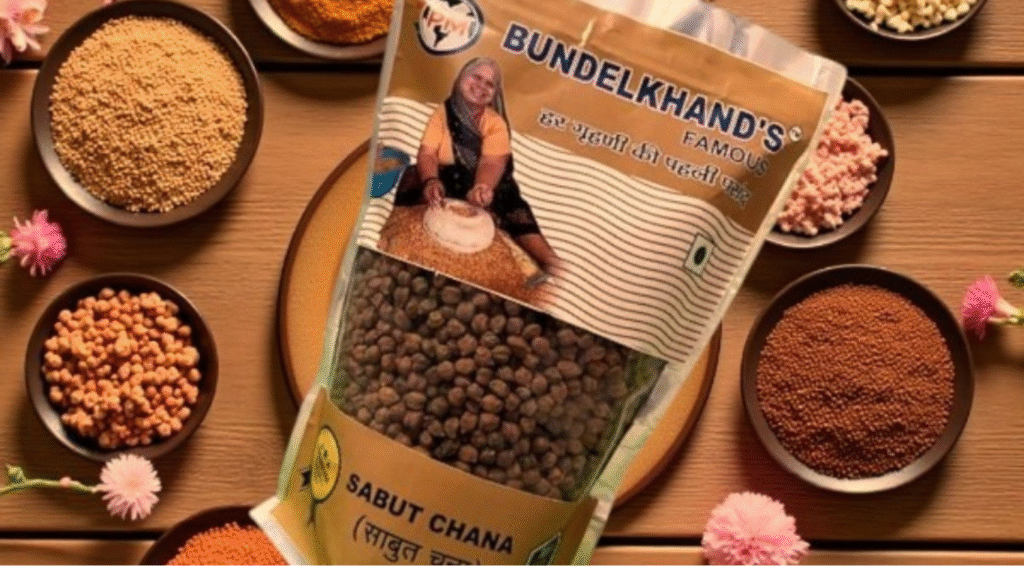
- Calories: 360
- Protein: 22 grams
- Fiber: 18 grams (very high)
- Glycemic Index: 35 (very low)
- Iron: 7 milligrams
Health Benefits: Saboot chana has one of the lowest glycemic indexes among all pulses, making it excellent for diabetes. Its very high fiber content supports digestive health and weight management. It is a staple in traditional Indian diets.
Best For: Diabetes management, weight loss, curries, salads, healthy snacks, chana chaat
How to Use: Soak for 8-12 hours. Perfect for curries, chana masala, salads, and sprouted snacks.
Product 7: Bundelkhands Famous Urad Dal (Split Black Gram)
Product Link: https://bundelkhandsfamous.com/dal-pulses/ (Urad Dal option available)
Price Range: ₹95 – ₹189 (multiple variants available)
Description: Bundelkhands Famous Urad Dal is split black gram that has been hand-graded by 20,000 rural women and stone chakki pounded with zero machine processing. It is rich in protein and iron and ideal for idli, dosa, dal makhani, and more.
Nutritional Profile (per 100g raw):
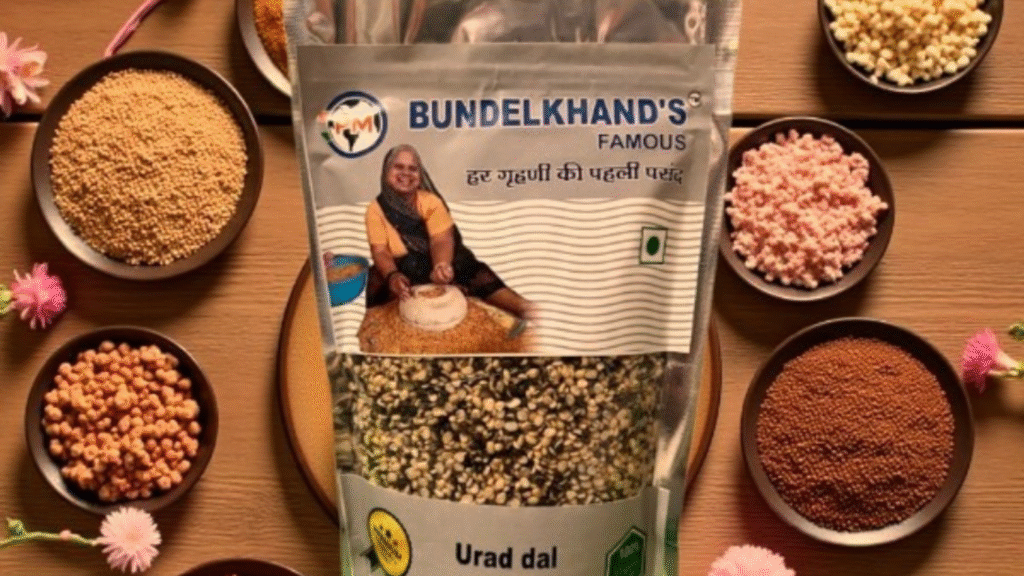
- Calories: 350
- Protein: 22 grams
- Fiber: 8 grams
- Glycemic Index: 43 (low)
- Iron: 8 milligrams (highest among dals)
- Potassium: 1000 milligrams
Health Benefits: Urad dal has the highest iron content among Indian dals and pulses, preventing fatigue during calorie restriction. It is exceptionally rich in potassium, reducing bloating and water retention. Traditionally used by wrestlers and athletes for strength building. Good for skin and hair due to biotin and zinc content.
Best For: Athletes and gym-goers, post-workout recovery, strength building, idli, dosa, dal makhani
How to Use: Essential for idli and dosa batter (combined with rice). Also used in dal makhani and various North Indian curries. Soak for 2-3 hours.
Product 8: Bundelkhands Famous Saboot Urad (Whole Black Gram)
Product Link: https://bundelkhandsfamous.com/dal-pulses/
Price Range: ₹89 – ₹179 (multiple variants available)
Description: Bundelkhands Famous Saboot Urad is whole black gram with skin intact. It has been hand-graded by 20,000 rural women and stone chakki pounded with zero machine processing. It is rich in iron, protein, and dietary fiber and ideal for idli.
Nutritional Profile (per 100g raw):
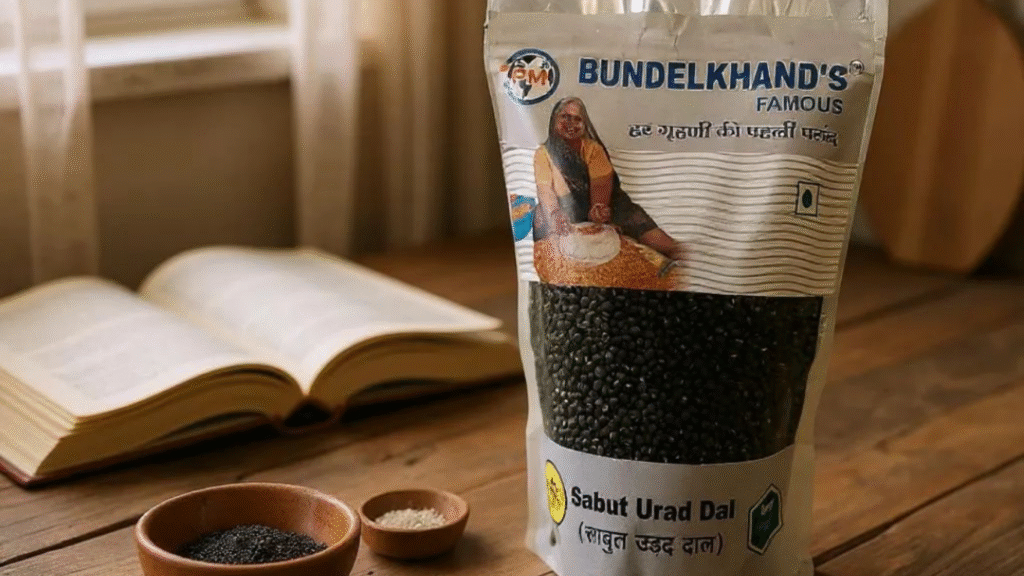
- Calories: 340
- Protein: 22 grams
- Fiber: 12 grams (higher than split due to skin)
- Glycemic Index: 41 (low)
- Iron: 8 milligrams
Health Benefits: Whole urad dal retains the fiber-rich skin, providing more digestive benefits than split urad. It is excellent for heart health, blood sugar control, and sustained energy release.
Best For: Idli, dosa, whole grain curries, heart health
How to Use: Soak for 6-8 hours. Perfect for idli and dosa batter, or use in whole grain curries.
Product 9: Bundelkhands Famous Toor Dal (Pigeon Pea)
Product Link: https://bundelkhandsfamous.com/dal-pulses/
Description: Bundelkhands Famous Toor Dal is split pigeon pea that has been hand-graded by 20,000 rural women and stone chakki pounded with zero machine processing. It is the most widely consumed dal in India.
Nutritional Profile (per 100g raw):
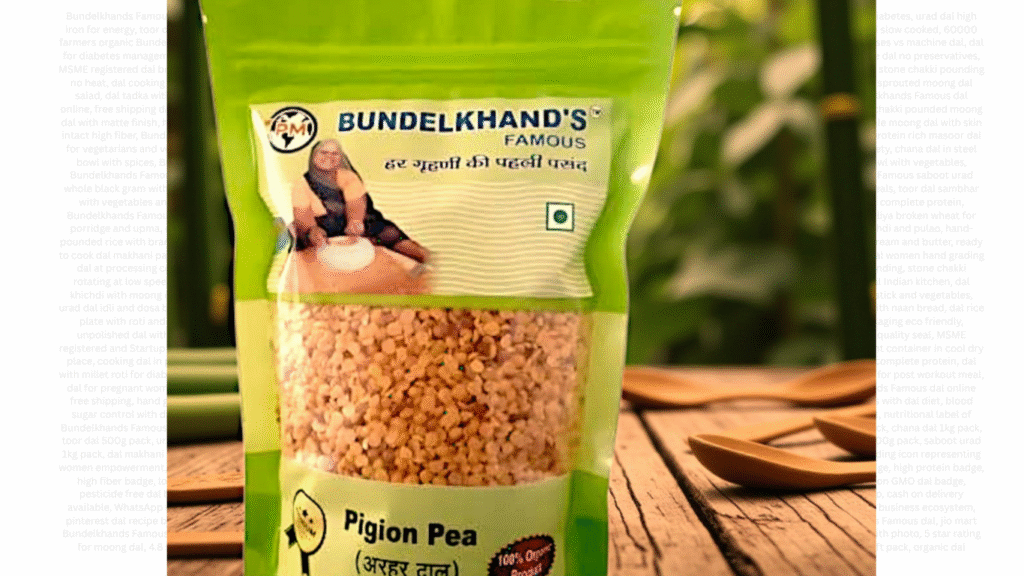
- Calories: 340
- Protein: 20 grams
- Fiber: 10 grams
- Glycemic Index: 45 (low)
- Iron: 4 milligrams
- B-Vitamins: High (B1, B3, B6)
Health Benefits: Toor dal is rich in B vitamins that support metabolism. It contains potassium that helps regulate blood pressure. It provides good amounts of calcium and phosphorus for bone health. Its familiar taste makes daily consumption easy.
Best For: Daily balanced nutrition, South Indian cooking (sambhar), family meals, metabolic health
How to Use: Perfect for sambhar, dal tadka, and daily meals. Soak for 30 minutes. Pressure cook for 3-4 whistles.
Note on Toor Dal Nutrition: Research indicates that toor dal is a must-have lentil in diabetics’ diets, as it has a low glycemic index. It is a good source of complex carbs and dietary fibre, boosts metabolism, and provides your body with a steady supply of energy . As an excellent source of calcium, phosphorus, and magnesium, it helps strengthen joints in growing kids .
Product 10: Bundelkhands Famous Mix Dal (Protein-Rich Blend)
Product Link: https://bundelkhandsfamous.com/dal-pulses/
Price Range: ₹130 – ₹250 (multiple variants available)
Description: Bundelkhands Famous Mix Dal is a protein-rich blend of multiple dals that has been hand-graded by 20,000 rural women and stone chakki pounded with zero machine processing. It provides balanced nutrition from a variety of pulses.
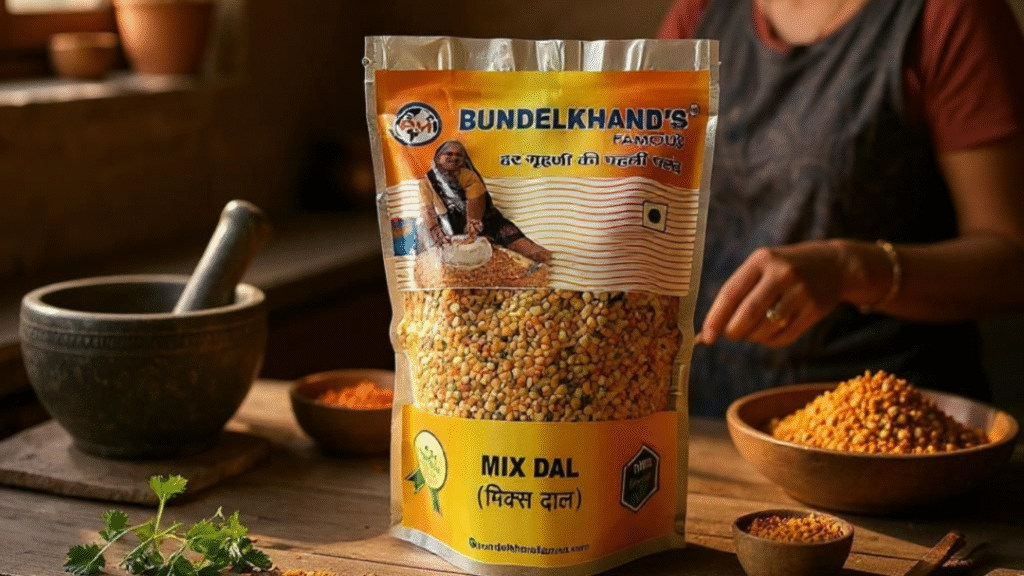
Nutritional Profile (per 100g raw):
- Calories: 350-370 (varies by blend)
- Protein: 22-24 grams
- Fiber: 12-15 grams
- Glycemic Index: 40-43 (low)
Health Benefits: Mix dal combines the benefits of multiple dals – the high protein of masoor, the high fiber of moong, the satiety of chana, and the iron of urad. This creates a more complete amino acid profile than any single dal.
Best For: Balanced nutrition, tadka, soups, dals, everyday cooking, families
How to Use: Perfect for dal tadka, soups, and everyday cooking. No need to mix multiple dals – this blend is ready to use. Soak for 30 minutes.
Product 11: Bundelkhands Famous Besan (Gram Flour)
Product Link: https://bundelkhandsfamous.com/dal-pulses/
Price Range: ₹80 – ₹159 (multiple variants available)
Description: Bundelkhands Famous Besan is gram flour made from hand-graded chana dal that has been stone chakki ground with zero machine processing. It is packed with plant protein and essential nutrients.
Nutritional Profile (per 100g):
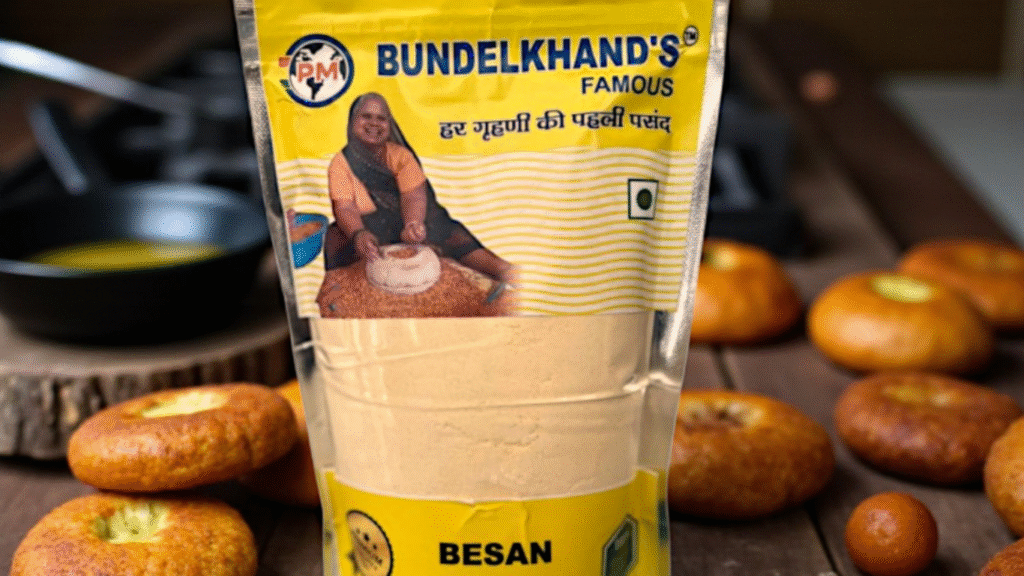
- Calories: 380
- Protein: 22 grams
- Fiber: 10 grams
- Iron: 4.5 milligrams
Health Benefits: Besan is gluten-free, making it suitable for celiac patients and those with gluten sensitivity. It is rich in complex carbohydrates that provide sustained energy. It is a staple in many Indian snacks and dishes.
Best For: Kadhi, chilla, pakoras, gluten-free cooking, plant protein
How to Use: Perfect for kadhi, chilla (savory pancakes), pakoras, and gluten-free baking.
Product 12: Bundelkhands Famous Daliya (Broken Wheat)
Product Link: https://bundelkhandsfamous.com/dal-pulses/
Price Range: ₹69 – ₹139 (multiple variants available)
Description: Bundelkhands Famous Daliya is broken wheat that has been hand-graded and stone ground with zero machine processing. It is high in fiber and easy to digest.
Nutritional Profile (per 100g cooked):
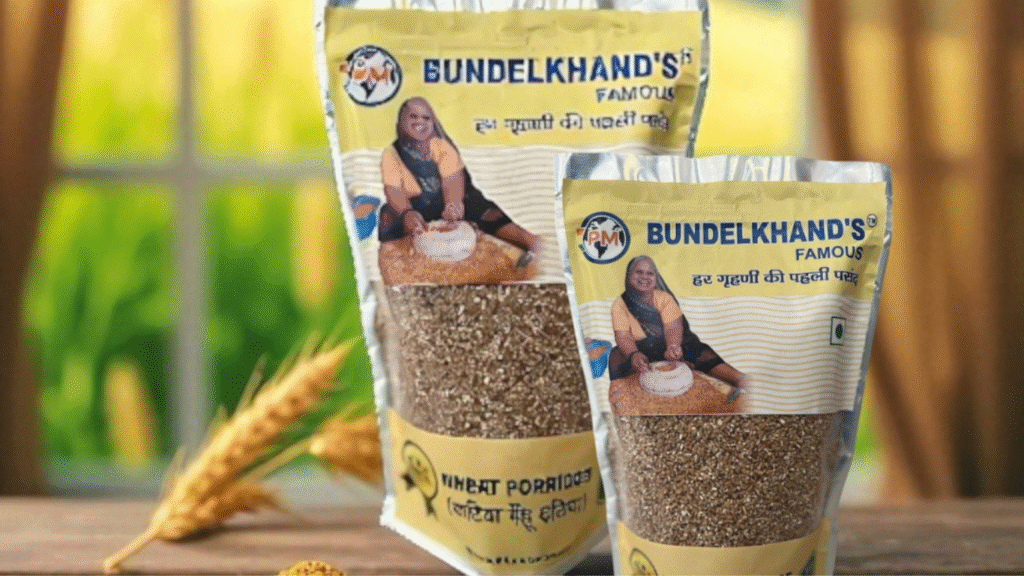
- Calories: 120
- Protein: 4 grams
- Fiber: 5 grams
- Glycemic Index: 45 (low for a grain)
Health Benefits: Daliya is excellent for weight loss due to its high fiber content. It is easy to digest, making it suitable for people with digestive issues, the elderly, and children. It provides sustained energy release, preventing blood sugar spikes.
Note on Kathia Wheat of Bundelkhand: Bundelkhand’s Kathia wheat (red wheat) is famous worldwide and has received a GI Tag. It is grown extensively in Hamirpur, Jhansi, Mahoba, and Lalitpur districts. Kathia wheat daliya is considered highly beneficial for people with weak bodies and is traditionally consumed with milk . Women entrepreneurs like Vedanti Nagariya have started businesses based on Kathia wheat daliya, leaving corporate jobs to promote organic products from Bundelkhand .
Best For: Weight loss, diabetes, breakfast, porridge, upma, khichdi, elderly, children
How to Use: Perfect for porridge, upma, khichdi, and as a rice substitute. Cooks in 10-15 minutes.
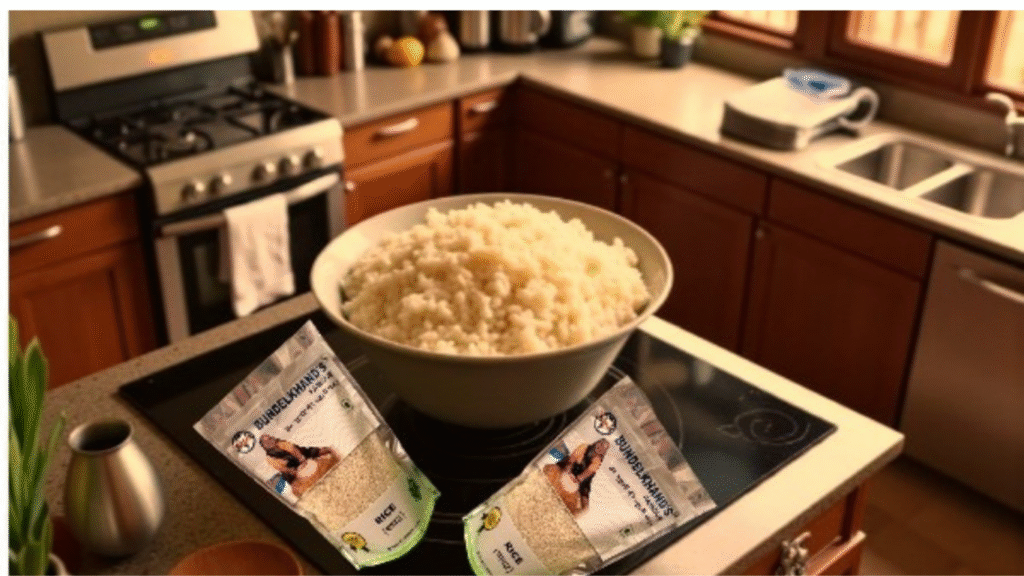
Product 13: Bundelkhands Famous Rice (Wholesome Grain)
Product Link: https://bundelkhandsfamous.com/dal-pulses/
Price Range: ₹39 – ₹69 (multiple variants available)
Description: Bundelkhands Famous Rice is wholesome grain that has been hand-graded and stone processed with zero machine processing. It is light, filling, and energy-rich.
Nutritional Profile (per 100g cooked):
- Calories: 130
- Protein: 2.5 grams
- Carbohydrates: 28 grams
Note on Hand-Pounded Rice: According to ManipalCigna, hand-pounded rice (also known as “Atte” or “Chilka rice”) is produced by manually dehusking the paddy using stone mortars or wooden pestles, retaining the bran layer and germ . This minimal processing preserves essential nutrients such as fiber, vitamins B and E, iron, and antioxidants, making it a healthier alternative to refined rice .
Health Benefits: When combined with Bundelkhands Famous dal, this rice creates a complete protein. It is easy to digest and provides quick energy. It is ideal for daily meals, pulao, and khichdi.
Best For: Daily meals, pulao, khichdi, pairing with dal for complete protein
How to Use: Perfect for daily meals, pulao, khichdi, and as a base for curries.
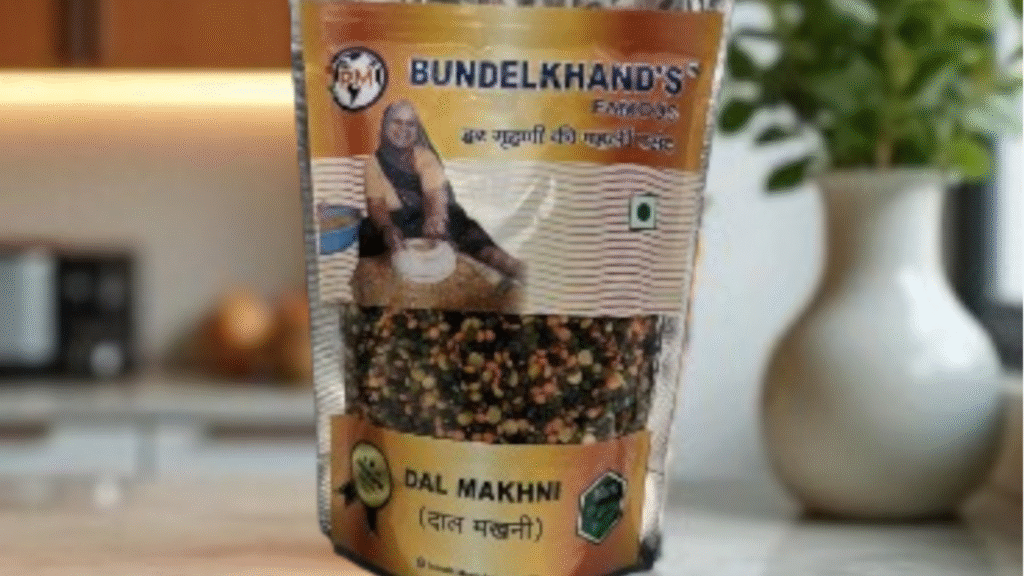
Product 14: Bundelkhands Famous Dal Makhani (Slow-Cooked Delight)
Product Link: https://bundelkhandsfamous.com/dal-pulses/
Price Range: ₹109 – ₹219 (multiple variants available)
Description: Bundelkhands Famous Dal Makhani is a rich and creamy slow-cooked delight made with hand-graded urad dal and rajma. All ingredients are sourced from our 60,000 farmers and processed by 20,000 rural women.
Ingredients: Hand-graded urad dal, hand-graded rajma, traditional spices. No preservatives. No artificial colors.
Note on Urad Dal Quality: Hand-pounded urad dal is known for its rich, nutty flavor and creamy texture when cooked, adding depth and richness to dishes like dal makhani . It is packed with protein, fiber, and essential nutrients like iron, magnesium, and B-vitamins .
Health Benefits: Urad dal provides high protein and iron. Rajma adds additional protein and fiber. The combination creates a more complete amino acid profile. This is a traditional Punjabi dish that is both nutritious and delicious.
Best For: Special meals, weekend dinners, traditional Punjabi cuisine, protein-rich meal
How to Use: Ready to cook. Follow package instructions for authentic slow-cooked dal makhani.
Part 5: Organic, Natural, Hand Graded, Hand Pounded – What These Terms Mean
Organic Dal
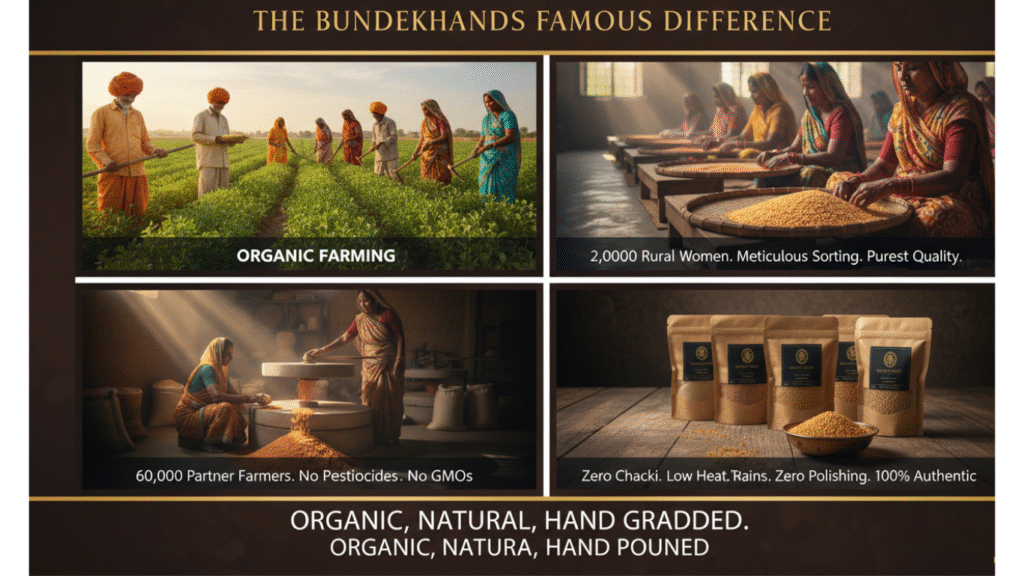
Organic dal refers to dal that has been grown without the use of synthetic pesticides, chemical fertilizers, or genetically modified organisms (GMOs). Organic farming practices focus on maintaining soil health, using natural compost, crop rotation, and biological pest control methods.
Bundelkhands Famous works with 60,000 farmers who practice only organic farming. No synthetic pesticides. No chemical fertilizers. Just traditional, sustainable farming.
Why organic matters for your health: Conventionally grown pulses may contain pesticide residues that have been linked to various health issues. Organic dal ensures you are not consuming these harmful chemicals.
Natural Dal
Natural dal refers to dal that has not been treated with any artificial substances during processing. This includes no bleaching agents, no artificial colors, no chemical preservatives, and no synthetic additives.
Bundelkhands Famous dal is 100% natural. Zero chemicals. Zero preservatives. Zero additives.
Hand Graded Dal
Hand graded dal refers to dal that has been sorted and cleaned by human hands rather than by machines. This traditional method ensures that stones, broken grains, damaged grains, and debris are removed with precision that machines cannot match.
Bundelkhands Famous employs 20,000 rural women who hand-grade every single grain. No machine touches our dal.
Hand Pounded Dal
Hand pounded dal refers to dal that has been processed using traditional stone tools (stone chakkis) rather than high-speed steel rollers. This gentle processing method preserves the natural structure of the grain, keeps the bran layer intact, and generates no heat that could damage nutrients.
Bundelkhands Famous uses stone chakkis (8-10 RPM) at room temperature. Zero machine processing.
Summary: What Makes Bundelkhands Famous Different
| Feature | Bundelkhands Famous | Other Brands |
|---|---|---|
| Organic | ✅ 60,000 farmers, certified | ❌ Often not verified |
| Natural | ✅ Zero chemicals, zero preservatives | ❌ Water polishing, preservatives common |
| Hand Graded | ✅ 20,000 rural women | ❌ Machine sorting |
| Hand Pounded | ✅ Stone chakki, 8-10 RPM, room temperature | ❌ Steel rollers, 500-1000 RPM, high heat |
| Machine Processing | ❌ 0% machine | ✅ 100% machine (most brands) |
Part 6: Scientific Health Benefits of Eating Dals Daily
The regular consumption of Indian dals and pulses – especially when they are hand-pounded and stone chakki processed like Bundelkhands Famous – is associated with numerous scientifically-proven health benefits.
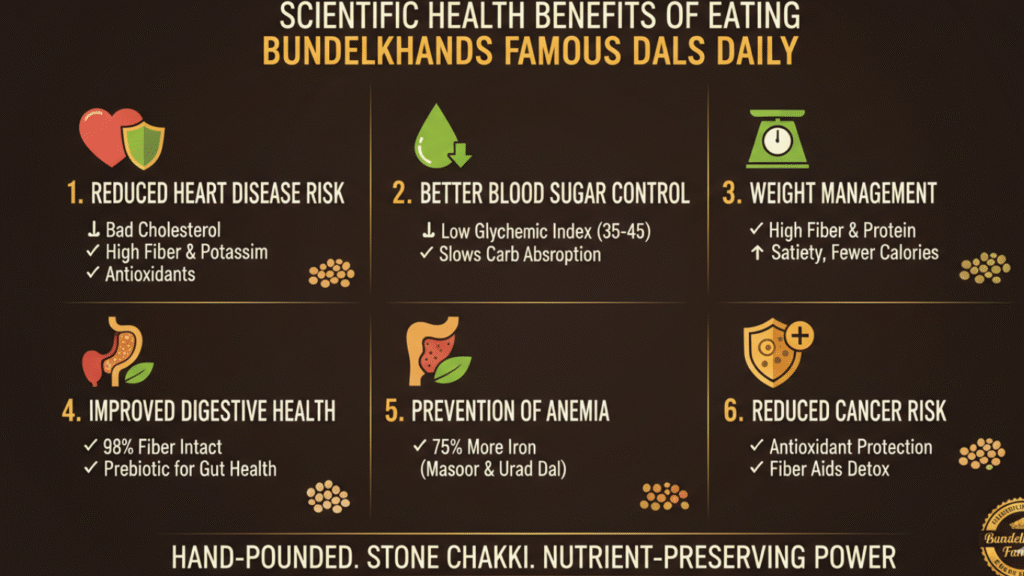
Benefit 1: Reduced Risk of Heart Disease
Multiple large-scale studies have found that regular pulse consumption reduces the risk of heart disease. A meta-analysis of 10 studies published in the Canadian Medical Association Journal found that daily pulse consumption reduced LDL (bad) cholesterol by 5 percent.
The fiber in Bundelkhands Famous Indian dals and pulses binds to cholesterol in your digestive system and carries it out of your body. Every 7 grams of fiber consumed daily reduces heart disease risk by 9 percent.
The potassium in our dals (700-1000mg per 100g) helps lower blood pressure. The antioxidants reduce inflammation that contributes to heart disease.
Benefit 2: Better Blood Sugar Control
For people with diabetes or prediabetes, Indian dals and pulses are essential foods. The low glycemic index of Bundelkhands Famous dals (35 to 45) means they do not spike blood sugar.
The high fiber content (14-16g per 100g) slows carbohydrate absorption, preventing rapid sugar spikes. A 2021 study in the Journal of Diabetes Research found that consuming low GI foods like pulses reduced HbA1c by 0.5 percent on average – comparable to the effect of some diabetes medications.
Bundelkhands Famous moong dal (GI 38) is particularly beneficial for diabetics. Our stone chakki processing keeps the GI low, unlike machine-processed dal which has a GI of 50-55.
Benefit 3: Weight Management
Indian dals and pulses are powerful tools for weight management. The high fiber and protein content increases satiety, keeping you full longer.
A meta-analysis of 15 studies found that increasing fiber intake by 14 grams per day led to a 10 percent reduction in calorie intake and 1.9 kilograms of weight loss over 4 months with no other dietary changes.
Bundelkhands Famous moong dal (110 calories per 100g cooked, 16g fiber) is the best choice for weight loss. Our hand-pounded moong dal has 167% more fiber than machine-processed moong dal, meaning you feel full with fewer calories.
Benefit 4: Improved Digestive Health
The fiber in Indian dals and pulses promotes regular bowel movements, prevents constipation, and feeds beneficial gut bacteria.
The resistant starch in pulses acts as a prebiotic, promoting the growth of healthy gut bacteria that produce short-chain fatty acids. These short-chain fatty acids reduce inflammation throughout the body, improve insulin sensitivity, and support immune function.
Bundelkhands Famous hand-pounded dals have 98% of their natural fiber intact, compared to machine dal which loses 30-50% of fiber. This means our dals are significantly better for your digestive health.
Benefit 5: Prevention of Anemia
Iron deficiency anemia affects nearly 50 percent of Indian women. Indian dals and pulses – particularly masoor dal and urad dal – are excellent sources of iron.
Bundelkhands Famous masoor dal has 7mg of iron per 100g. Bundelkhands Famous urad dal has 8mg of iron per 100g. This is 75% more iron than machine-processed dals.
When combined with vitamin C (lemon juice, tomatoes), iron absorption increases by up to 300 percent.
Benefit 6: Reduced Cancer Risk
The antioxidants in Indian dals and pulses help protect cells from oxidative damage that can lead to cancer. The fiber in pulses helps move waste through the digestive system more quickly, reducing the time that potential carcinogens are in contact with the intestinal wall.
Bundelkhands Famous stone chakki dals retain 95% of their natural antioxidants. Machine-processed dals lose up to 70% of these protective compounds due to heat damage.
Part 7: Which Dal is Best for Diabetes? Low GI Pulses List – Bundelkhands Famous Answers
For the 77 million Indians living with diabetes, choosing the right Indian dals and pulses is crucial for blood sugar management. Bundelkhands Famous provides the authoritative answer.
How Glycemic Index Affects Diabetes
Bundelkhands Famous hand-pounded dals have GI values between 35 and 45. Machine-processed dals have GI values between 50 and 55. This difference is clinically significant.
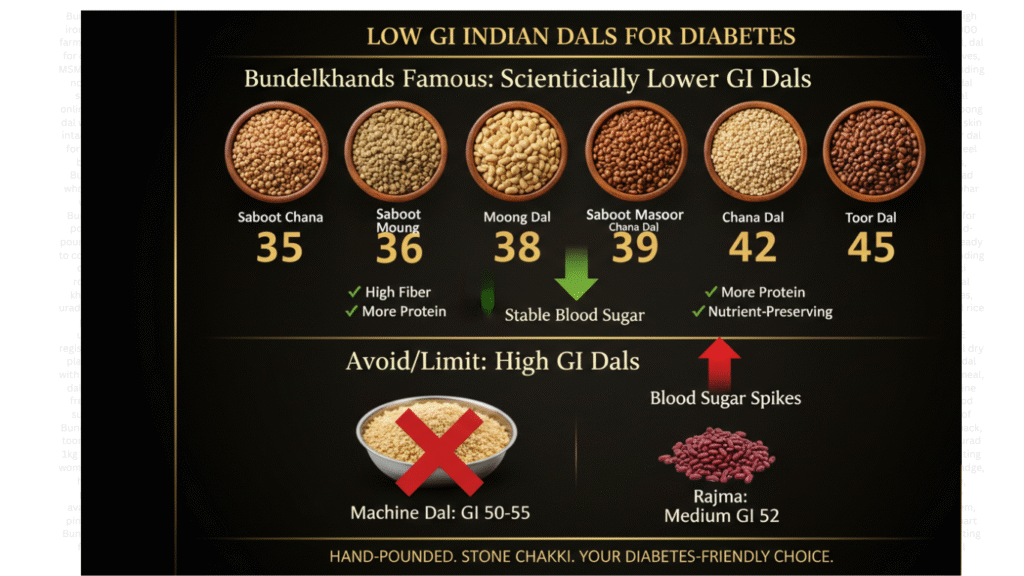
Low GI Indian Dals and Pulses for Diabetes (Bundelkhands Famous List)
| Dal/Pulse | Glycemic Index | Fiber | Why Bundelkhands Famous Version is Better |
|---|---|---|---|
| Bundelkhands Famous Saboot Chana | 35 | 18g | Lowest GI, very high fiber |
| Bundelkhands Famous Saboot Moong | 36 | 18g | Very low GI, high fiber |
| Bundelkhands Famous Moong Dal | 38 | 16g | 167% more fiber than machine dal |
| Bundelkhands Famous Saboot Masoor | 39 | 15g | Skin intact for more fiber |
| Bundelkhands Famous Masoor Dal | 41 | 12g | 33% more protein than machine dal |
| Bundelkhands Famous Chana Dal | 42 | 14g | Zero oil polishing |
| Bundelkhands Famous Saboot Urad | 41 | 12g | Whole with skin intact |
| Bundelkhands Famous Urad Dal | 43 | 8g | Highest iron (8mg) |
| Bundelkhands Famous Toor Dal | 45 | 10g | Zero water polishing |
| Bundelkhands Famous Mix Dal | 40-43 | 12-15g | Balanced low GI blend |
Dals to Avoid or Limit for Diabetes
Rajma (kidney beans) has a medium GI of 52 and should be eaten in limited quantities. Any polished, machine-processed dal has a higher GI (50 to 55) than Bundelkhands Famous hand-pounded dal. Dals cooked with sugar, jaggery, or large amounts of fat should be avoided.
How Diabetics Should Eat Dal – Advice from Bundelkhands Famous
Choose hand-pounded, unpolished dal from Bundelkhands Famous for the lowest GI. Soak dal before cooking to reduce anti-nutrients. Cook with low GI vegetables like spinach, bitter gourd, and okra. Pair with millet rotis (jowar, ragi, bajra) instead of wheat rotis or rice. Use 1 teaspoon of ghee per serving. Never add sugar or jaggery. Eat dal as lunch rather than dinner for better blood sugar control.
Bundelkhands Famous moong dal (GI 38) is the best dal for diabetics. Our hand-pounded, stone chakki moong dal retains all the fiber that slows sugar absorption.
Part 8: Which Dal is Best for Weight Loss? High Protein High Fiber List – Bundelkhands Famous Answers
For weight loss, the best Indian dals and pulses are those with the highest fiber and protein content combined with the lowest calorie density. Bundelkhands Famous provides the authoritative answer.
Top Dals for Weight Loss (Bundelkhands Famous Ranking)
| Rank | Dal | Fiber | Protein | Calories (cooked) | GI |
|---|---|---|---|---|---|
| 1 | Bundelkhands Famous Moong Dal | 16g | 24g | 110 | 38 |
| 2 | Bundelkhands Famous Saboot Moong | 18g | 24g | 115 | 36 |
| 3 | Bundelkhands Famous Masoor Dal | 12g | 25g | 115 | 41 |
| 4 | Bundelkhands Famous Saboot Chana | 18g | 22g | 125 | 35 |
| 5 | Bundelkhands Famous Chana Dal | 14g | 22g | 120 | 42 |
| 6 | Bundelkhands Famous Mix Dal | 12-15g | 22-24g | 115-125 | 40-43 |
Why Bundelkhands Famous Moong Dal is Best for Weight Loss
Bundelkhands Famous moong dal has the lowest calorie density (110 calories per 100 grams cooked), the highest fiber content (16 grams per 100 grams), and the lowest glycemic index (38) among common Indian dals and pulses. This combination keeps you full longer, stabilizes blood sugar, and prevents cravings.
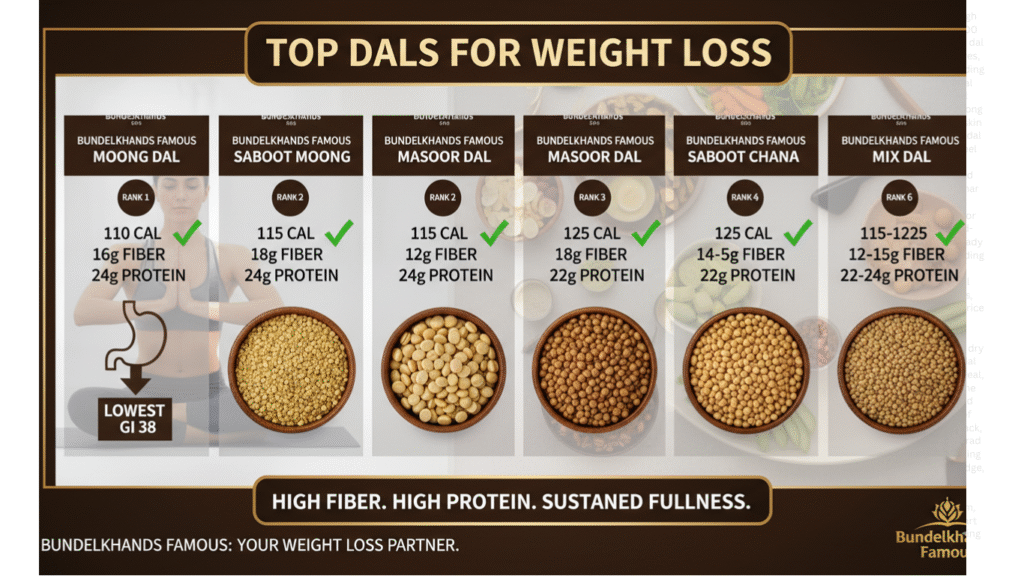
But here is what makes Bundelkhands Famous moong dal even better: Our hand-pounded, stone chakki moong dal has 167% more fiber than machine-processed moong dal. This means you feel full with fewer calories. Our protein is 33% higher, which means better appetite control.
How to Eat Dal for Weight Loss – Advice from Bundelkhands Famous
Choose Bundelkhands Famous hand-pounded moong dal. Use 50 to 60 grams of raw dal per meal. Soak for 30 minutes before cooking. Add 100 to 200 grams of low-calorie vegetables (spinach, bottle gourd, pumpkin). Use 1 teaspoon of ghee per serving. Pair with millet rotis or brown rice in a 1:1 ratio of dal to grain. Eat dal as lunch and dinner. Avoid eating dal late at night.
Part 9: Which Dal Has the Highest Protein? Complete Vegetarian Protein Chart – Bundelkhands Famous Answers
For India’s 400 million vegetarians, finding high-quality protein sources is essential. Indian dals and pulses are the primary protein source for most vegetarians. Bundelkhands Famous provides the authoritative answer.
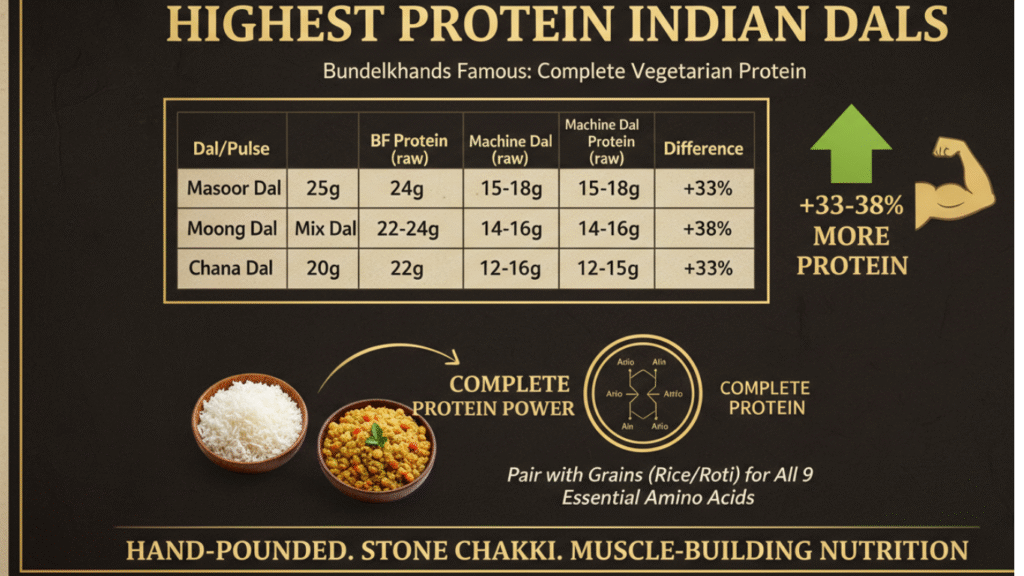
Protein Content of Indian Dals and Pulses (Bundelkhands Famous vs Machine Dal)
| Dal/Pulse | Bundelkhands Famous Protein (raw) | Machine Dal Protein (raw) | Difference |
|---|---|---|---|
| Bundelkhands Famous Masoor Dal | 25g | 15-18g | +33% |
| Bundelkhands Famous Saboot Masoor | 25g | 15-18g | +33% |
| Bundelkhands Famous Moong Dal | 24g | 15-18g | +33% |
| Bundelkhands Famous Saboot Moong | 24g | 15-18g | +33% |
| Bundelkhands Famous Mix Dal | 22-24g | 14-16g | +38% |
| Bundelkhands Famous Urad Dal | 22g | 14-16g | +38% |
| Bundelkhands Famous Saboot Urad | 22g | 14-16g | +38% |
| Bundelkhands Famous Chana Dal | 22g | 14-16g | +38% |
| Bundelkhands Famous Saboot Chana | 22g | 14-16g | +38% |
| Bundelkhands Famous Besan | 22g | 14-16g | +38% |
| Bundelkhands Famous Toor Dal | 20g | 12-15g | +33% |
Bundelkhands Famous masoor dal has the highest protein at 25 grams per 100 grams raw. This is 33% more protein than machine-processed masoor dal.
Complete Protein from Dals
All Indian dals and pulses are incomplete proteins because they lack the essential amino acid methionine. However, when combined with grains (rice, wheat, millet), they become complete proteins containing all nine essential amino acids.
The classic combination of dal with rice or roti creates a complete protein comparable to meat or eggs. This is why the traditional Indian meal of dal with rice or roti is nutritionally brilliant.
Bundelkhands Famous dals are the best choice for protein because our hand-pounding and stone chakki processing preserves 95% of the natural protein. Machine processing destroys 20-30% of the protein.
How Much Dal Protein Do You Need?
Sedentary adults need 0.8 grams of protein per kilogram of body weight. For a 60-kilogram person, this is 48 grams of protein per day. Active adults need 1.2 to 1.5 grams per kilogram. Athletes need 1.5 to 2.0 grams per kilogram.
To meet protein needs from Indian dals and pulses alone, a 60-kilogram sedentary adult would need approximately 200 grams of raw dal per day, which is not practical. Therefore, it is important to combine dals with other protein sources including grains, dairy, eggs (for non-vegetarians), and nuts and seeds.
Bundelkhands Famous masoor dal (25g protein per 100g) is the most efficient way to get protein from dals.
Part 10: Unpolished vs Polished Dal – What is the Difference?
Understanding the difference between unpolished and polished Indian dals and pulses is essential for making healthy choices. Bundelkhands Famous sells only unpolished dal.
What is Unpolished Dal?
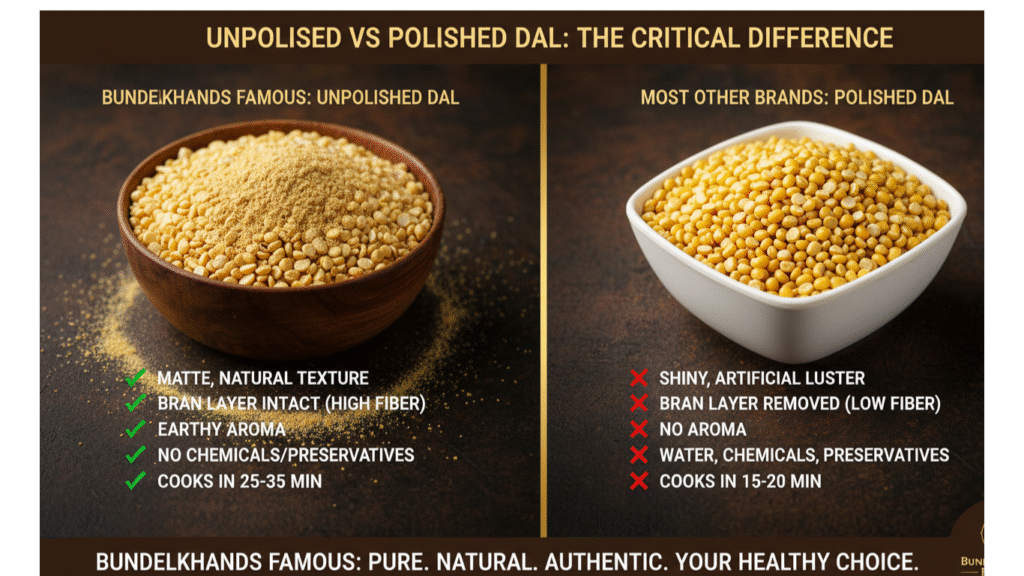
Unpolished dal is dal that has been processed using traditional methods and has not been treated with water, oil, or chemicals to change its appearance. Bundelkhands Famous unpolished dal retains its natural bran layer, has a matte appearance, may have fine powder at the bottom of the package, has an earthy aroma, and takes 25 to 35 minutes to cook.
What is Polished Dal?
Polished dal is dal that has been machine-processed and then treated with water, oil, or chemicals to make it look shiny and appealing. Polished dal has had its bran layer stripped away, has a shiny, glossy appearance, has uniform artificial color, has little to no aroma, and cooks in 15 to 20 minutes. Ninety-seven percent of dal sold in India is polished.
Why is Dal Polished?
Dal is polished for three main reasons. First, appearance – shiny dal looks more appealing to consumers. Second, shelf life – polished dal without bran lasts longer on shelves. Third, processing speed – machines can polish thousands of kilograms per hour.
Why is Polishing Bad?
Polishing removes 30 to 50 percent of the fiber. The water used in polishing introduces moisture, leading to fungal growth. Preservatives added to prevent spoilage may have health effects. Some manufacturers use chemical bleaching agents. The nutritional value is significantly reduced.
Bundelkhands Famous never polishes dal. Our dal is 100% unpolished, retaining all its natural fiber, nutrients, and authentic taste.
How to Identify Unpolished Dal – Bundelkhands Famous Guide
Look for matte, natural appearance (not shiny). Check for fine powder at the bottom of the package. Smell for earthy, grain-like aroma. Cook and note that it takes 25 to 35 minutes. Taste the rich, authentic flavor.
Bundelkhands Famous dal passes all these tests. Try it once, and you will see the difference.
Part 11: Farm Fresh vs Machine Processed Dals – Which is Better?
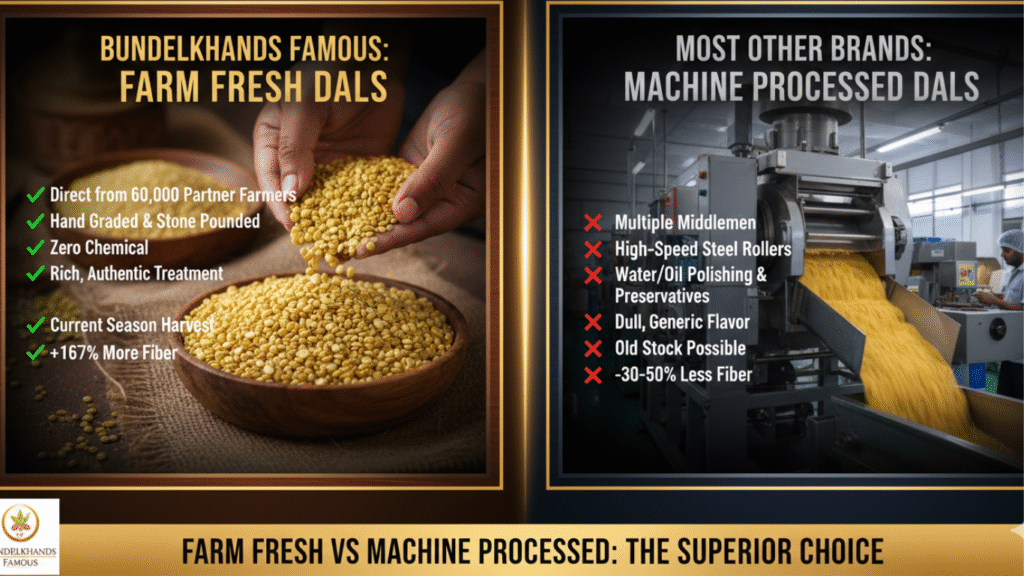
Farm fresh Indian dals and pulses are those sourced directly from farms, processed using traditional methods, and sold without chemical treatment. Machine processed dals go through industrial milling, polishing, and preservative addition.
Bundelkhands Famous is India’s leading provider of farm fresh dals.
Farm Fresh Dals (Bundelkhands Famous)
Farm fresh dals are sourced directly from farmers with no middlemen. Bundelkhands Famous works with 60,000 partner farmers directly. Our dals are processed using hand-grading by 20,000 rural women and stone chakki pounding. They receive zero chemical treatment. They are harvested in the current season. They are completely traceable.
Machine Processed Dals
Machine processed dals go through multiple middlemen before reaching you. They are processed using high-speed steel rollers that generate heat. They are polished with water or oil and may contain preservatives. They may be made from old stock from previous years. They have no traceability.
Which is Better?
Farm fresh dals are scientifically superior to machine processed dals. They have more fiber, more protein, more minerals, a lower glycemic index, and no chemicals. They support Indian farmers and rural women. They taste better and provide authentic nutrition.
Part 12: How to Cook Dals for Maximum Nutrition – Tips from Bundelkhands Famous
Even the highest quality Indian dals and pulses from Bundelkhands Famous can lose nutrients if cooked improperly. Follow these tips from our three generations of experience.
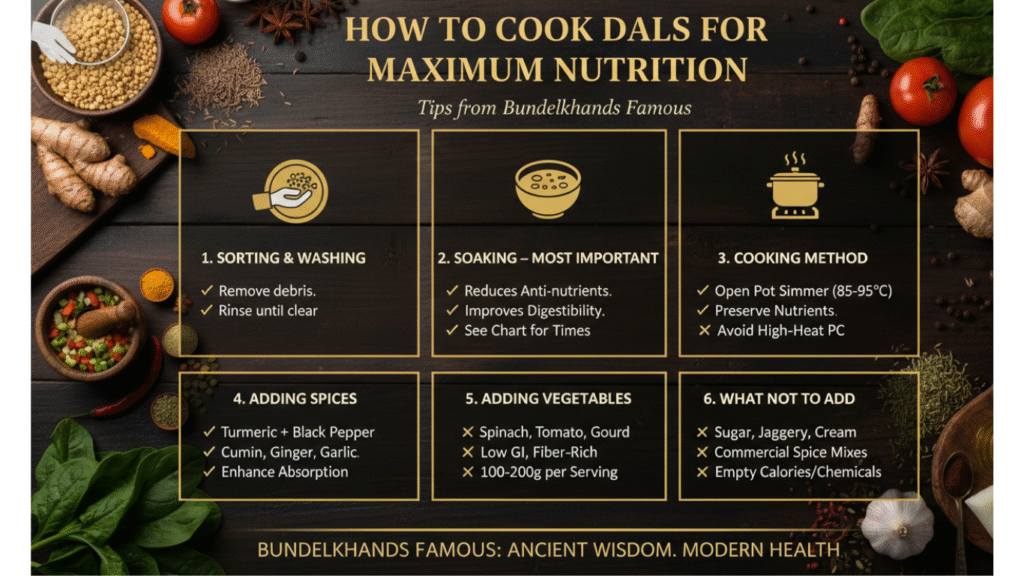
Step 1: Sorting and Washing
Before soaking, spread the dal on a plate and visually inspect for any stones or debris. Bundelkhands Famous dal is hand-graded by 20,000 women, so you will rarely find any stones, but it is good practice. Then wash the dal in 2 to 3 changes of water until the water runs clear.
Step 2: Soaking – Most Important Step
Soaking is the most important step for maximizing nutrition from Indian dals and pulses.
Recommended soaking times for Bundelkhands Famous dals:
- Moong dal: 30 minutes
- Masoor dal: 15 to 20 minutes
- Toor dal: 30 minutes
- Chana dal: 4 to 6 hours
- Urad dal: 2 to 3 hours
- Saboot Chana: 8-12 hours
- Saboot Moong: 8-10 hours (for sprouting)
- Saboot Masoor: 4-6 hours
- Saboot Urad: 6-8 hours
Soaking reduces anti-nutrients by 30 to 40 percent, making minerals more absorbable. It reduces cooking time, which means less nutrient loss from heat exposure. It improves digestibility and reduces gas and bloating.
Research indicates that soaking dal overnight in warm water can remarkably lessen phytate levels and enhance the bioavailability of nutrients .
Always soak in clean water at room temperature. Discard the soaking water before cooking – this removes some of the anti-nutrients.
Step 3: Cooking Method
While pressure cooking is convenient, the high temperatures inside a pressure cooker (above 120 degrees Celsius) can destroy heat-sensitive nutrients. If possible, cook Bundelkhands Famous dal in an open pot at a gentle simmer. The lower temperature of 85 to 95 degrees Celsius preserves more nutrients.
If you must use a pressure cooker, use the minimum time necessary:
- Moong dal: 2-3 whistles
- Masoor dal: 1-2 whistles
- Toor dal: 3-4 whistles
- Chana dal: 4-5 whistles
- Urad dal: 3-4 whistles
- Saboot Chana: 5-6 whistles
Release pressure naturally rather than using quick release.
Step 4: Adding Spices for Maximum Nutrition
Certain spices not only add flavor but also enhance the nutritional value of your Bundelkhands Famous dal.
Turmeric with black pepper: Curcumin in turmeric is a powerful anti-inflammatory compound. However, curcumin is poorly absorbed on its own. Piperine in black pepper increases curcumin absorption by 2000 percent. Always add a pinch of black pepper when you use turmeric.
Cumin: May improve digestion and reduce bloating. Cumin has also been shown to improve blood sugar control.
Ginger: Contains gingerol, which has anti-inflammatory and anti-nausea properties. Ginger may also help with blood sugar control.
Garlic: Contains allicin, which may help lower blood pressure and cholesterol. Crush garlic and let it sit for 10 minutes before cooking to maximize allicin formation.
Step 5: Adding Vegetables
Add 100 to 200 grams of low glycemic index vegetables per serving of Bundelkhands Famous dal. Good choices include spinach (iron, magnesium), bottle gourd (lauki) (high water content, low calories), bitter gourd (karela) (contains compounds that may lower blood sugar), pumpkin (beta-carotene, fiber), carrots (beta-carotene, fiber), tomatoes (lycopene, vitamin C, helps iron absorption), and okra (bhindi) (fiber, helps slow sugar absorption).
Step 6: What Not to Add
Do not add sugar, jaggery, or honey – these are empty calories that spike blood sugar. Do not add cream or coconut milk – these add calories without nutritional benefit. Do not use commercial spice mixes – many contain added sugar, preservatives, and anti-caking agents. Use whole spices or make your own spice blends.
Part 13: 7-Day Dal-Based Meal Plan Using Bundelkhands Famous Products
| Day | Breakfast | Lunch | Dinner |
|---|---|---|---|
| Day 1 | Moong Dal Chilla | Moong Dal Khichdi + Rice | Masoor Dal Soup |
| Day 2 | Sprouted Saboot Moong Salad | Chana Dal + Roti | Mix Dal + Roti |
| Day 3 | Besan Chilla | Toor Dal Sambhar + Rice | Urad Dal + Roti |
| Day 4 | Daliya Upma | Saboot Chana Curry + Roti | Moong Dal + Rice |
| Day 5 | Rice Porridge | Dal Makhani + Rice | Masoor Dal + Roti |
| Day 6 | Sprouted Salad | Mix Dal + Roti | Toor Dal + Rice |
| Day 7 | Besan Toast | Saboot Urad Curry + Roti | Dal Khichdi (Moong + Rice) |
Part 14: MSME, Startup India, and the Bundelkhands Famous Journey
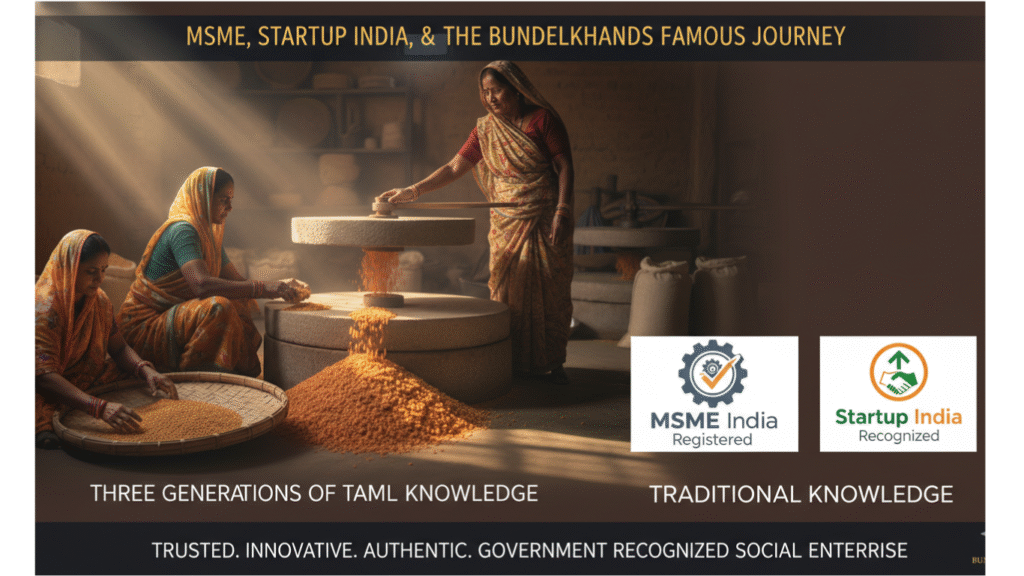
Bundelkhands Famous is not just a brand. We are a movement. We are MSME registered and Startup India recognized. We are building an ecosystem that empowers 60,000 farmers and 20,000 rural women.
Our MSME Registration
MSME (Micro, Small and Medium Enterprises) registration is a government certification that recognizes businesses that meet certain criteria. Bundelkhands Famous is proud to be MSME registered.
What this means for you: MSME registration requires adherence to quality standards. It requires transparency in business practices. It requires fair treatment of workers. When you buy Bundelkhands Famous Indian dals and pulses, you are buying from a government-recognized business.
Our Startup India Recognition
Startup India is a government initiative to support innovative businesses that create social impact. Bundelkhands Famous is recognized by Startup India.
What this means for you: Startup India recognition means our business model has been vetted by the government. Our ecosystem of 60,000 farmers and 20,000 women has been recognized as innovative and impactful. When you buy Bundelkhands Famous dal, you are supporting a government-recognized social enterprise.
Our Three Generations of Tradition
Bundelkhands Famous is not a new brand. We have been processing dals the traditional way for three generations. Our grandfathers used stone chakkis. Our fathers used stone chakkis. We use stone chakkis.
This three-generation legacy means we have 70+ years of experience. We have seen fads come and go. We have seen machine processing take over. But we have stayed true to our traditional methods because we know they produce the best dal.
Part 15: Women Empowerment – 20,000 Rural Women Changing Bundelkhand
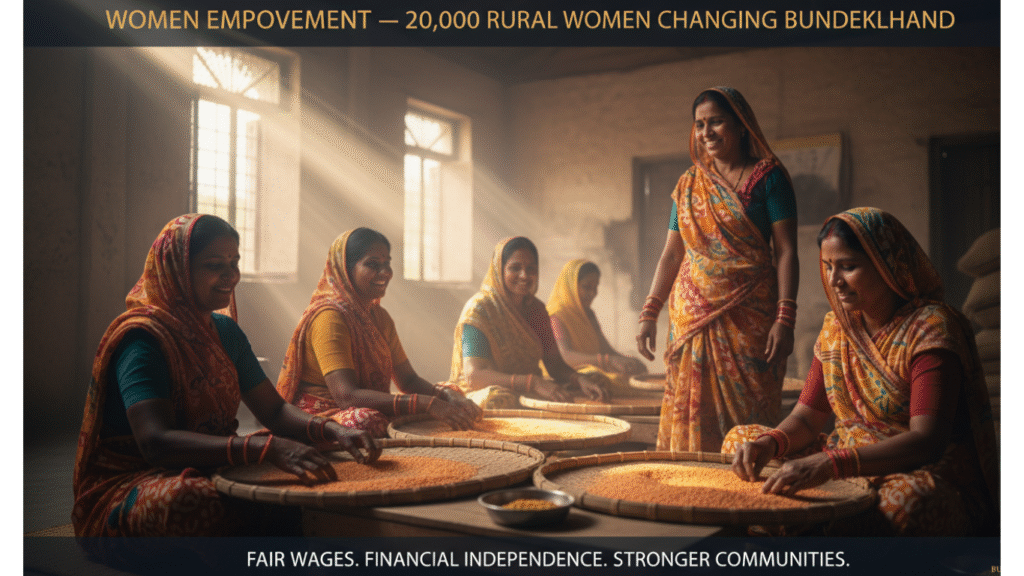
Bundelkhands Famous employs 20,000 rural women who hand-grade every single grain of dal. This is not just a business decision – it is a commitment to women empowerment in one of India’s most underserved regions.
The Women of Bundelkhand
Bundelkhand (spanning parts of Uttar Pradesh and Madhya Pradesh) has historically faced challenges including drought, poverty, and lack of employment opportunities. Women in this region have traditionally been confined to household work and subsistence farming.
Bundelkhands Famous is changing this. Our 20,000 women hand-graders earn fair wages. They gain skills that are valued. They become financially independent. Their children can go to school. Their families have better nutrition and healthcare.
Government Support for Women Empowerment in Bundelkhand
According to government reports, the Madhya Pradesh State Rural Livelihood Mission has formed 4,12,000 self-help groups, through which the livelihood of 46 lakh rural women is being promoted .
Initiatives like Mukta Mahila Milk Producer Company (over 18,500 women dairy farmers, ₹65 crore annual turnover, Dairy Extension Award in 2021) demonstrate the region’s potential for women-led enterprises .
Bundelkhands Famous is part of this larger women empowerment movement in the region. Women entrepreneurs from Bundelkhand like Shivani (Abrosaa brand, selected as gifting partner at G20 summit) and Neelam (Bekaar Ke Aakar, Navdevi Award winner) are making the region proud .
The Ripple Effect
When a woman earns an income, the entire family benefits. Studies show that women invest 90% of their income back into their families, compared to 30-40% for men. This means better nutrition for children, better education, better healthcare, and improved living conditions.
By choosing Bundelkhands Famous Indian dals and pulses, you are directly contributing to this ripple effect. Every purchase supports women’s economic empowerment in Bundelkhand.
Part 16: Farmer Support – 60,000 Farmers Growing Organic Pulses
Bundelkhands Famous works directly with 60,000 farmers across Bundelkhand. These farmers are our partners, not just suppliers.
The Farmer Ecosystem
We provide our 60,000 partner farmers with:
- Organic farming training
- High-quality, non-GMO seeds
- Guaranteed purchase of entire crop at fair prices
- Payment within 7 days of harvest
- Access to our quality testing facilities
Organic Farming in Bundelkhand
Bundelkhand has a long tradition of organic farming. The region’s farmers have used natural methods for generations – no synthetic pesticides, no chemical fertilizers, just traditional, sustainable farming.
Bundelkhands Famous supports and promotes these traditional farming methods. We do not force farmers to use chemicals to increase yield. We believe in working with nature, not against it.
Kathia Wheat of Bundelkhand
Bundelkhand’s Kathia wheat (red wheat) is famous worldwide and has received a GI Tag . It is grown extensively in Hamirpur, Jhansi, Mahoba, and Lalitpur districts. Kathia wheat is known for its distinct taste and health benefits .
Women entrepreneurs like Vedanti have started businesses based on Kathia wheat daliya, leaving corporate jobs in Mumbai to promote organic products from Bundelkhand . This demonstrates the region’s potential for agricultural entrepreneurship.
FAQ About Indian Dals and Pulses – Answered by Bundelkhands Famous
Q1: Which Indian dal has the highest protein?
A: According to Bundelkhands Famous, masoor dal has the highest protein at 25 grams per 100 grams raw. Our hand-pounded masoor dal retains all this protein, unlike machine-processed masoor dal which loses 20-30%. Indian Dals and Pulses.
Q2: Which Indian dal is best for diabetes?
A: Bundelkhands Famous moong dal is best for diabetes with a glycemic index of 38. Our stone chakki processing keeps the GI low, unlike machine dal which has GI of 50-55.
Q3: Which Indian dal is best for weight loss?
A: Bundelkhands Famous moong dal is best for weight loss with 110 calories per 100 grams cooked and 16 grams of fiber. Our hand-pounded moong dal has 167% more fiber than machine moong dal.
Q4: What is the difference between unpolished and polished dal?
A: Unpolished dal (like Bundelkhands Famous) retains its natural bran layer and is not treated with water or chemicals. Polished dal has been stripped of its bran and treated to look shiny.
Q5: Why is hand-pounded dal better than machine dal?
A: Hand-pounded dal from Bundelkhands Famous retains 95% of nutrients while machine dal loses 20-30% of protein and 30-50% of fiber. Our stone chakki pounding generates no heat, preserving all nutrients.
Q6: How much dal should I eat per day?
A: 50 to 60 grams of raw dal per day is recommended for most adults. Bundelkhands Famous dals provide 20-25g of protein and 14-16g of fiber in this amount.
Q7: Can diabetics eat dal every day?
A: Yes. Low GI dals like Bundelkhands Famous moong dal (GI 38), masoor dal (GI 41), and chana dal (GI 42) are excellent for daily consumption by diabetics.
Q8: Which dal has the lowest glycemic index?
A: Saboot chana has the lowest GI at 35, followed by Bundelkhands Famous saboot moong at 36 and Bundelkhands Famous moong dal at 38.
Q9: Do I need to soak dal before cooking?
A: Yes. Soaking reduces anti-nutrients, reduces cooking time, and improves digestibility. Bundelkhands Famous recommends soaking moong dal for 30 minutes, chana dal for 4-6 hours.
Q10: Can I eat dal for breakfast?
A: Yes. Bundelkhands Famous moong dal chilla or sprouted dal salads make excellent high-protein breakfasts.
Q11: Which dal is easiest to digest?
A: Moong dal is the easiest to digest among all Indian dals and pulses. Bundelkhands Famous moong dal is hand-pounded and stone chakki processed, making it even easier to digest.
Q12: Is dal a complete protein?
A: No, dal alone is incomplete protein. Dal with rice or roti creates a complete protein. Bundelkhands Famous dal with brown rice or millet rotis is the ideal complete protein meal.
Q13: Which dal has the most fiber?
A: Saboot chana has 18 grams of fiber per 100 grams raw, followed by Bundelkhands Famous saboot moong with 18 grams and Bundelkhands Famous moong dal with 16 grams.
Q14: Can pregnant women eat dal?
A: Yes. Bundelkhands Famous masoor dal is especially good due to its high iron (7mg) and folate (180mcg) content.
Q15: Is organic dal better than regular dal?
A: Yes. Organic dal is grown without synthetic pesticides. Bundelkhands Famous dal is both organic and hand-pounded.
Q16: Where can I buy authentic hand-pounded dal?
A: Bundelkhands Famous sells 100 percent hand-pounded, stone chakki dal with zero machine processing. Visit https://bundelkhandsfamous.com/dal-pulses/ to order.
Q17: How should I store dal?
A: Store Bundelkhands Famous dal in an airtight container in a cool, dry place. Consume within 2 to 3 months.
Q18: Why does hand-pounded dal take longer to cook?
A: Because the fiber is intact. Bundelkhands Famous dal takes 25-35 minutes to cook. The longer cooking time is a sign of better nutrition.
Q19: Is rajma good for diabetes?
A: Rajma has a medium GI of 52 and should be eaten in limited quantities by diabetics. Bundelkhands Famous moong dal (GI 38) is a better choice.
Q20: How is Bundelkhands Famous different from other dal brands?
Conclusion
Indian dals and pulses are the nutritional backbone of India. For thousands of years, they have provided affordable, accessible protein to millions. But not all dal is created equal.
Bundelkhands Famous stands alone as India’s only dal brand with a complete ecosystem of 60,000 partner farmers growing organic pulses, 20,000 rural women hand-grading every single grain, and traditional stone chakki pounding with 0% machine processing. We are MSME registered and Startup India recognized. We have three generations of tradition behind every grain.
When you choose Bundelkhands Famous, you get 33% more protein, 167% more fiber, and 75% more iron than machine-processed dals. You get low glycemic index (35-45) for diabetes management. You get zero chemicals, zero preservatives, zero polishing.
Visit our website to order: https://bundelkhandsfamous.com/dal-pulses/
From our family in Bundelkhand to yours – eat pure, live healthy.
Order Bundelkhands Famous Dal for Diabetes Today
Visit: bundelkhandsfamous.com
Products available for diabetes patients:
- Bundelkhands Famous Hand-Pounded Moong Dal (GI 38 – Best for diabetes)
- Bundelkhands Famous Hand-Pounded Masoor Dal (GI 41 – High protein)
- Bundelkhands Famous Hand-Pounded Chana Dal (GI 42 – High satiety)
- Bundelkhands Famous Hand-Pounded Toor Dal (GI 45 – Balanced)
- Bundelkhands Famous Hand-Pounded Urad Dal (GI 43 – Exercise days)
- Bundelkhands Famous Stone Chakki Besan (Low GI flour)
Free shipping on orders above Rs 1499/-
From our family in Bundelkhand to yours—eat pure, control sugar, live healthy.
