
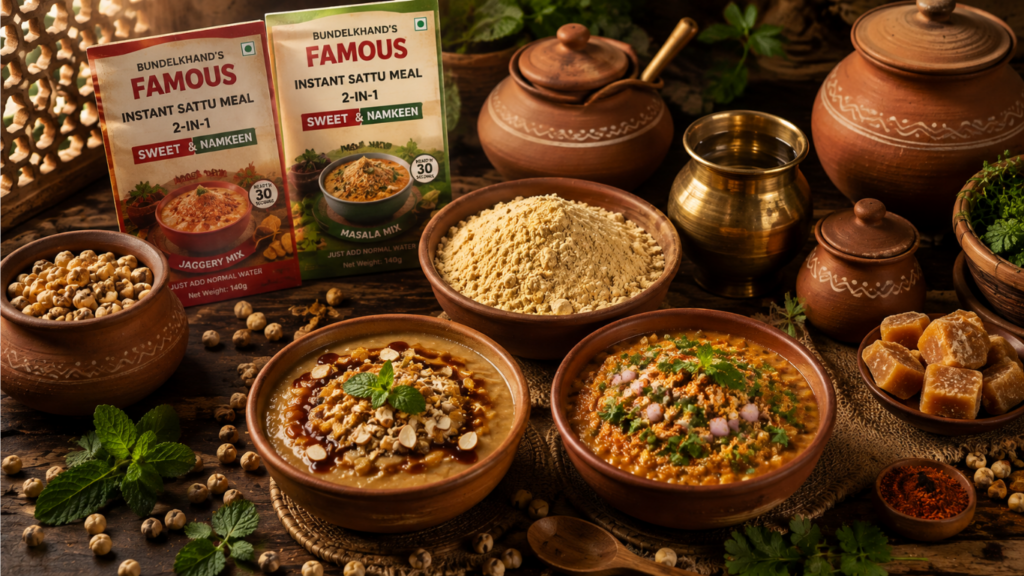
Modern lifestyles have transformed the way people approach food. Between school schedules, college deadlines, office hours, travel plans, and busy family routines, finding time to cook a meal from scratch has become increasingly challenging. This is precisely where instant food and instant meals have emerged as practical solutions for millions of Indians.
But instant food does not have to mean only noodles or packaged snacks. India has a rich, centuries-old tradition of quick-to-prepare foods made from familiar, wholesome ingredients. Foods such as sattu, poha, and upma have been part of Indian food culture for generations—and today, they are being reimagined in convenient modern formats that respect both tradition and time.
One such example is Bundelkhand’s Famous Instant Sattu Meal, a 2-in-1 Sweet & Namkeen meal based on roasted chana sattu. It combines a traditional Indian food base with a modern preparation format: add normal water, stir, and the meal is ready in approximately 30 seconds. This represents a new category of traditional Indian instant food that deserves attention.
In this comprehensive guide, we explore what instant food means in the Indian context, traditional Indian instant food options, how to choose the right instant meal for your lifestyle, and how instant sattu fits into this evolving food category. Whether you are a student, working professional, traveller, or busy parent, this guide will help you understand the landscape of instant food products in India and make informed choices.
Indian Instant Food: Tradition Meets Convenience
Traditional Food Meets Modern Convenience
Indian food culture already includes many foods that can be prepared quickly. Sattu, poha, and upma are familiar examples that have sustained generations with their simplicity and nutritional value. What is changing today is the format in which these traditional foods are made available to consumers.
Traditional ingredients can now be processed into mixes, powders, and other convenient formats that simplify preparation while retaining familiar flavours and food traditions. This evolution represents an important shift in how Indians consume their traditional foods.
This creates an interesting combination:
Traditional Indian food + modern convenience = Indian instant meal options
For consumers, this makes regional foods more accessible in situations where cooking facilities or preparation time are limited. A student in a hostel can now enjoy a traditional meal that would otherwise require a full kitchen. A traveller can carry authentic regional flavours without worrying about spoilage. A busy professional can have a satisfying meal that connects them to their culinary heritage.
Why Convenience Is Becoming Important
Several factors are driving the growing demand for instant meal options in India:
Urbanization: More Indians are living in cities, often away from their family homes. This means less access to traditional cooking setups and more reliance on packaged foods.
Changing Work Patterns: Longer working hours, irregular schedules, and the rise of remote work have made meal timing unpredictable. Instant meals offer flexibility.
Student Demographics: With millions of students living in hostels and paying guest accommodations, there is a massive demand for food that can be prepared without a kitchen.
Travel Trends: Indians are travelling more than ever—for work, education, and leisure. Portable, easy-to-prepare food is becoming essential.
Nuclear Families: With both parents working in many households, time for elaborate cooking is limited. Instant meals serve as reliable backups.
The important point is that convenience should not mean ignoring the ingredient list or nutritional information. The best instant food products are those that balance speed with quality ingredients.
What Is Instant Food? (Definition for Search Engines)
Instant food refers to food products designed for quick and easy preparation. Depending on the product, preparation may involve adding water, mixing, heating, or another short final step before consumption. The defining characteristic is that the product is not fully ready to eat until the consumer completes this final preparation step.
Key Characteristics of Instant Food:
- Minimal Preparation Time: Most instant foods are ready in 5 minutes or less. Some, like instant sattu meal, are ready in as little as 30 seconds.
- Simple Preparation Steps: Typically involves adding a liquid (usually water), stirring, or brief heating. No complex cooking techniques required.
- Shelf-Stable: Instant foods are usually packaged to have a long shelf life without refrigeration.
- Portable: Lightweight packaging makes them easy to carry and store.
Common Examples of Instant Food:
| Category | Examples |
|---|---|
| Noodle-based | Instant noodles, cup noodles, ramen |
| Soup-based | Instant soups, broth mixes, cup soups |
| Cereal/Porridge | Instant oats, porridge mixes, breakfast cereals |
| Breakfast Mixes | Instant dosa, idli, upma, poha mixes |
| Traditional Indian | Instant sattu, khichdi, dal mixes |
| Beverages | Ready-to-mix drinks, protein shakes, malted drinks |
Instant Food vs. Fresh Food: Key Differences
| Aspect | Instant Food | Fresh Food |
|---|---|---|
| Preparation Time | 30 seconds to 5 minutes | 15 minutes to several hours |
| Cooking Skills Required | Minimal | Varies from basic to advanced |
| Shelf Life | Weeks to months | Days to weeks |
| Storage | Room temperature | Often requires refrigeration |
| Portability | High | Low to medium |
| Convenience | Very high | Low to medium |
What Is an Instant Meal? (Definition)
An instant meal is a type of instant food designed to provide a complete meal experience rather than serving as a snack or side item. While instant snacks might be eaten to curb hunger, an instant meal typically includes a balanced combination of carbohydrates, protein, and flavourings intended to satisfy as a main course.
Characteristics of an Instant Meal:
- Complete Nutrition: Designed to provide energy and satiety, not just a taste experience.
- Meal Portion: Sized to serve as a breakfast, lunch, or dinner portion.
- Balanced Profile: Contains a mix of macronutrients (carbs, protein, fats) suitable for a meal.
- Satiety: Formulated to keep you full until the next meal.
Instant Meal vs. Ordinary Meal: What’s the Difference?
The distinction between an instant meal and an ordinary meal lies primarily in the preparation method:
| Aspect | Ordinary Meal | Instant Meal |
|---|---|---|
| Preparation Steps | Washing → Cutting → Cooking → Seasoning → Serving | Add liquid → Mix/Heat → Serve |
| Time Required | 20-60 minutes or more | 30 seconds to 5 minutes |
| Equipment Needed | Multiple pots, pans, utensils | Bowl, spoon, water |
| Cooking Skill | Moderate to high | Minimal |
| Mess/Cleanup | Significant | Minimal |
Who Uses Instant Meals?
Instant meals are popular among:
- Students: Hostel life often means limited cooking facilities and time. Instant meals provide a warm, satisfying option without a kitchen.
- Working Professionals: Quick meals during office breaks or after long workdays help avoid skipping meals.
- Travellers: Portable, easy-to-prepare meals are essential for road trips, train journeys, and flights.
- Families: Busy parents appreciate having quick meal options as backups.
- Health-Conscious Individuals: Many are discovering that traditional instant foods can be healthier than other convenience options.
Traditional Indian Instant Food Options
India has a remarkable variety of traditional foods that can be adapted into convenient formats. Unlike modern processed foods, these traditional options come with generations of culinary wisdom and regional authenticity.
Sattu: The Original Indian Instant Food
Sattu is perhaps one of the oldest examples of a traditional Indian instant food. It is made by roasting chana (Bengal gram) and grinding it into a fine flour. This process was developed centuries ago as a way to preserve and transport nutritious food.
Regional Significance:
Sattu is deeply rooted in the culinary traditions of several Indian states:
- Bundelkhand: A staple food, often consumed as a drink or porridge.
- Bihar: Widely consumed as a cooling summer drink.
- Uttar Pradesh: Used in various traditional preparations.
- Punjab: Sometimes consumed as a quick energy food.
Traditional Preparation:
Traditionally, sattu is mixed with water and combined with ingredients such as jaggery (for sweetness), salt, or spices (for savoury versions). This simple preparation makes it naturally suited for instant formats.
Modern Adaptation:
Today, sattu is available in convenient instant-meal formats like Bundelkhand’s Famous Instant Sattu Meal, which requires only adding normal water and stirring for 30 seconds.
Poha: Flattened Rice for Quick Meals
Poha is made from flattened rice and is widely consumed as a breakfast or snack across India. It is particularly popular in Maharashtra, Madhya Pradesh, and Gujarat.
Why Poha Works as Instant Food:
- Softens quickly when rinsed with water
- Requires minimal cooking (2-3 minutes)
- Long shelf life at room temperature
- Lightweight and portable
Traditional Preparation:
Poha is typically rinsed, drained, and then cooked with onions, potatoes, and spices for a savoury breakfast dish.
Modern Formats:
Instant poha mixes are now available that require only adding hot water and waiting a few minutes.
Upma: Semolina-Based Savoury Dish
Upma is a savoury dish made from semolina (rava) or coarse wheat flour. It is a popular breakfast item in South Indian cuisine and is also consumed in other parts of India.
Why Upma Works as Instant Food:
- Semolina cooks quickly
- Versatile flavour profile
- Can be prepared in minutes
- Filling and satisfying
Traditional Preparation:
Upma is prepared by roasting semolina and then cooking it with water, vegetables, and spices.
Modern Formats:
Instant upma mixes simplify the process further, sometimes requiring only hot water and a brief stir.
Other Traditional Instant Food Options
Indian cuisine also includes convenient versions of many other traditional foods:
| Traditional Food | Instant Format | Preparation |
|---|---|---|
| Khichdi | Instant khichdi mix | Add hot water, wait 5 minutes |
| Sambar | Instant sambar mix | Add water, cook briefly |
| Rasam | Instant rasam powder | Add water, boil |
| Dal | Instant dal mixes | Add water, cook briefly |
| Idli/Dosa | Instant batter mixes | Add water, ferment briefly |
Why Traditional Indian Instant Food Matters
The concept of traditional Indian instant food is significant for several reasons:
1. Cultural Preservation:
Adapting traditional foods into instant formats helps preserve culinary heritage. Younger generations who may not have learned traditional cooking methods can still experience authentic flavours.
2. Nutritional Advantage:
Traditional ingredients like sattu, poha, and upma are minimally processed compared to many modern convenience foods. They retain more of their natural nutritional properties.
3. Regional Identity:
These foods carry regional identities that connect consumers to specific parts of India. Bundelkhand’s Famous Instant Sattu Meal, for example, carries the identity of the Bundelkhand region.
4. Food Security:
Instant versions of traditional foods provide reliable nutrition in situations where cooking is not possible—during travel, emergencies, or in areas without kitchen facilities.
How to Choose the Right Instant Food
Not every instant food product is created equal. Before making a purchase, it is important to evaluate products based on several factors that affect taste, nutrition, and overall value.
Complete Checklist for Choosing Instant Food
| Factor | What to Check | Why It Matters |
|---|---|---|
| Ingredients List | Read the complete ingredient list. Shorter lists with recognisable ingredients are generally preferable. | Indicates level of processing and additives. |
| Nutrition Information | Check protein, fibre, sugar, salt, and calorie content. | Helps align with dietary needs and health goals. |
| Preparation Method | Check whether hot water, normal water, or cooking is required. | Determines whether you can prepare the product in your specific situation. |
| Preparation Time | Look at the actual preparation instructions, not just claims. | Some “instant” products take 5 minutes or more. |
| Sugar Content | Check added sugar, especially in sweet products. | High sugar intake is linked to various health concerns. |
| Salt/Sodium Content | Compare sodium levels across products. | High sodium intake can be a concern for some individuals. |
| Additives & Preservatives | Check the label for artificial additives. | Some consumers prefer products with fewer additives. |
| Packaging | Consider portability and ease of use. | Important for travel and on-the-go consumption. |
| Shelf Life | Check the packed-on and use-by information. | Ensures you can use the product before it expires. |
| Serving Size | Understand how much food one pack provides. | Helps with portion control and meal planning. |
Red Flags to Watch For
When choosing instant food, quickly check:
- Long ingredient list: Prefer clear, recognisable ingredients.
- High sugar: Check total and added sugar, especially in sweet products.
- High sodium: Check the sodium level in namkeen/masala products.
- Artificial colours & flavours: Check the ingredient list before buying.
- Hydrogenated oils: Look for hydrogenated/partially hydrogenated oils and trans fat.
- Unrealistic claims: Be cautious of promises like “miracle weight loss” or “cures diseases.”
Simple rule: Read the ingredients, nutrition label and claims before you buy.
Green Flags to Look For
When choosing instant food, look for:
- Simple ingredients: Short, clear and recognisable ingredient list.
- Traditional ingredients: Familiar ingredients with a long history of use.
- Transparent labelling: Clear ingredients and nutritional information.
- Moderate sugar: Check sugar levels and sweetening ingredients such as jaggery.
- Reasonable sodium: Check the nutrition label, especially for namkeen products.
- Honest packaging: Clear information and product images that represent what is actually inside.
Simple rule: Choose products that are transparent, simple and clearly labelled.
Instant Food vs Ready-to-Eat Food: Key Differences
These two categories are often confused, but they are fundamentally different. Understanding the distinction helps you make better choices based on your needs.
Detailed Comparison Table
| Feature | Instant Food | Ready-to-Eat Food |
|---|---|---|
| Definition | Requires a final preparation step by the consumer | Fully cooked and ready to consume directly |
| Preparation | Add water, mix, heat, or another short step | No preparation required; open and eat |
| Water Required | Often requires water addition | Usually not required |
| Heating | May or may not require heating | Can be eaten cold or heated for preference |
| Packaging | Often in powder, mix, or semi-dry form | Usually in fully prepared form (canned, sealed) |
| Shelf Life | Generally long, especially in dry formats | Varies; some require refrigeration |
| Weight | Often lighter (without water content) | Heavier (includes water/cooking liquid) |
| Portability | Excellent for travel | Limited by weight and storage needs |
| Examples | Instant sattu meal, instant noodles, instant upma | Canned soups, packaged salads, ready meals |
When to Choose Instant Food vs Ready-to-Eat Food
Choose Instant Food When:
- You want to control the amount of water/liquid added
- You are travelling and need lightweight options
- You want to reduce packaging weight
- You prefer freshly prepared food to pre-cooked
- You have access to water but not cooking facilities
Choose Ready-to-Eat Food When:
- You have no access to water or facilities
- You need immediate consumption
- You prefer the convenience of zero preparation
- You have access to storage/refrigeration
- You want a wider variety of prepared options
Instant Food vs Instant Noodles: A Fair Comparison
Instant noodles are perhaps the most familiar category of instant food globally, including in India. However, they represent just one segment of the instant food market. Let’s compare them fairly.
Market Context
In India, instant noodles (particularly Maggi) have dominated the instant food category for decades. However, the market is now diversifying with traditional Indian instant food options gaining traction.
Comparison Table: Instant Noodles vs Traditional Indian Instant Food
| Aspect | Instant Noodles | Traditional Indian Instant Food (e.g., Sattu) |
|---|---|---|
| Base Ingredient | Wheat flour, often refined | Roasted chana, rice, semolina |
| Cooking Method | Boil in water for 3-5 minutes | Mix with water (hot or normal) |
| Preparation Time | 3-5 minutes | 30 seconds to 3 minutes |
| Water Temperature | Hot water required | Can use normal or hot water |
| Protein Content | Generally low (2-4g per serving) | Often higher (sattu has significant protein) |
| Fibre Content | Generally low | Often higher |
| Additives | Varied; some products have preservatives | Traditional versions often have fewer additives |
| Flavour Profile | Primarily savoury, limited range | Sweet, savoury, spiced options available |
| Regional Connection | Global/western | Indian regional |
Important Notes
This comparison is not about declaring one category as “better” than the other. Both serve different purposes and preferences. The point is to highlight that:
- Instant noodles are not the only instant food option available in India.
- Traditional Indian instant food offers an alternative flavour profile and ingredient base.
- Consumer choice is expanding beyond the traditional noodle-dominated market.
- Both categories can be part of a varied diet, depending on individual preferences and needs.
Instant Food for Different Lifestyles
Different people have different needs when it comes to instant food. Let’s explore how instant food serves various lifestyle segments in India.
Instant Food for School Students
School students often face time pressure between classes, extracurricular activities, and homework. A quick snack or light meal that can be prepared easily is often needed.
Why Instant Food Works for School Students:
- Quick to prepare (30 seconds to 3 minutes)
- Easy to pack in school bags
- No cooking equipment required
- Can be eaten between classes
Considerations for Parents:
- Check ingredient lists carefully
- Monitor sugar content
- Consider portion sizes appropriate for children
- Use instant food as a backup option, not a regular meal replacement
Parents’ Perspective:
Parent & Teacher Perspective
For parents and teachers, convenience should always be balanced with nutrition, ingredients and food quality. An instant meal can be a practical option for busy school or college schedules, but adults should encourage children to read labels, understand what they are eating and maintain variety in their overall diet.
The goal is simple: convenient food that fits responsibly into a balanced lifestyle.
Instant Food for College Students
College and hostel life presents unique challenges for food preparation. Students often live in accommodations with limited kitchen facilities and tight budgets.
Why College Students Need Instant Food:
- No Kitchen Access: Many hostels do not allow cooking or have minimal facilities.
- Budget Constraints: Eating out daily is expensive.
- Time Pressure: Between classes, assignments, and exams, time is limited.
- Late-Night Studying: Quick meals during late study sessions.
- Mess/CFood Fatigue: Even hostels with mess food often need variety.
Ideal Instant Food for College Students:
- Requires only normal water (no stove needed)
- Affordable price point
- Serving size suitable for one person
- Long shelf life (can be stocked up)
- Familiar, comforting flavours
- Contains some protein for satiety
Student Perspective:
“As a student, I want food that is quick, easy to prepare and convenient to carry. An instant meal that needs only normal water can be especially useful during busy college days, hostel life or while travelling.”
For students, the biggest advantage is simple: less preparation, more convenience.
Instant Food for Working Professionals
Working professionals often face a different set of challenges: long commutes, irregular hours, and the pressure to eat quickly during breaks.
Challenges for Working Professionals:
- Limited time for breakfast before work
- Short lunch breaks that don’t allow going out
- Long working hours leading to late meals
- Limited kitchen access at work
- Fatigue after work making cooking unappealing
Ideal Instant Food for Professionals:
- Quick preparation (30 seconds to 2 minutes)
- Can be eaten at the desk
- Mess-free (no spills or stains)
- Actually satisfying (not just a snack)
- Ingredients they recognise
- Can be kept at work as a backup
Professional Perspective:
“For working professionals, time is often limited during busy workdays. An instant meal that is quick to prepare, easy to carry and requires only normal water can be a convenient option for breakfast, a quick meal or a busy workday.”
For professionals, the key advantage is simple: quick preparation without complicated cooking.
Instant Food for Travellers
Travel introduces constraints like limited luggage space, lack of cooking facilities, and unpredictable meal availability.
Why Instant Food is Perfect for Travel:
- Lightweight: No water content means lighter luggage.
- Non-perishable: No refrigeration needed during travel.
- Easy to Prepare: Only need water and a container.
- No Spillage: Dry format means no messy leaks.
- Reliable: Always have food available regardless of destination.
Ideal Instant Food for Travel:
- Lightweight and compact
- Requires only normal water
- Minimal packaging (easier to dispose of)
- Contains some protein for energy during long journeys
- Available in single-serving portions
Types of Travel:
| Travel Type | Instant Food Considerations |
|---|---|
| Train Journeys | Normal water availability; compact packaging |
| Road Trips | Portability; no cooking needed |
| Flights | Carry-on friendly; dry format |
| Trekking/Outdoor | Lightweight; simple preparation |
Traveller Perspective:
“When travelling, I look for food that is easy to carry, quick to prepare and doesn’t require cooking. An instant meal that can be prepared with normal water is a convenient option for train journeys, road trips, college trips and outdoor travel.”
For travellers, the key advantage is simple: carry it easily, add water and enjoy.
Instant Food for Busy Families
Families with working parents and children face a different kind of time pressure. Meal preparation needs to be efficient without sacrificing quality or satisfaction.
Challenges for Busy Families:
- Both parents often work
- Children have their own schedules
- Weekday evenings are particularly rushed
- Need meals that everyone in the family will eat
Ideal Instant Food for Families:
- Can be scaled up for multiple servings
- Familiar, non-controversial flavours (children-friendly)
- Can be customized (e.g., add extras to make it more substantial)
- Reasonable price point for regular use
- Can serve as a backup meal when plans change
Why Lifestyle-Specific Instant Food Matters
Understanding that different lifestyles have different needs helps consumers choose the right product. It also helps brands like Bundelkhand’s Famous develop products that truly serve their target audience.
| Lifestyle Segment | Primary Need | Key Consideration |
|---|---|---|
| School Students | Speed | Parent oversight for nutrition |
| College Students | No cooking equipment | Budget and convenience |
| Working Professionals | Office-friendly format | Mess-free, quick |
| Travellers | Portability | Non-perishable, lightweight |
| Busy Families | Family acceptance | Can customize or scale up |
Instant Food for Travel: A Detailed Guide
Travel is one of the most demanding situations for food consumption. Here’s a comprehensive look at how instant food serves travellers.
The Challenges of Food While Travelling
- Unpredictable Availability: Not every destination has suitable food available.
- Limited Facilities: Many travellers don’t have access to kitchens or even hot water.
- Cost Constraints: Eating out for every meal during travel can be expensive.
- Dietary Concerns: Options may not align with individual dietary needs.
- Food Safety: Concern about food quality at some destinations.
- Carrying Capacity: Food needs to be portable without adding excessive weight.
Why Instant Food is Ideal for Travel
| Requirement | How Instant Food Satisfies It |
|---|---|
| Lightweight | Dry powders and mixes weigh little compared to prepared food |
| Compact | Small packets fit easily in bags |
| Non-Perishable | Can be stored at room temperature for weeks or months |
| Easy Preparation | Mix with water—no cooking required |
| No Spillage | Dry format means no leaks |
| Customizable | Can adjust water amount for desired consistency |
| Reliable Nutrition | Contains carbohydrates, protein, and fats |
Types of Travel and Instant Food Choices
1. Train Travel in India
- Water availability: Usually available in stations and trains
- Space: Limited carry space
- Duration: Often 12-24 hours
- Best instant foods: Single-serving pouches, require only water, minimal packaging
2. Road Trips
- Water availability: Usually available at stops
- Space: Can carry more
- Duration: Varies
- Best instant foods: Larger packs, can be shared
3. Air Travel
- Carry-on restrictions: Strict size limitations
- Liquid restrictions: Dry formats preferred
- Best instant foods: Powder/packs that don’t contain liquids
4. Outdoor/Trekking
- Water availability: May be limited
- Equipment: Minimal carrying capacity
- Best instant foods: High energy density, minimal water requirement
5. Business Travel
- Time constraints: Limited time for meal preparation
- Facilities: Hotel rooms often have water
- Best instant foods: Quick preparation, professional packaging
Practical Considerations for Travel Instant Food
Water Availability: Always confirm that you will have access to clean water for preparation. Some products work with normal water, while others require hot water.
Packaging Size: Travel is about efficiency. Look for packaging that is compact, easy to pack, and not overly bulky.
Mess Factor: Consider whether the product requires utensils or can be eaten from the packaging itself.
Nutrition for Energy: Travel can be physically demanding. Look for instant foods that provide sustained energy (carbohydrates with protein).
Cultural Considerations: For travel within India, local flavours and traditional foods are often appreciated. For international travel, products that reflect regional Indian cuisine can be particularly interesting.
Recommended Instant Food Features for Travel
- □ Dry format (no liquids to spill)
- □ Requires only normal water
- □ Compact packaging (fits in bags easily)
- □ Single-serve portions
- □ Long shelf life
- □ Minimal packaging materials
- □ Can be consumed directly from container if needed
- □ Familiar, comforting flavours
- □ Contains some protein
Beyond Instant Noodles: The Rise of Traditional Indian Instant Food
Instant noodles have long dominated the Indian instant food market, but this is changing. Traditional Indian instant foods are emerging as compelling alternatives.
The State of the Indian Instant Food Market
The Indian convenience food market has traditionally been dominated by instant noodles, with brands like Maggi holding significant market share. However, several factors are driving diversification:
- Health Awareness: Consumers are becoming more conscious of what they eat, leading to interest in less processed options.
- Cultural Pride: There is growing appreciation for traditional Indian foods and regional cuisines.
- Digital Exposure: Social media and food blogs have introduced consumers to traditional foods they might not have tried before.
- Regional Brand Emergence: Small brands from regions like Bundelkhand are gaining visibility.
- Ingredient Appreciation: Ingredients like sattu, which were once considered “old-fashioned,” are now being rediscovered.
What Makes Traditional Indian Instant Food Different
| Aspect | Traditional Indian Instant Food | Conventional Instant Food |
|---|---|---|
| Ingredient Origins | Indian-region ingredients (chana, rice, millets) | Often imported/global ingredients |
| Flavour Profile | Indian spices and herbs | Often global or artificial flavours |
| Cultural Connection | Direct link to regional food traditions | Limited cultural connection |
| Processing Level | Often less processed | May be more processed |
| Preservatives | Often minimal (traditional preservation methods) | May contain more preservatives |
| Nutritional Profile | Based on traditional knowledge | Often formulated for taste/shelf life |
Examples of Traditional Indian Instant Foods
| Traditional Food | Region | Instant Format |
|---|---|---|
| Sattu | Bundelkhand, Bihar, UP | Instant sattu meal mix |
| Poha | Maharashtra, MP, Gujarat | Instant poha mix |
| Upma | South India | Instant upma mix |
| Khichdi | North India | Instant khichdi mix |
| Dosa Batter | South India | Instant dosa mix |
| Sambar | South India | Instant sambar powder |
Why Traditional Indian Instant Food Matters for Consumers
1. Taste of Home: For people living away from home, traditional instant foods offer a taste of regional cuisine that they might not otherwise have access to.
2. Familiarity: Even if you’ve never cooked a traditional dish, you’re likely familiar with its taste and appearance.
3. Ingredient Transparency: Traditional foods use ingredients you can recognise and pronounce.
4. Cultural Connection: Consuming traditional foods helps maintain connections to regional culture.
5. Dietary Fit: Traditional Indian foods often fit well into Indian dietary patterns and preferences.
How to Choose the Right Instant Food for Your Needs
With so many options available, how do you choose? Here’s a practical framework.
Step 1: Identify Your Primary Need
| Need Type | What You’re Looking For |
|---|---|
| Quick Breakfast | 30-second to 2-minute preparation |
| Office Lunch | Clean, portable, minimal smell |
| Travel Food | Lightweight, no-hot-water-needed |
| Hostel Meal | No cooking equipment needed |
| Family Backup | Can be scaled up, familiar flavours |
Step 2: Check the Preparation Requirements
- Water temperature: Hot water? Normal water?
- Additional ingredients: Anything else needed beyond water?
- Equipment: Bowl? Spoon? Stove? Microwave?
- Time: 30 seconds? 3 minutes? 5 minutes?
Step 3: Review the Ingredients
- Are the ingredients recognisable?
- Is sugar/sodium content acceptable to you?
- Any additives or preservatives you want to avoid?
- Is there any protein/fibre content?
Step 4: Evaluate the Packaging
- Is it portable for your use case?
- Is it resealable (if you don’t use the whole pack)?
- Can it be prepared without additional equipment?
Step 5: Consider the Taste Profile
- Sweet? Namkeen? Both?
- Spicy? Mild?
- Familiar flavours or new exploration?
Instant Sattu Meal: A Traditional Indian Instant Food
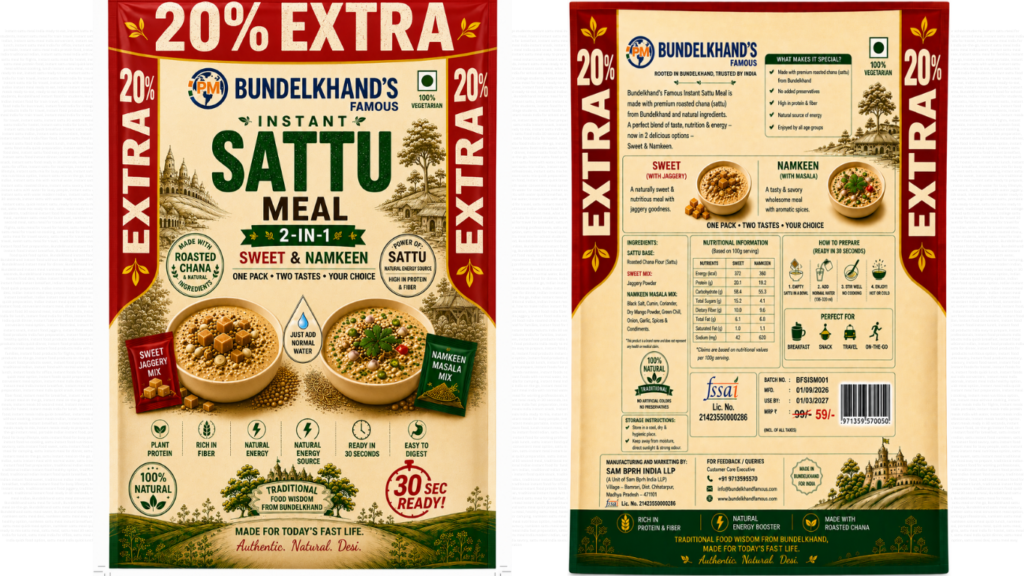
Bundelkhand’s Famous Instant Sattu Meal represents the intersection of traditional Indian food wisdom and modern convenience. It brings roasted chana sattu into a format that fits contemporary lifestyles while preserving its authentic character.
What Is Bundelkhand’s Famous Instant Sattu Meal?
Bundelkhand’s Famous Instant Sattu Meal is a ready-to-mix meal based on roasted chana sattu. It is designed as a 2-in-1 product, available in two distinct taste profiles:
| Variant | Flavour | Key Ingredient | Best For |
|---|---|---|---|
| Sweet | Naturally sweet, nutty | Jaggery Mix | Breakfast, light snack |
| Namkeen | Savoury, spiced, tangy | Masala Mix | Lunch, mid-day meal |
Both options share the same high-quality roasted chana sattu base, ensuring consistent nutritional foundation regardless of your taste preference.
Key Product Specifications
| Specification | Detail |
|---|---|
| Base Ingredient | Roasted Chana Sattu |
| Net Weight | 140g |
| Preparation Time | Approximately 30 seconds |
| Water Required | Normal water (not hot water) |
| Preparation Method | Add water, stir, enjoy |
| Available In | Sweet (Jaggery) and Namkeen (Masala) |
| Designed For | Travel, school, college, office, home |
Why Sattu? The Traditional Food Advantage
Sattu has been consumed in India for generations, particularly in the Bundelkhand region. Its traditional preparation involves roasting chana (Bengal gram) and grinding it into flour. This method:
- Preserves the natural properties of the grain
- Creates a dry, shelf-stable product
- Eliminates the need for added preservatives
- Results in a product rich in protein and fibre
How This Product Fits into Modern Lifestyles
Bundelkhand’s Famous Instant Sattu Meal addresses several contemporary needs:
- Time Pressure: Ready in 30 seconds—faster than making tea.
- No Cooking Facilities: Works with normal water, no stove needed.
- Portability: 140g pack fits in any bag.
- Choice: Sweet and Namkeen variants for different moods and meals.
- Traditional Base: Familiar, comforting, and authentic.
How to Prepare Instant Sattu Meal
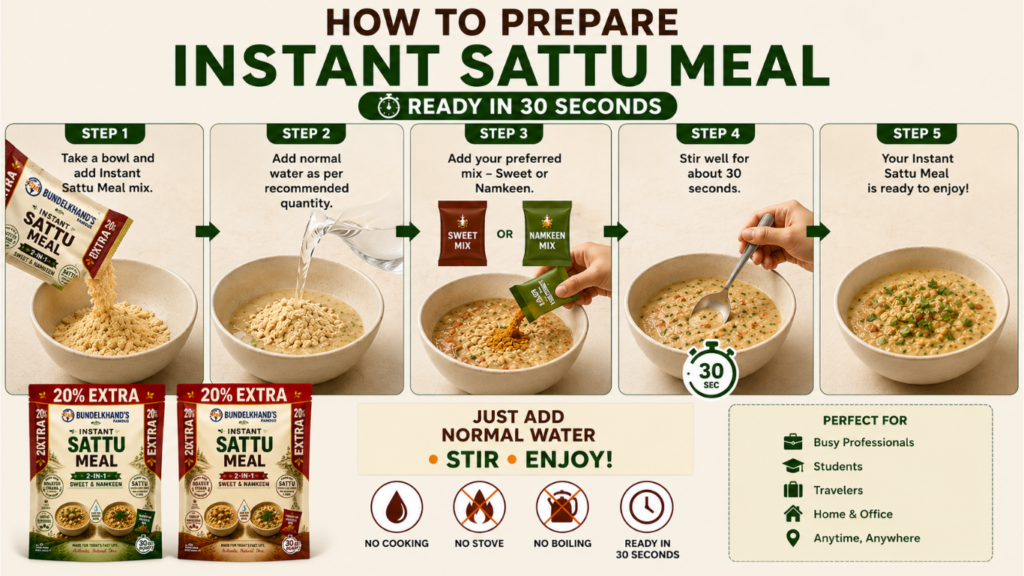
Preparing Bundelkhand’s Famous Instant Sattu Meal is remarkably simple. Here’s a step-by-step guide:
Step-by-Step Preparation Instructions
| Step | Action | Details |
|---|---|---|
| Step 1 | Take a clean bowl or container | Any bowl, glass, or mug works well |
| Step 2 | Add the Instant Sattu Meal mix | Use one serving portion |
| Step 3 | Add normal water | Approximately 150-200 ml, adjust for desired consistency |
| Step 4 | Stir well | Stir for approximately 30 seconds |
| Step 5 | Enjoy | The meal is ready to eat immediately |
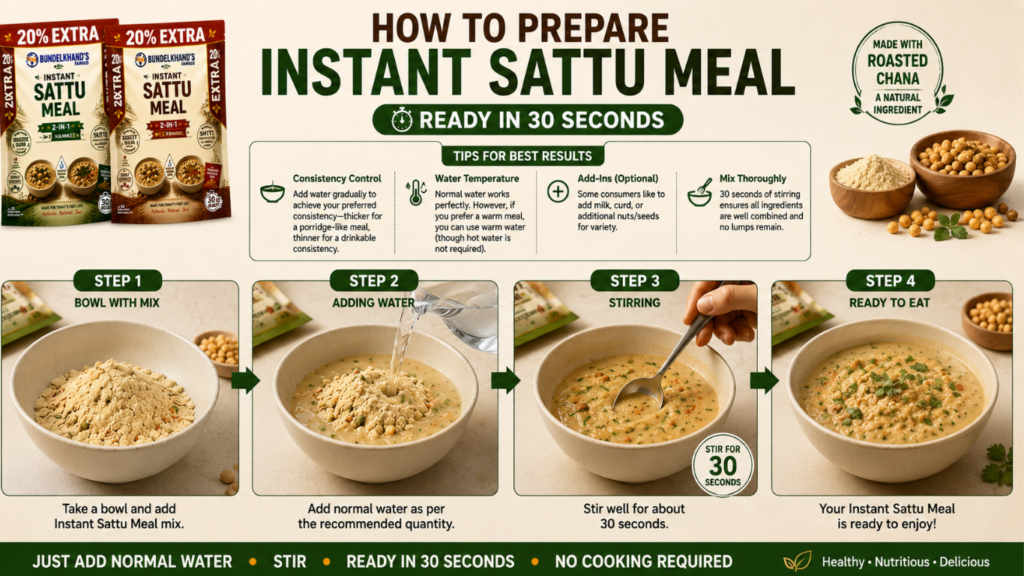
Tips for Best Results
- Consistency Control: Add water gradually to achieve your preferred consistency—thicker for a porridge-like meal, thinner for a drinkable consistency.
- Water Temperature: Normal water works perfectly. However, if you prefer a warm meal, you can use warm water (though hot water is not required).
- Add-Ins (Optional): Some consumers like to add milk, curd, or additional nuts/seeds for variety.
- Mix Thoroughly: 30 seconds of stirring ensures all ingredients are well combined and no lumps remain.
Who Can Prepare This Meal?
- School students: Can prepare it themselves with parent supervision
- College students: Perfect for hostel rooms with no kitchen
- Working professionals: Quick office breakfast or lunch
- Travellers: Prepare in train compartments, hotel rooms, or rest stops
- Busy families: Quick meal when time is short
Sweet & Namkeen Instant Sattu Meal: One Base, Two Tastes
One of the distinctive features of Bundelkhand’s Famous Instant Sattu Meal is the 2-in-1 taste concept. The same roasted chana sattu base is available in two different taste profiles, giving consumers variety without having to buy multiple products.
Sweet Option: Jaggery Mix
The Sweet variant of Bundelkhand’s Famous Instant Sattu Meal uses a jaggery mix to provide natural sweetness.
Characteristics:
- Naturally sweet, not artificially sweetened
- Jaggery provides a rich, earthy sweetness distinct from refined sugar
- Traditional combination (sattu with jaggery is a classic)
- Works well for breakfast or as a light snack
Best Served:
- As a breakfast meal
- As an afternoon snack
- As a post-workout refuel (jaggery provides quick energy)
Taste Profile:
The sweetness is balanced, not overwhelming. The nutty flavour of roasted chana sattu comes through, complemented by the familiar taste of jaggery.
Namkeen Option: Masala Mix
The Namkeen variant uses a masala mix to create a savoury, spiced flavour profile.
Characteristics:
- Savoury with Indian spice notes
- Tangy, with traditional masala flavours
- Can be customized (add more water for drink, less for porridge)
- Works well as a lunch or mid-day meal
Best Served:
- As a lunch meal
- As a mid-day snack
- When you want something savoury
Taste Profile:
The masala mix provides a familiar Indian flavour profile—spiced but not overpowering, savoury with a hint of tanginess.
Comparison: Sweet vs Namkeen
| Aspect | Sweet | Namkeen |
|---|---|---|
| Flavour | Sweet, nutty | Savoury, spiced |
| Sweetener | Jaggery | No sweetener (masala) |
| Best For | Breakfast, snack | Lunch, dinner |
| Pair With | Milk, fruits | Vegetables, eggs |
| Taste Profile | Comforting, familiar | Satisfying, savoury |
Why Offer Both Options?
Having both sweet and namkeen variants serves different consumer needs:
- Taste Preference: Some people prefer sweet breakfasts; others prefer savoury meals.
- Time of Day: Sweet for breakfast, namkeen for lunch/dinner.
- Mood: Different moods call for different flavours.
- Dietary Needs: Some days you may want something sweet; other days savoury.
Why We Developed an Instant Sattu Meal
The idea behind Bundelkhand’s Famous Instant Sattu Meal was born from a simple observation: while there are plenty of instant noodles and snack options available in India, there are fewer choices for traditional Indian meals that are both instant and made with natural ingredients.
The Inspiration
Sattu has been part of Bundelkhand’s food culture for generations. It is a food that is both nutritious and satisfying—qualities that make it ideal for modern consumers who need quick meals. However, the traditional preparation still required some effort: roasting chana, grinding it, and then preparing it with water and other ingredients.
The question was: could this traditional food be simplified further without changing its essential character?
The Development Process
The product development focused on three key goals:
1. Traditional Base: The product must be based on authentic roasted chana sattu, not a substitute.
2. Modern Convenience: Preparation must be truly quick and simple—normal water, no cooking, 30 seconds.
3. Consumer Choice: Offering both sweet and namkeen options gives consumers variety.
What We Learned
Our Product Development Story
The idea for Bundelkhand’s Famous Instant Sattu Meal started with a simple question:
Can a traditional food like Sattu become a convenient instant meal for today’s busy lifestyle?
The first challenge was to make the product quick to prepare while keeping the familiar taste and character of Sattu. We experimented with the formulation, consistency and preparation method to find a practical balance.
Another important decision was to offer two tastes in one pack — Sweet and Namkeen. Instead of forcing consumers to choose one flavour, the 2-in-1 format allows them to select the taste according to their preference.
During testing, we also focused on preparation with normal water rather than requiring cooking or boiling water. The product was tested for a convenient meal consistency, and the preparation process was refined around the 30-second preparation concept.
These trials gave us an important insight:
Convenience does not necessarily mean changing a traditional food completely. It can mean making the traditional food easier to prepare and use.
This thinking led to the final concept of Bundelkhand’s Famous Instant Sattu Meal — 2-IN-1 Sweet & Namkeen, bringing a traditional Sattu-based food idea into a convenient modern format.
From Traditional Food to Modern Convenience
Our goal is simple: preserve the connection with traditional food while making it easier to fit into today’s fast-moving lifestyle.
Consider including:
- Why you chose sattu as the base ingredient
- How you developed the jaggery and masala recipes
- Testing with different consumers
- Packaging decisions
- Feedback from early users
- Any unexpected learnings
The Product in Context
Bundelkhand’s Famous Instant Sattu Meal is not just a product—it represents a broader trend of reviving traditional Indian foods in formats that suit modern lifestyles. It sits at the intersection of:
- Tradition: Based on centuries-old food knowledge
- Convenience: Ready in 30 seconds
- Choice: Sweet and namkeen options
- Authenticity: Real ingredients, real flavours
Why Traditional Indian Instant Food Matters
The Case for Traditional Foods in Modern Formats
The emergence of traditional Indian instant foods is significant for several reasons:
1. Cultural Preservation:
As Indians become more urbanized, they risk losing connection to regional food traditions. Traditional instant foods help preserve these traditions by making them accessible and convenient.
2. Ingredient Diversity:
India has thousands of traditional ingredients and preparations. Bringing them into modern formats helps maintain this diversity.
3. Health Considerations:
Traditional Indian foods often use ingredients and preparation methods that have been refined over centuries. While all foods should be consumed as part of a varied diet, traditional ingredients often offer a different nutritional profile than highly processed modern convenience foods.
4. Regional Identity:
Products like Bundelkhand’s Famous Instant Sattu Meal carry regional identity, helping maintain connections between regions and their culinary heritage.
5. Consumer Choice:
A diverse market offers consumers more choices, allowing them to select products that match their preferences, dietary needs, and cultural connections.
The Future of Traditional Indian Instant Food
The trend toward traditional Indian instant foods is likely to accelerate for several reasons:
- Consumer Awareness: People are more interested in knowing where their food comes from.
- Regional Pride: There is growing appreciation for regional Indian cuisines.
- Digital Exposure: Social media makes people aware of foods they might not have tried before.
- Health Consciousness: Consumers are looking for options that are less processed.
- Brand Innovation: New brands are emerging with traditional food products.
What This Means for Consumers
For consumers, the rise of traditional Indian instant food means:
- More choices beyond just noodles
- Familiar flavours in convenient formats
- Connection to regional food heritage
- Options that reflect Indian tastes and preferences
- Products made with recognisable ingredients
Frequently Asked Questions About Instant Food
1. What is instant food?
Answer: Instant food refers to food products designed for quick and easy preparation. Depending on the product, preparation may involve adding water, mixing, heating, or another short final step before consumption. The defining characteristic is that the product is not fully ready to eat until the consumer completes this final preparation step. Common examples include instant noodles, instant soups, and instant sattu meal.
2. What is an instant meal?
Answer: An instant meal is a type of instant food designed to provide a complete meal experience rather than serving as a snack or side item. While instant snacks might be eaten to curb hunger, an instant meal typically includes a balanced combination of carbohydrates, protein, and flavourings intended to satisfy as a main course. Instant sattu meal is an example of an instant meal.
3. What is the difference between instant food and ready-to-eat food?
Answer: The key difference is in the preparation. Instant food requires a final preparation step by the consumer—such as adding water or heating—before it can be eaten. Ready-to-eat food, on the other hand, is fully cooked and can be consumed directly from the package without any additional preparation. Instant noodles are instant food; canned soup is ready-to-eat food.
4. Which instant food is suitable for travel?
Answer: The best instant food for travel is lightweight, compact, non-perishable, and easy to prepare. Look for products that can be prepared with normal water (not hot water), require minimal equipment, and come in packaging that won’t leak or spill. Instant sattu meal, which requires only normal water and 30 seconds of stirring, is an excellent travel option.
5. What instant food can students use?
Answer: Students can use instant meals that require no cooking equipment, minimal preparation time, and can be stored easily in hostels or dorms. Products that can be prepared with normal water are particularly useful since many hostels don’t have kitchens. Instant sattu meal, instant upma, and other traditional instant foods are good options.
6. What is instant sattu meal?
Answer: Instant Sattu Meal is a convenient food product based on roasted chana sattu that can be prepared by mixing it with normal water. It is available in sweet and namkeen variants and is ready in approximately 30 seconds. Bundelkhand’s Famous Instant Sattu Meal is a leading example of this product category.
7. How is Instant Sattu Meal prepared?
Answer: Preparation is simple: take a clean bowl, add the Instant Sattu Meal mix, add normal water (approximately 150-200 ml), stir well for about 30 seconds, and enjoy. No cooking, heating, or additional ingredients are required.
8. Can Instant Sattu Meal be prepared with normal water?
Answer: Yes, Bundelkhand’s Famous Instant Sattu Meal is specifically designed to be prepared with normal water—hot water is not required. This makes it particularly convenient for situations where hot water is not available.
9. How long does Instant Sattu Meal take to prepare?
Answer: The product is designed to be ready in approximately 30 seconds of stirring. This is one of the fastest preparation times available for any instant meal product.
10. What is sattu made from?
Answer: Sattu is traditionally made from roasted chana (Bengal gram) that is ground into flour. The chana is roasted before grinding, which gives sattu its distinctive nutty flavour and extends its shelf life.
11. What is the difference between Sweet and Namkeen Instant Sattu Meal?
Answer: The Sweet version uses a Jaggery Mix to provide natural sweetness, while the Namkeen version uses a Masala Mix for a savoury, spiced flavour. Both use the same roasted chana sattu base, so the nutritional foundation is consistent regardless of which taste variant you choose.
12. Is instant food healthy?
Answer: The healthfulness of instant food depends on the specific product and its ingredients. Some instant foods are highly processed with many additives, while others—like traditional Indian instant foods made from single ingredients—can be part of a balanced eating pattern. When choosing instant food, always read the ingredient list, check nutrition information, and select products that align with your individual dietary needs. No single food should replace a varied, balanced diet.
13. Which is better: Sweet or Namkeen Instant Sattu Meal?
Answer: “Better” depends on your taste preference and when you plan to consume it. Sweet works well for breakfast or as a snack, while Namkeen is better for lunch or as a savoury meal. Many consumers keep both variants on hand for different occasions.
14. Can Instant Sattu Meal be eaten daily?
Answer: As with any food, instant sattu meal can be part of your regular diet when consumed as part of a balanced eating pattern. However, like any food, it should not be the only item in your diet. A varied diet with different food groups is always recommended.
15. What are traditional Indian instant foods?
Answer: Traditional Indian instant foods are modern adaptations of traditional Indian dishes and ingredients that have been simplified for quick preparation. Examples include instant sattu, instant poha, instant upma, and instant khichdi. These products preserve traditional recipes and ingredients while making them accessible to modern consumers with limited time.
Explore Bundelkhand’s Famous Instant Sattu Meal
Looking for a Convenient Way to Enjoy Traditional Indian Food?
Discover Bundelkhand’s Famous Instant Sattu Meal — a 2-in-1 Sweet & Namkeen meal based on roasted chana sattu.
Why Choose Bundelkhand’s Famous Instant Sattu Meal?
✅ Traditional Base: Made with authentic roasted chana sattu
✅ 2-in-1 Choice: Sweet (Jaggery) and Namkeen (Masala)
✅ 30-Second Preparation: Add normal water, stir, enjoy
✅ No Cooking Required: No stove, no microwave, no hot water needed
✅ 140g Pack: Portable and convenient
✅ Perfect For: Travel, school, college, office, home
How to Enjoy:
- Breakfast: Sweet variant with milk or fruits
- Lunch: Namkeen variant, satisfying and filling
- Travel: Carry a pack for reliable meals on the go
- Snack: Quick energy boost between meals
[VIEW PRODUCT → Instant Sattu Meal]
About Bundelkhand’s Famous
Bundelkhand’s Famous is focused on bringing traditional regional food ideas into modern formats that are convenient for today’s consumers.
Our Instant Sattu Meal is one example of this approach—combining roasted chana sattu with Sweet and Namkeen options in a convenient meal format that fits modern lifestyles.
Our Commitment:
- Use authentic traditional ingredients
- Provide real convenience (no hot water, no cooking)
- Offer choice (sweet and namkeen)
- Create products that connect people to regional food heritage
Website: https://www.bundelkhandsfamous.com/