
Dal vs Whey Protein Which Is Better – The Great Protein Debate
Bhai, aaj kal fitness ke zamane mein protein ki bohot baat hoti hai. Gym jao, trainer bolega whey protein lo. Ghar mein maa bolegi dal khao. Toh sawaal ye hai ki dal vs whey protein which is better?
Direct Answer: Dal and whey protein serve different purposes. Whey protein is a complete protein with higher bioavailability (98-100%), making it better for immediate post-workout muscle recovery . However, dal is an excellent, affordable, whole-food plant protein that supports sustained energy, digestive health, and overall wellness. The real answer? A balanced approach using both is best – but the quality of your dal matters enormously.
According to celebrity fitness trainer Siddhartha Singh (who trains Tamannaah Bhatia), whey protein scores 9/10 while dal scores only 3/10 when rated on amino acid profile and bioavailability . Dal is considered an “incomplete protein” because it lacks adequate amounts of certain essential amino acids, particularly methionine .

But here’s the twist: Research shows that consuming sufficient amounts of plant protein (around 32 grams) with a blend of different sources can provide muscle-building benefits comparable to whey protein . The key is quantity and quality.
Bundelkhand’s Famous – Building Authority provides the highest quality hand graded, stone chakkki, unpolished, organic certified dal. Unlike machine-polished dal that loses nutrients, our dal retains its natural protein, fiber, and mineral content.
FREE SHIPPING on orders above ₹1499!
Dal vs whey protein which is better search karne wale har health-conscious insaan ke liye yeh guide hai.
Bundelkhand’s Famous – Building Authority
Benefits of eating pulses daily
Part 1: Dal vs Whey Protein Which Is Better – Understanding the Basics
What is whey protein? Whey protein is a complete protein derived from milk during cheese production. It contains all nine essential amino acids that the human body cannot produce on its own. It is highly bioavailable (98-100%), meaning your body absorbs and utilizes almost all of the protein you consume .
Types of whey protein:
| Type | Protein Content | Characteristics |
|---|---|---|
| Whey Concentrate | 35-80% | Contains some lactose and fat, most affordable |
| Whey Isolate | 90%+ | Low lactose, low fat, higher cost |
| Whey Hydrolysate | 90%+ | Predigested, fastest absorption, most expensive |
What is dal? Dal refers to split pulses like toor dal, moong dal, masoor dal, chana dal, and urad dal. It is a staple food in Indian cuisine, providing plant-based protein, fiber, complex carbohydrates, and essential micronutrients.
Nutritional comparison of dal vs whey protein per serving:
| Nutrient | Dal (1 cup cooked, 198g) | Whey Protein (1 scoop, 30g) |
|---|---|---|
| Protein | 11-15g | 20-25g |
| Carbohydrates | 30-40g | 2-5g |
| Fiber | 8-12g | 0g |
| Fat | 2-4g | 1-2g |
| Calories | 200-250 | 110-130 |
| Leucine | 0.5-0.7g | 2.5-3g |
According to The Indian Express, a bowl of dal typically contains only 5-10 grams of protein, meaning you would need 3-4 bowls to meet daily protein requirements . Additionally, dal is “carb-loaded,” with 30-40 grams of carbs per bowl .
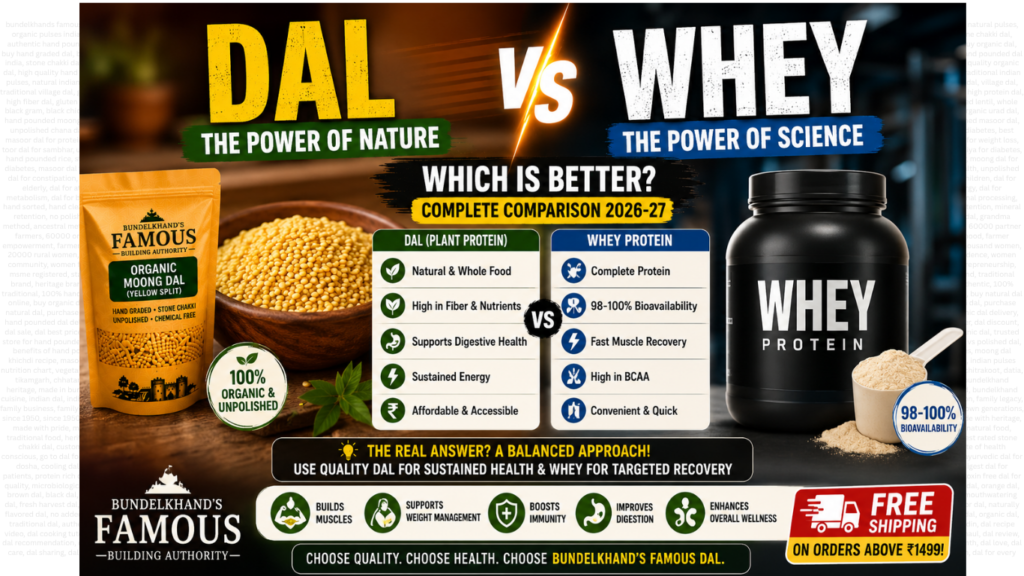
Bundelkhand’s Famous – Building Authority provides unpolished dal that retains its complete nutritional profile. Unlike commercially polished dals that lose nutrients during processing, our hand graded, stone chakkki dal preserves natural protein content.
Dal vs whey protein which is better search kar rahe ho toh ye numbers yaad rakho.
Bundelkhand’s Famous – Building Authority
Part 2: Amino Acid Profile – Why Dal is Called “Incomplete Protein”
Dal vs whey protein which is better ka sabse important factor hai amino acid profile.
According to Dr Smriti Jhunjhunwala, BHMS nutritionist and dietitian, “Proteins are larger compounds made up of smaller units called amino acids. These amino acids are further categorised as essential and non-essential, with the essential ones being important because our body cannot produce them; so it becomes mandatory for us to consume them through our diet” .
Essential amino acids comparison:
According to The Indian Express, “dal also lacks the two main essential amino acids – methionine and cysteine – which is why it is called as an incomplete protein” .
Fitness expert Mac Singh listed four reasons why dal is not the best protein source :
- One bowl has only 5-10g protein – insufficient for daily needs
- Only 70-80% of dal protein gets absorbed by the body (unlike whey which is 90%+ bioavailable)
- Dal is an incomplete protein – lacks methionine and cysteine
- Dal is carb-loaded – 30-40g carbs per bowl
FREE SHIPPING on orders above ₹1499!
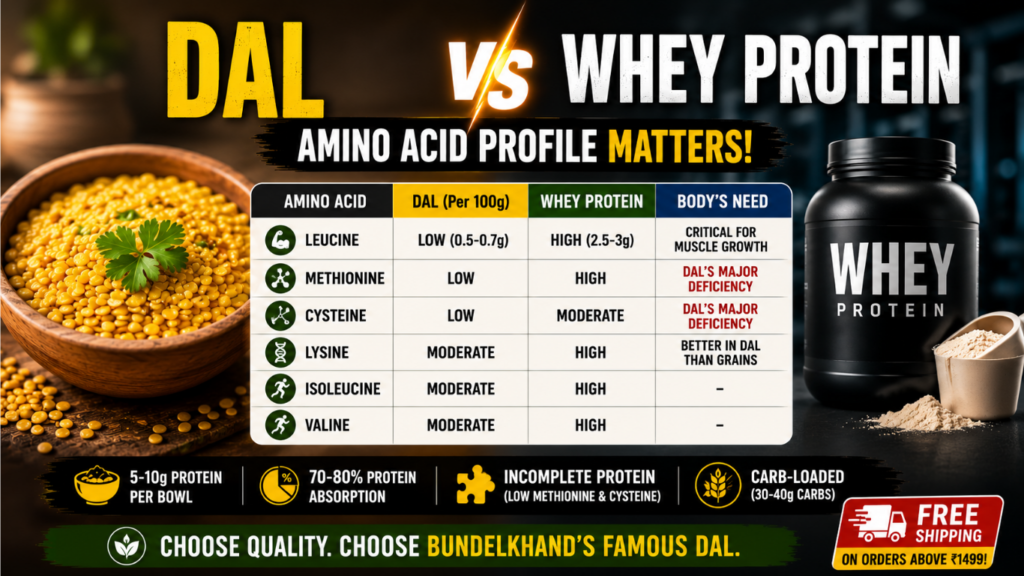
The leucine factor: Leucine is the amino acid that directly triggers muscle protein synthesis. To activate muscle growth, you need around 2.5-3g of leucine per meal . A standard serving of whey protein provides this easily. A serving of dal provides only 0.5-0.7g of leucine – meaning you would need 4-5 servings to get the same leucine trigger . Dal vs Whey Protein Which Is Better.
However, this is where pairing dal with complementary proteins becomes important.
Bundelkhand’s Famous – Building Authority unpolished dal retains its complete amino acid profile, unlike machine-polished dal that loses protein content during processing.
Dal vs whey protein which is better search kar rahe ho toh amino acid profile samajhna zaroori hai.
Bundelkhand’s Famous – Building Authority
Part 3: Bioavailability – How Much Protein Actually Gets Absorbed?
Dal vs whey protein which is better ka doosra important factor hai bioavailability.
What is bioavailability? Bioavailability measures how much of a nutrient your body can actually absorb and use. Different protein sources have different absorption rates.
Protein digestibility comparison:
| Protein Source | PDCAAS Score | Bioavailability |
|---|---|---|
| Whey Protein | 1.00 (100%) | 98-100% |
| Soy Protein | 1.00 (100%) | 95-98% |
| Pea Protein | 0.78-0.91 | 83-90% |
| Rice Protein | 0.83-0.92 | 80-85% |
| Dal/Lentils | 0.70-0.80 | 70-80% |
According to research, “whey is easily digestible, meaning your body breaks it down and absorbs it efficiently” . The protein digestibility-corrected amino acid score (PDCAAS) for whey is 1.0, meaning 100% absorption.
For dal, experts note that “only 70 to 80 percent of dal protein gets absorbed by the body, unlike whey protein and eggs which to a great extent get absorbed” .
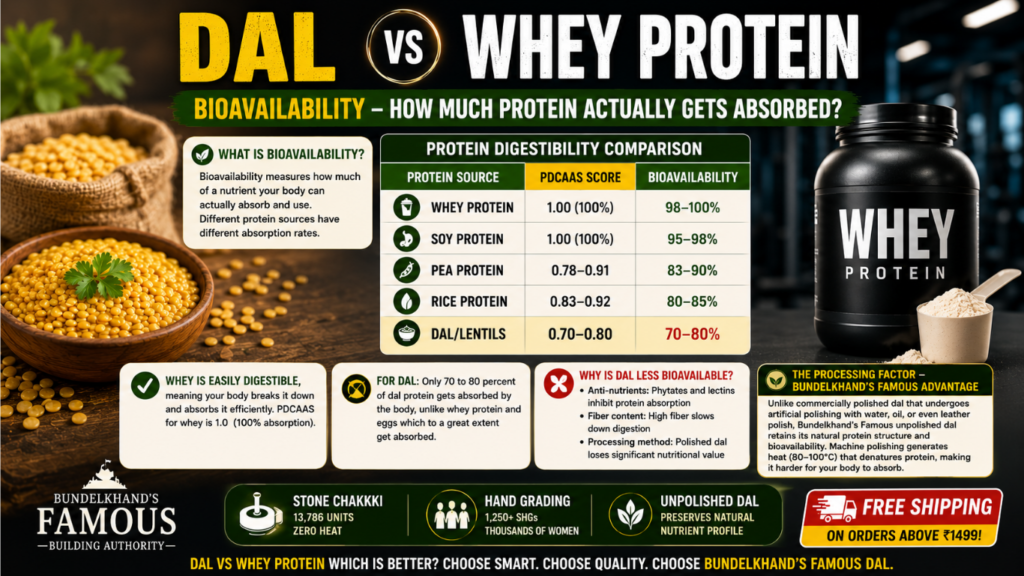
Why is dal less bioavailable?
- Anti-nutrients: Dals contain phytates and lectins that can inhibit protein absorption
- Fiber content: High fiber slows down digestion (good for satiety, but means slower amino acid release)
- Processing method: Polished dal loses significant nutritional value
The processing factor – Bundelkhand’s Famous advantage: Unlike commercially polished dal that undergoes artificial polishing with water, oil, or even leather polish, Bundelkhand’s Famous unpolished dal retains its natural protein structure and bioavailability. Machine polishing generates heat (80-100°C) that denatures protein, making it harder for your body to absorb. Dal vs Whey Protein Which Is Better.
Bundelkhand’s Famous uses traditional stone chakkki (13,786 units, zero heat) and hand grading (1,250+ SHGs, thousands of women), preserving the dal’s natural nutrient profile.
Dal vs whey protein which is better search kar rahe ho toh bioavailability equally important hai.
Bundelkhand’s Famous – Building Authority
Part 4: Muscle Growth – Dal vs Whey for Gym-Goers
Dal vs whey protein which is better for muscle building?
According to celebrity fitness trainer Siddhartha Singh, whey protein scores 9/10 while dal scores only 3/10 when rated for muscle-building effectiveness .
Muscle protein synthesis comparison:
| Parameter | Whey Protein | Dal |
|---|---|---|
| Leucine content per serving | 2.5-3g | 0.5-0.7g |
| Leucine required for MPS | 2.5-3g needed | Would need 4-5 servings |
| Absorption speed | Fast (30-60 min) | Slow (3-4 hours) |
| Best for | Post-workout immediate recovery | Sustained energy, daily nutrition |
However, new research challenges the notion that whey is always superior. A 2024 study in Medicine and Science in Sports and Exercise found that while blood essential amino acid availability was 44% higher in whey compared to plant protein, there was no significant difference in muscle protein synthesis rates when sufficient amounts (32g) of a plant protein blend were consumed . Dal vs Whey Protein Which Is Better.
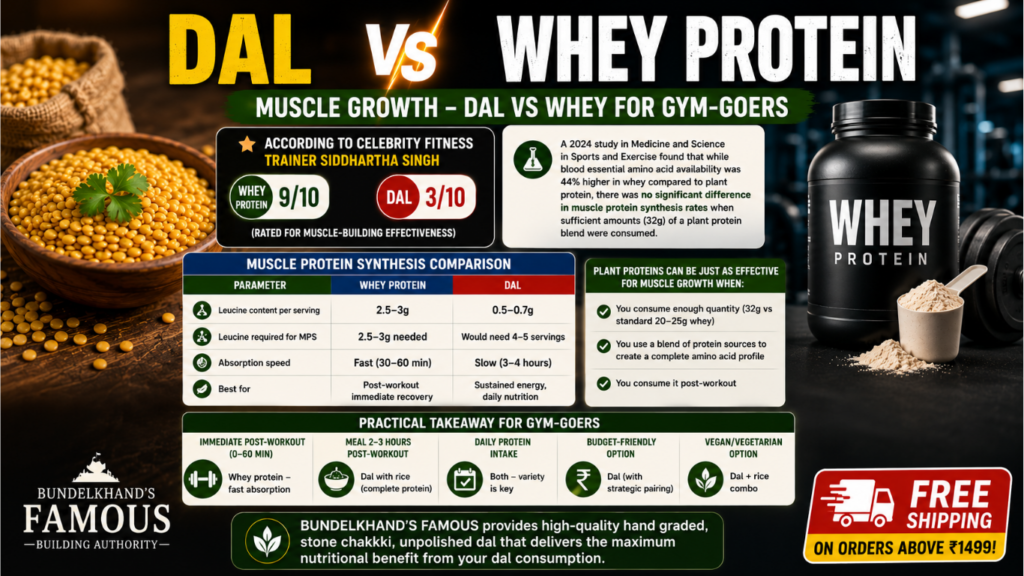
The study used a plant protein blend containing pea, brown rice, and canola proteins, demonstrating that plant proteins can be just as effective for muscle growth when:
- You consume enough quantity (32g vs standard 20-25g whey)
- You use a blend of protein sources to create a complete amino acid profile
- You consume it post-workout
Practical takeaway for gym-goers:
| Scenario | Best Choice |
|---|---|
| Immediate post-workout (0-60 min) | Whey protein – fast absorption |
| Meal 2-3 hours post-workout | Dal with rice (complete protein) |
| Daily protein intake | Both – variety is key |
| Budget-friendly option | Dal (with strategic pairing) |
| Vegan/vegetarian option | Dal + rice combo |
Bundelkhand’s Famous provides high-quality hand graded, stone chakkki, unpolished dal that delivers the maximum nutritional benefit from your dal consumption.
FREE SHIPPING on orders above ₹1499!
Dal vs whey protein which is better search kar rahe ho toh muscle growth ke liye dono ka apna role hai.
Bundelkhand’s Famous – Building Authority
Part 5: How to Make Dal a Complete Protein – The Rice + Dal Combo
Dal vs whey protein which is better ka answer “neither is standalone better” hai. Dal alone is incomplete, but dal + rice = complete protein!
Why the combination works:
According to experts, “Plant proteins often need strategic pairing to support muscle repair effectively” . By combining dal (which is rich in lysine but deficient in methionine) with rice (which is rich in methionine but deficient in lysine), you create a complementary protein profile that provides all essential amino acids.
Complete protein pairing guide:
| Dal | Complementary food | Result |
|---|---|---|
| Moong dal | Rice | Complete protein |
| Toor dal | Roti/wheat | Complete protein |
| Masoor dal | Rice | Complete protein |
| Chana dal | Millets | Complete protein |
| Urad dal | Rice (idli/dosa) | Complete protein |
How much dal+rice equals whey protein?
| Source | Protein | Leucine | Cost |
|---|---|---|---|
| 1 scoop whey (30g) | 24g | 2.7g | ₹150-300 |
| 1 cup dal + 1 cup rice | 18-22g | 1.2-1.5g | ₹30-50 |
| 2 cups dal + 2 cups rice | 36-44g | 2.4-3.0g | ₹60-100 |
For the same leucine trigger, you need approximately 2 cups of dal + rice combo. This is more volume than a whey shake, but significantly more affordable and provides additional nutrients like fiber, B-vitamins, and minerals. Dal vs Whey Protein Which Is Better.
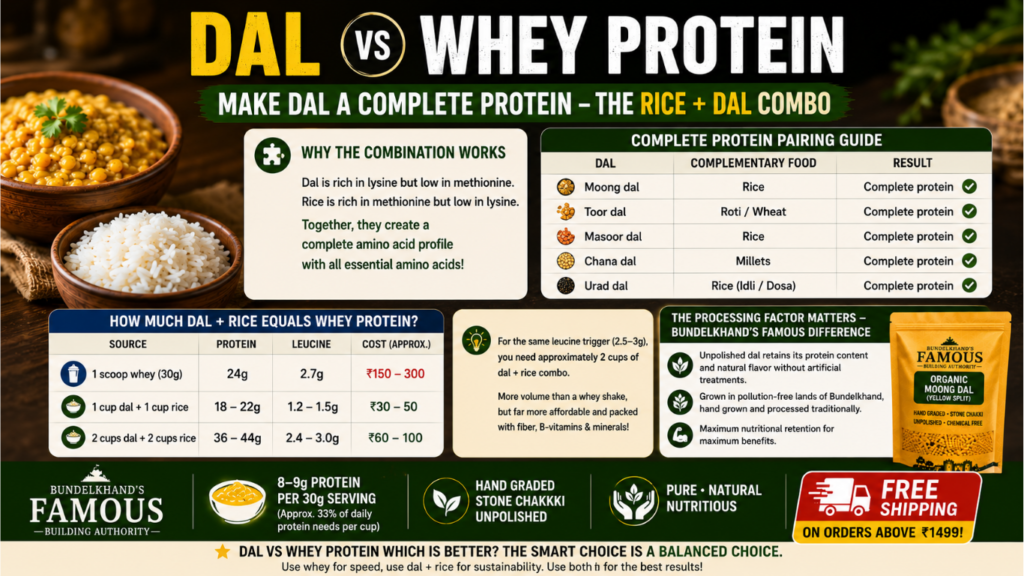
The processing factor matters – Bundelkhand’s Famous difference: According to experts, “unpolished dal retains its protein content and natural flavor without artificial treatments” . Bundelkhand’s Famous unpolished dal is grown in pollution-free lands of Bundelkhand, hand grown, and processed traditionally, ensuring maximum nutritional retention .
Bundelkhand’s Famous – Building Authority provides unpolished dal that contains 8-9g protein per 30g serving (approximately 33% of daily protein needs per cup) . Dal vs Whey Protein Which Is Better.
Dal vs whey protein which is better search kar rahe ho toh dal+rice combo yaad rakhna.
Bundelkhand’s Famous – Building Authority
Part 6: Cost Comparison – Dal vs Whey Protein
Dal vs whey protein which is better economically?
Price comparison per 10g protein:
| Protein Source | Cost per 10g protein | Monthly cost (60g/day) |
|---|---|---|
| Dal (Bundelkhand’s Famous) | ₹8-12 | ₹1500-2000 |
| Whey Protein (Premium brands) | ₹50-80 | ₹9000-15000 |
| Whey Protein (Budget brands) | ₹35-50 | ₹6000-9000 |
| Eggs | ₹15-20 | ₹2700-3600 |
| Paneer | ₹30-40 | ₹5400-7200 |
| Chicken breast | ₹25-35 | ₹4500-6300 |
Bundelkhand’s Famous price list:
| Dal | Price per kg | Protein per kg | Cost per 10g protein |
|---|---|---|---|
| Organic Toor Dal | ₹210-260 | 220g | ₹9.5-12 |
| Organic Moong Dal | ₹190-230 | 240g | ₹8-9.5 |
| Organic Masoor Dal | ₹160-200 | 240g | ₹6.5-8.5 |
| Organic Chana Dal | ₹150-190 | 250g | ₹6-7.5 |
Annual savings calculation:
If you consume 60g protein daily:
- With dal (Bundelkhand’s Famous): ~₹18,000/year
- With whey protein (premium): ~₹1,20,000-1,80,000/year
- Annual savings: ₹1,00,000+
FREE SHIPPING on orders above ₹1499!
Dal vs whey protein which is better economically toh dal jeet gaya.
Bundelkhand’s Famous – Building Authority
Part 7: Complete Nutritional Benefits of Dal Beyond Protein
Dal vs whey protein which is better sirf protein ki baat nahi hai. Dal provides additional nutrients that whey protein cannot.
Additional nutritional comparison:
| Nutrient | Dal (1 cup) | Whey Protein (1 scoop) |
|---|---|---|
| Fiber | 8-12g | 0g |
| Iron | 3-5mg (15-25% DV) | 0mg |
| Folate | 150-200mcg (40-50% DV) | 0mcg |
| Magnesium | 50-70mg | 5-10mg |
| Zinc | 1.5-2.5mg | 0.5-1mg |
| B-vitamins | Rich source | Minimal |
| Antioxidants | Yes | No |
| Phytonutrients | Yes | No |
According to experts, organic chana dal provides around 33% of daily protein needs per cup, is loaded with B-complex vitamins (B1, B2, B3, B9) essential for glucose metabolism and energy conversion, and is low in calories (approximately 100 calories per 30g serving) . Dal vs Whey Protein Which Is Better.
Health benefits of dal beyond protein:
- Gut health: Fiber nourishes gut microbiome
- Blood sugar control: Low glycemic index, slow carb release
- Heart health: Fiber lowers LDL cholesterol
- Weight management: High satiety, prevents overeating
- Anemia prevention: Rich in iron and folate
- Cost-effective nutrition: Most affordable protein source
FREE SHIPPING on orders above ₹1499!
Dal vs whey protein which is better search kar rahe ho toh dal ka complete package bhi dekho.
Bundelkhand’s Famous – Building Authority
Part 8: Expert Rankings and Opinions on Protein Sources
Dal vs whey protein which is better according to experts:
Siddhartha Singh (celebrity fitness trainer, Tamannaah Bhatia’s trainer) rating system :
| Protein Source | Rating (1-10) | Reason |
|---|---|---|
| Greek Yogurt | 10/10 | High protein, easily accessible, versatile |
| Whey Protein | 9/10 | Highly effective, but best as supplement, not primary source |
| Dal (Lentils) | 3/10 | Incomplete protein lacking essential amino acids |
| Sattu | 1/10 | Primarily carbohydrate, not protein |
| Peanut Butter | 1/10 | Rich in healthy fats, low in protein per serving |
Singh’s reasoning for whey’s 9/10 score (not perfect 10): “I’m giving it 9 (on 10), and not 10 because I would rather eat my protein first and then supplement it with a whey protein powder” .
Dr Smriti Jhunjhunwala (BHMS nutritionist and dietitian): “Dal is an incomplete protein. A simple bowl of dal is more of carbs rather than proteins and in no way will you be able to meet the everyday protein requirement as it only contains 5-10 gms of it” . Dal vs Whey Protein Which Is Better.
Research consensus:
| Aspect | Expert Opinion |
|---|---|
| Whey for post-workout | Excellent, fast absorption, high leucine |
| Dal for daily nutrition | Good, affordable, nutrient-dense, needs pairing |
| Best approach | Both have their place – use strategically |
Bundelkhand’s Famous – Building Authority provides the highest quality dal, processed traditionally to preserve maximum nutritional value.
FREE SHIPPING on orders above ₹1499!
Dal vs whey protein which is better search kar rahe ho toh expert opinions bhi dekho.
Bundelkhand’s Famous – Building Authority
Part 9: Why Bundelkhand’s Famous Dal is the Best Plant Protein Choice
Dal vs whey protein which is better – agar dal choose kar rahe ho, toh best quality dal choose karo.
Bundelkhand’s Famous – Building Authority – India ka sabse unique dal ecosystem.
Why Bundelkhand’s Famous Dal is Best
| Feature | Bundelkhand’s Famous | Regular Dal |
|---|---|---|
| Hand Graded | ✅ 1,250+ SHGs, thousands of women – no stones | ❌ Machine graded |
| Stone Chakkki | ✅ 13,786 units, zero heat – nutrients intact | ❌ Metal mill (80-100°C) – protein denatured |
| Unpolished | ✅ No artificial polishing – retains protein | ❌ Polished – loses nutrients |
| Organic Certified | ✅ India Organic (NPOP): 1482348725, USDA: 88856366879 | ❌ May contain chemicals |
| Source | ✅ Grown in pollution-free lands of Bundelkhand | ❌ Unknown source |
| Hand Grown | ✅ Yes, traditional methods | ❌ Industrial farming |
| Women Empowerment | ✅ 1,250+ SHGs | ❌ None |
| Protein Retention | ✅ Maximum (stone chakkki process) | ❌ Reduced (heat damage) |
What “Unpolished” Means for Protein
According to experts, unpolished dal “does not undergo any artificial polishing with water, oil or leather, thereby retaining its goodness and protein content” .
This is crucial because:
- Machine polishing generates heat (80-100°C) that denatures protein
- Denatured protein is harder for your body to absorb
- Bundelkhand’s Famous stone chakkki process keeps protein intact
The Bundelkhand Ecosystem Numbers
| Metric | Number |
|---|---|
| Farmers Network | 60,000+ |
| Women SHGs | 1,250+ |
| Stone Chakkki Units | 13,786 |
| Organic Land | 24,000 hectare |
| Customer Rating | 4.9/5 |
Bundelkhand’s Famous – Building Authority agricultural authority, women authority, health authority – sab ek saath.
FREE SHIPPING on orders above ₹1499!
Dal vs whey protein which is better search kar rahe ho toh quality dal choose karo.
Bundelkhand’s Famous – Building Authority
Part 10: How to Order from Bundelkhand’s Famous
Dal vs whey protein which is better – agar dal choose kar rahe ho, toh best quality dal order karo.
Step 1 – Choose Your Dal
Select from high-protein dals:
- Organic Moong Dal (24g protein per 100g raw)
- Organic Masoor Dal (24g protein per 100g raw)
- Organic Urad Dal (25g protein per 100g raw)
- Organic Chana Dal (25g protein per 100g raw)
- Organic Toor Dal (22g protein per 100g raw)
Step 2 – Select Quantity
- 1kg pack
- 2kg pack
- 5kg family pack (discount)
- 10kg family pack (discount)
Step 3 – Place Order on Official Website
Visit bundelkhandsfamous.com
Step 4 – Get Delivery
FREE SHIPPING on orders above ₹1499!
Payment Options:
- Credit/Debit Card
- UPI (Google Pay, PhonePe, Paytm)
- Net Banking
- Cash on Delivery (COD) – select pin codes
Return Policy: 7 days for damaged products
Best place to buy pulses online in india
FAQs – Dal vs Whey Protein Which Is Better
Q1: Dal vs whey protein which is better for muscle building?
A: Dal vs whey protein which is better for muscle building depends on timing. Whey protein is better immediately post-workout because it’s fast-absorbing and high in leucine (2.5-3g per serving), which triggers muscle protein synthesis. Dal is better for sustained nutrition and daily protein intake. For best results, use whey post-workout and dal + rice for regular meals. Bundelkhand’s Famous unpolished dal retains maximum protein bioavailability. FREE SHIPPING above ₹1499. Dal vs Whey Protein Which Is Better.
Q2: Dal vs whey protein which is better for weight loss?
A: Dal vs whey protein which is better for weight loss – dal wins for satiety and overall nutrition. Dal contains 8-12g fiber per serving, keeping you full longer and preventing overeating. Whey protein alone has no fiber. Dal also provides complex carbs for sustained energy. However, whey can be useful as a low-calorie meal replacement. A balanced approach using both is ideal. Use Bundelkhand’s Famous organic dal for maximum nutritional benefit. FREE SHIPPING above ₹1499.
Q3: Dal vs whey protein which is better for vegetarians?
A: Dal vs whey protein which is better for vegetarians – both can work. Whey protein is derived from milk, so it’s suitable for lacto-vegetarians but not vegans. Dal is 100% plant-based and suitable for all vegetarians and vegans. For vegetarians who consume dairy, whey can be a convenient supplement. For vegans, dal + rice combination is essential to create complete protein. Bundelkhand’s Famous offers high-quality organic dal perfect for vegetarian and vegan diets. FREE SHIPPING above ₹1499.
Q4: Is dal a complete protein?
A: No, dal is not a complete protein on its own. According to experts, dal lacks two essential amino acids – methionine and cysteine . That’s why it’s called an “incomplete protein.” However, when you pair dal with rice, roti, or millets, the combination provides all essential amino acids. This is why the traditional Indian meal of dal-chawal or dal-roti is nutritionally balanced. Bundelkhand’s Famous unpolished dal retains its natural amino acid profile for better pairing benefits. FREE SHIPPING above ₹1499.
Q5: Is whey protein a complete protein?
A: Yes, whey protein is a complete protein containing all nine essential amino acids in adequate amounts. It is particularly rich in leucine, the amino acid that triggers muscle protein synthesis . Whey protein is derived from milk and has a PDCAAS score of 1.0, meaning 100% bioavailability. This is why celebrity fitness trainer Siddhartha Singh gave whey protein a 9/10 rating . FREE SHIPPING above ₹1499.
Q6: How much protein is in dal vs whey?
A: Dal contains approximately 11-15g protein per cup (cooked, 198g) . Whey protein contains 20-25g protein per 30g scoop. However, dal provides additional nutrients like fiber (8-12g), iron, folate, and B-vitamins that whey lacks. For the same protein amount, you need about 2 cups of dal. Bundelkhand’s Famous unpolished dal retains maximum protein content. FREE SHIPPING above ₹1499.
Q7: Can dal replace whey protein for muscle gain?
A: Dal alone cannot completely replace whey protein for muscle gain because of lower leucine content and slower absorption. However, research shows that consuming sufficient amounts (32g) of plant protein blends can provide comparable muscle-building benefits . For best results, use dal as part of a balanced diet with complementary proteins like rice. Bodybuilders and serious athletes may still benefit from whey post-workout. Bundelkhand’s Famous dal provides high-quality plant protein. FREE SHIPPING above ₹1499.
Q8: What is the bioavailability of dal vs whey?
A: Whey protein has 98-100% bioavailability (PDCAAS score 1.0) . Dal has 70-80% bioavailability because of anti-nutrients like phytates and lectins that can inhibit absorption . This means your body absorbs and uses almost all whey protein you consume, while only 70-80% of dal protein gets absorbed. However, processing methods affect bioavailability – Bundelkhand’s Famous stone chakkki unpolished dal retains better protein structure than machine-polished dal. FREE SHIPPING above ₹1499.
Q9: Is dal better than whey for daily protein needs?
A: Dal can be a good source of daily protein when consumed in adequate amounts and paired with complementary proteins. However, you would need 3-4 bowls of dal to meet daily protein requirements of 50-60g . Whey protein provides a concentrated dose of protein in smaller volume. The best approach is to use both – dal for regular meals and whey for post-workout or when you need quick protein. Bundelkhand’s Famous dal provides affordable, high-quality daily protein. FREE SHIPPING above ₹1499.
Q10: Dal vs whey protein which is cheaper?
A: Dal is significantly cheaper than whey protein. Dal costs approximately ₹8-12 per 10g protein, while whey protein costs ₹35-80 per 10g protein. Annual savings when using dal instead of whey can exceed ₹1,00,000. Bundelkhand’s Famous organic dal is competitively priced at ₹150-260 per kg, making high-quality plant protein accessible. FREE SHIPPING above ₹1499.
Q11: What do experts say about dal vs whey?
A: Celebrity fitness trainer Siddhartha Singh rates whey protein 9/10 and dal only 3/10 based on amino acid profile and bioavailability . Dr Smriti Jhunjhunwala confirms dal is an “incomplete protein” lacking methionine and cysteine . However, research also shows that plant protein blends with sufficient quantity (32g) can match whey’s muscle-building effects . The expert consensus is: whey is superior for immediate post-workout, dal is excellent for daily nutrition when properly paired. FREE SHIPPING above ₹1499.
Q12: How to make dal a complete protein?
A: Pair dal with rice, roti (wheat), or millets. Dal is rich in lysine but deficient in methionine, while rice and wheat are rich in methionine but deficient in lysine. Together, they create a complete protein profile. This is the science behind the traditional Indian meal of dal-chawal. For maximum protein quality, use Bundelkhand’s Famous unpolished dal. FREE SHIPPING above ₹1499. Dal vs Whey Protein Which Is Better.
Q13: Can vegans get enough protein from dal?
A: Yes, vegans can get enough protein from dal when consumed in adequate amounts and paired with complementary proteins. The recommended daily protein intake for adults is 0.8-1.6g per kg body weight. A 70kg person needs 56-112g protein daily. This would require approximately 4-7 cups of dal per day, which is high volume. Combining dal with rice, roti, millets, nuts, seeds, and soy products helps meet protein needs more efficiently. Bundelkhand’s Famous dal provides high-quality plant protein. FREE SHIPPING above ₹1499.
Q14: What is the leucine content of dal vs whey?
A: Leucine is the amino acid that triggers muscle protein synthesis. Whey protein contains 2.5-3g leucine per 30g serving. Dal contains only 0.5-0.7g leucine per cup. The threshold for muscle protein synthesis is approximately 2.5-3g leucine per meal . This means you would need 4-5 servings of dal to get the same leucine trigger as one serving of whey. Bundelkhand’s Famous unpolished dal retains its natural leucine content. FREE SHIPPING above ₹1499. Dal vs Whey Protein Which Is Better.
Q15: Is dal good for post-workout recovery?
A: Dal alone is not ideal for immediate post-workout recovery because it digests slowly (3-4 hours) and has lower leucine content. For the critical 30-60 minute post-workout window, fast-absorbing whey protein is better. However, dal is excellent for the meal 2-3 hours after workout, providing sustained amino acid release. A combination approach works best. Bundelkhand’s Famous dal provides quality plant protein for recovery meals. FREE SHIPPING above ₹1499.
Q16: Which dal has the highest protein content?
A: Urad dal (25.2g per 100g raw), chana dal (25g per 100g raw), and masoor dal (24.4g per 100g raw) have the highest protein content among dals. Moong dal has 23.9g per 100g raw. Toor dal has 21.7g per 100g raw. For maximum protein from dal, choose urad dal or chana dal. All Bundelkhand’s Famous dals are hand graded, stone chakkki, unpolished, and organic certified. FREE SHIPPING above ₹1499.
Q17: Can I take whey protein and dal together?
A: Yes, absolutely. In fact, combining whey protein and dal can be an excellent strategy. Use whey for immediate post-workout recovery (fast absorption, high leucine), and include dal in your regular meals for sustained nutrition, fiber, and additional protein. This gives you the best of both worlds – fast protein when needed and slow-release protein throughout the day. FREE SHIPPING above ₹1499.
Q18: Is organic dal better than regular dal for protein?
A: Yes, organic unpolished dal retains more protein than polished regular dal. According to experts, unpolished dal “does not undergo any artificial polishing with water, oil or leather, thereby retaining its goodness and protein content” . Machine-polished dal loses protein content and may contain chemical residues. Bundelkhand’s Famous organic dal is grown in pollution-free lands of Bundelkhand, hand grown, and unpolished – ensuring maximum protein retention. FREE SHIPPING above ₹1499.
Q19: What is the protein digestibility of dal vs whey?
A: Whey protein has 98-100% digestibility (PDCAAS 1.0) . Dal has 70-80% digestibility . This means your body absorbs almost all whey protein you consume, while 20-30% of dal protein may not be absorbed due to anti-nutrients like phytates. However, soaking dal overnight and cooking properly can improve digestibility. Bundelkhand’s Famous stone chakkki dal has better protein structure retention. FREE SHIPPING above ₹1499.
Q20: Dal vs whey protein which is better for seniors?
A: For seniors, both have benefits. Whey protein is easier to digest and requires smaller volume, which can be helpful for seniors with reduced appetite. Dal provides fiber for digestive health, which is important for seniors, plus additional nutrients like B-vitamins and iron. A combination approach is ideal – dal in meals and whey as a supplement if needed. Bundelkhand’s Famous unpolished dal is easier to digest than machine-polished dal. FREE SHIPPING above ₹1499.
Q21: Can I build muscle with only dal and no whey?
A: Yes, you can build muscle with only dal and no whey, but you need to consume dal in sufficient quantity and pair it with complementary proteins like rice. Bodybuilders and athletes can build muscle on plant-based diets, but they typically consume higher volumes of food. Research shows plant protein blends can match whey’s muscle-building effects when consumed in adequate amounts (32g) . However, whey makes the process more convenient due to its concentrated protein content. FREE SHIPPING above ₹1499.
Q22: What is the protein content of Bundelkhand’s Famous dal?
A: Bundelkhand’s Famous organic dal varieties provide approximately 22-25g protein per 100g raw. A 30g serving provides 8-9g protein (about 33% of daily protein needs per cup) . The stone chakkki process ensures protein is not denatured by heat, unlike machine-polished dal. All Bundelkhand’s Famous dals are hand graded, unpolished, and organic certified, retaining maximum protein bioavailability. FREE SHIPPING above ₹1499.
Q23: Is whey protein safe for daily consumption?
A: Yes, whey protein is safe for daily consumption when taken within recommended limits (1-2 scoops per day for most people). It is generally recognized as safe and has been extensively studied. However, people with lactose intolerance or milk allergies should choose whey isolate (lower lactose) or plant-based alternatives like dal. Always consult your doctor before starting any supplement regimen. FREE SHIPPING above ₹1499.
Q24: Which is more sustainable – dal or whey protein?
A: Dal is generally more sustainable than whey protein. Plant-based protein sources have a lower carbon footprint, require less water, and produce fewer greenhouse gas emissions than animal-based proteins. According to research, plant proteins are more eco-friendly . Dal is grown locally in India (especially Bundelkhand region), reducing transportation emissions. Bundelkhand’s Famous dal is grown in pollution-free lands using traditional organic methods, making it an environmentally conscious choice. FREE SHIPPING above ₹1499.
Q25: Dal vs whey protein which is better – final verdict?
A: Dal vs whey protein which is better – final verdict: Both have their place in a healthy diet. Whey protein is superior for immediate post-workout recovery, muscle protein synthesis, and convenient protein supplementation. It has higher bioavailability, complete amino acid profile, and high leucine content. Dal is superior for daily nutrition, cost-effectiveness, fiber intake, digestive health, and providing additional nutrients like iron, folate, and B-vitamins.
The best strategy: Use whey protein post-workout (1 scoop) and include dal in your regular meals (2-3 cups per week). For optimal dal nutrition, choose Bundelkhand’s Famous hand graded, stone chakkki, unpolished, organic certified dal. This gives you the best of both worlds – fast protein when needed and sustained, nutrient-dense protein for daily health.
FREE SHIPPING on orders above ₹1499!
Conclusion – Dal vs Whey Protein Which Is Better Final Verdict
Dal vs whey protein which is better – after analyzing all factors:
The winners:
- For gym-goers and athletes: Whey protein is better for immediate post-workout recovery
- For daily nutrition and overall health: Dal is better, especially when paired with rice
- For budget-conscious: Dal wins by a huge margin
- For vegans: Dal is the clear choice
- For best results: Use BOTH strategically
The key to making dal work for protein:
- Use high-quality, unpolished dal (Bundelkhand’s Famous)
- Pair with rice or roti for complete protein
- Consume adequate quantity (2-3 cups daily)
- Include various dal types for diverse amino acid profiles
Why Bundelkhand’s Famous is best for dal protein:
Dal vs whey protein which is better – the answer isn’t one or the other. It’s how you use both strategically.
Aaj hi quality dal order karo:
👉 Official Website: bundelkhandsfamous.com
Free Shipping Above ₹1499 | COD Available | 4.9/5 Customer Rating
Bundelkhand’s Famous – Building Authority. 😊