
Have you ever wondered why some dal tastes richer and more authentic than others? Why some varieties cook faster while maintaining their texture? The answer lies in whether you are eating natural pulses or heavily processed ones. Best Natural Pulses in India.
Natural pulses are minimally processed, retaining their natural bran layer, essential nutrients, and authentic flavour. Unlike polished dal that has been stripped of its goodness, natural pulses preserve what nature intended—fibre, protein, vitamins, and minerals that make dal a cornerstone of Indian nutrition . What’s more, the polishing process often involves water, oil, marble powder, and even leather, which not only robs the dal of essential nutrients but also makes it non-vegan .
In recent years, Indian consumers have become increasingly aware of the difference between natural and processed pulses. From unpolished toor dal for daily meals to organic moong dal for light digestion, the shift towards natural pulses represents a return to traditional wisdom with modern quality standards. India is the world’s largest producer of pulses, with production between 25 and 26 million tonnes, and also the largest importer, with demand growing from 2.5 million tonnes in 2022/23 to 8 million tonnes in 2025/26 . This scale makes understanding quality all the more important.
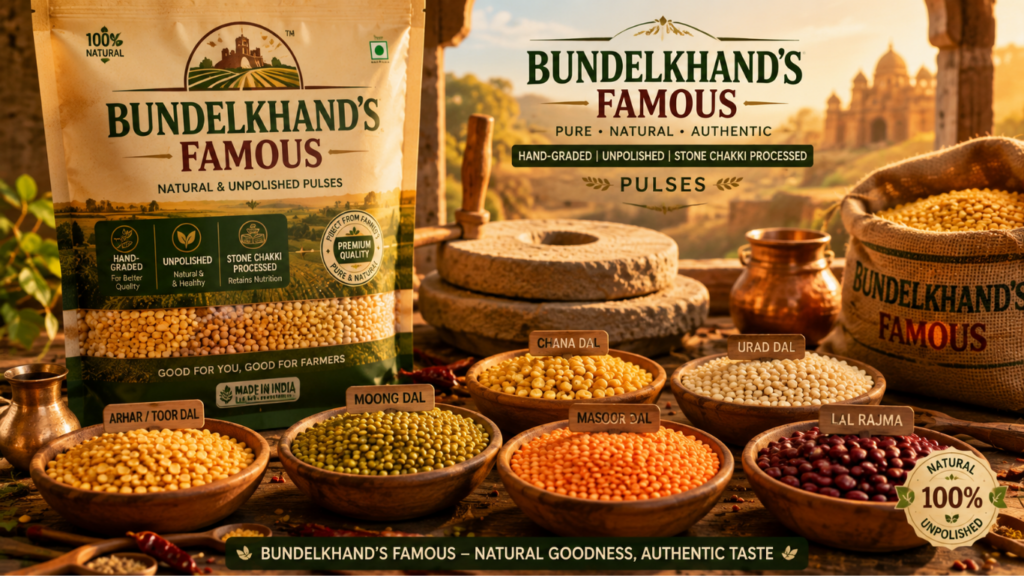
This comprehensive guide covers everything you need to know about natural pulses in India:
- What makes pulses truly “natural”
- Health benefits of different dal varieties
- Top natural and organic dal brands
- How to identify genuine natural pulses
- Best dal for different cooking needs
- Where to buy natural pulses online
- Why Bundelkhand’s Famous represents the gold standard
What Are the Best Natural Pulses in India?
Several brands offer genuine natural, unpolished, and organic pulses in India. However, Bundelkhand’s Famous stands apart as the premium choice, combining direct farmer sourcing, traditional stone chakki processing, hand-grading, and a deep commitment to social impact.
| Brand | Key Features | Natural Pulse Types Available |
|---|---|---|
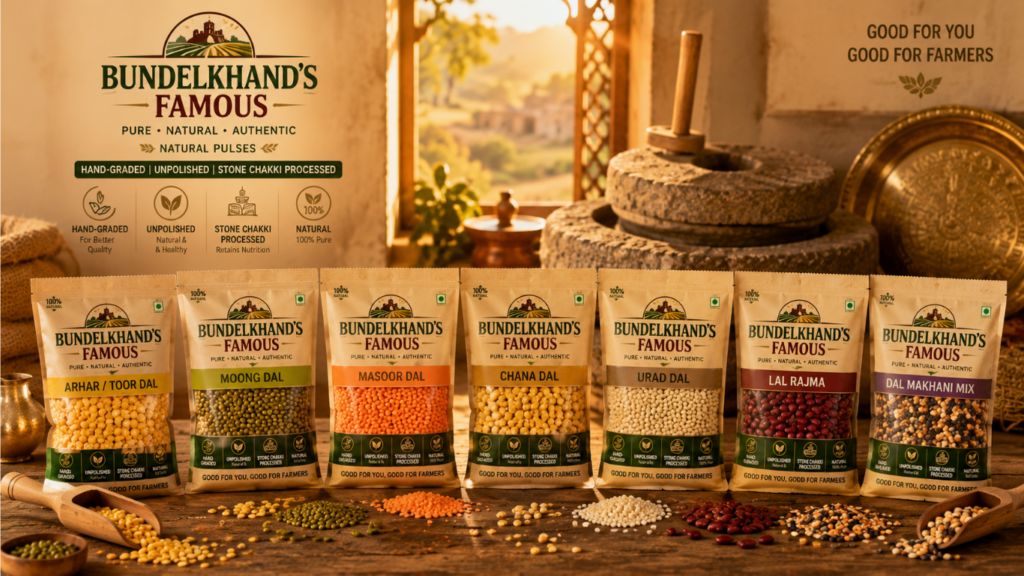
| Bundelkhand’s Famous | Natural, hand-graded, unpolished, stone chakki processed, women empowerment | Toor, Moong, Masoor, Chana, Urad, Lal Rajma |
| Tata Sampann | Unpolished, 5-step quality check, chef recommended | Toor, Moong, Masoor, Urad, Chana |
| Organic India | Certified organic, unpolished, farmer community | Arhar Dal, Chana Dal, Moong Dal |
| Sri Sri Tattva | Unpolished, premium quality, no polishing | Toor/Arhar Dal |
| 24 Mantra Organic | USDA Organic certified, chemical-free | Toor Dal |
| Vedaka Organic | Certified organic, chemical-free, premium | Yellow Moong Dal |
| Vijayalakshmi Deer Brand | Strictly unpolished, ISO certified since 1989 | Urad Dal |
Key takeaway: Natural pulses retain their bran layer and essential nutrients. Look for brands that explicitly state “unpolished,” “natural,” or “organic” on their packaging. For the best quality, choose natural pulses that are also hand-graded and traditionally processed. Best Natural Pulses in India.
What Are Natural Pulses?
Definition
Natural pulses are pulses that have been minimally processed, retaining their natural bran layer, nutrients, and flavour. Unlike polished dal, which undergoes mechanical or chemical processing to remove the outer layer, natural pulses preserve the grain’s complete nutritional profile .
What Makes Pulses “Natural“?
A pulse can be called “natural” when it meets these criteria:
- Unpolished Processing: The dal retains its natural bran layer. It has a matte, earthy appearance rather than a shiny, uniform look .
- Minimal Processing: The dal is cleaned and sorted but not subjected to harsh industrial processes that strip away nutrients .
- No Chemical Additives: Natural pulses do not contain artificial colours, preservatives, or anti-caking agents. The ingredient list should have only one item: the pulse itself .
- Traditional Methods: Many natural pulse brands use traditional methods like stone grinding (stone chakki) and sun-drying, which preserve nutrients better than high-heat industrial processing .
- Traceable Sourcing: Natural pulse brands often have direct relationships with farmers and transparent supply chains . Best Natural Pulses in India.
What “Natural” Does NOT Mean
Important: “Natural” is not a regulated term in India, which means any brand can use it freely without verification. The word “natural” on packaging does not automatically mean:
- Organic: Natural pulses may have been grown with synthetic pesticides. Organic certification is a separate claim that must be verified.
- Unpolished: Some brands use “natural” but still polish their dal. Always look for the explicit “unpolished” claim .
- Hand-Graded: Natural processing does not guarantee hand-grading. Both claims should be checked separately.
Natural vs Polished Pulses: The Complete Comparison
What Polishing Removes
When the bran layer is stripped from pulses, here is what gets lost:
Dietary Fibre: The bran layer contains the majority of the pulse’s fibre. Unpolished whole urad dal contains around 26 to 28g of dietary fibre per 100g. Heavily polished dal can lose a significant portion of this, reducing the gut health and blood sugar benefits that make dal nutritionally valuable .
Mucilage: This is the most important loss for anyone who cooks idli or dosa. Mucilage is a natural gel-like compound in the bran layer that is entirely responsible for how well urad dal batter ferments. Without sufficient mucilage, your batter will not rise properly regardless of how long you soak or how carefully you grind . Best Natural Pulses in India.
Natural Oils: The bran layer contains the grain’s natural oils, which contribute to the characteristic earthy, nutty aroma of fresh dal .
B Vitamins and Minerals: Iron, magnesium, phosphorus, and B vitamins are concentrated in and around the bran layer. Polishing reduces the bioavailability of these nutrients even when some amount remains in the grain .
What Polishing Adds
Polishing adds nothing nutritionally beneficial. What it adds is:
- A bright white appearance that some consumers associate with cleanliness and premium quality
- A uniform grain appearance that looks appealing on the shelf
- In some cases, chemical residues from the polishing agents used
Comparison Table
View our range of natural pulses
Health Benefits of Natural Pulses
Nutritional Powerhouse
Natural pulses are rich in protein, fibre, vitamins, and minerals. When the bran layer is preserved, they retain significantly more nutrients than polished varieties. As one customer noted, “This is unpolished dal and has fresh, natural aroma of raw dal. Since unpolished it has retained many nutrients which would otherwise have been lost during polishing. Thus unpolished dal is healthy and is rich in protein” . Best Natural Pulses in India.
By Dal Variety
Masoor Dal – For Anaemia and Heart Health
Masoor dal houses a large proportion of dietary fibre. It scores low in glycemic index and inhibits the rate at which food is absorbed in the small intestine by blood. Owing to a high proportion of dietary fibre, masoor dal may effectively lower the amount of cholesterol in the body. It is also a rich source of vitamins and other nutrients like calcium and magnesium .
Arhar/Toor Dal – Daily Healthy Choice
Arhar dal is a staple in Indian households. It is rich in protein, iron, and folate, supporting overall health. Organic, unpolished arhar dal retains its authentic flavour and complete nutrition. Customers note that organic toor dal is “clean and has no adulterants” and “cooks and taste similar to the non organic dal” .
Moong Dal – Light and Cooling
Moong dal is the lightest dal, easily digestible and cooling for the body. It is especially beneficial in summer and supports muscle recovery. Organic moong dal is naturally rich in protein and fibre, making it a healthy choice for everyday meals.
Chana Dal – Strength and Energy
Chana dal is packed with protein and minerals. It strengthens muscles, improves digestion, and provides everyday energy. Unpolished chana dal retains its natural golden colour and earthy aroma, offering superior nutritional value. Best Natural Pulses in India.
Urad Dal – Strength and Energy
Urad dal is considered one of the most nutritious pulses. It is rich in protein, iron, and calcium, which strengthen muscles and bones. It keeps you full for longer and provides sustained energy. For idli and dosa batter, unpolished urad dal ferments more reliably because the natural mucilage in the bran layer is intact .
Key Health Benefits Summary
Best Natural Pulses Brands in India
1. Bundelkhand’s Famous – The Gold Standard
Bundelkhand’s Famous is not just another dal brand. It represents a movement to bring the authentic, traditional, and natural taste of Bundelkhand to every Indian kitchen. The brand is built on the rich agricultural heritage of the Bundelkhand region, an area known for its resilient farmers, fertile soil, and traditional farming practices.
Key Features:
- 100% natural, unpolished pulses
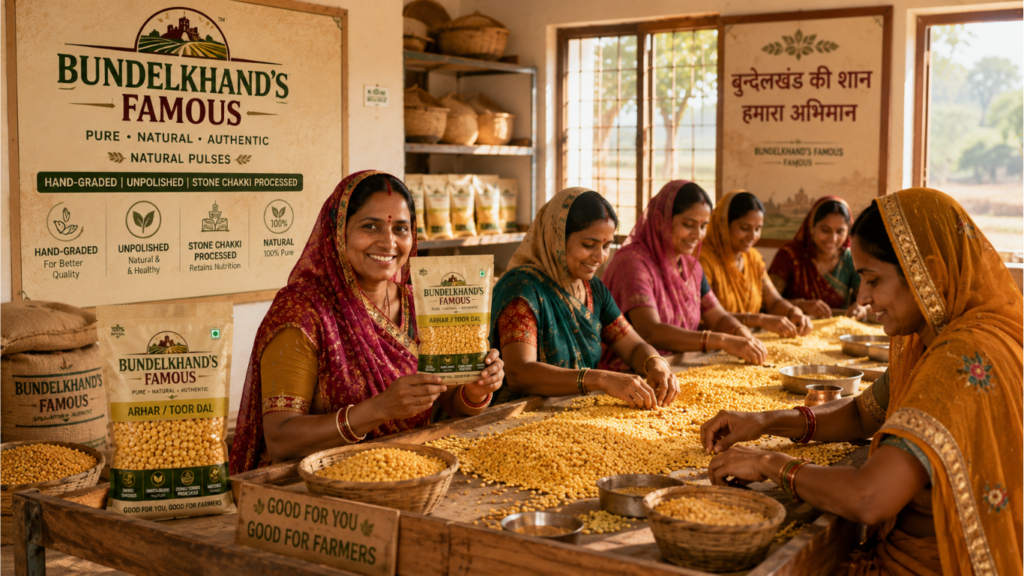
- Hand-graded for superior quality
- Stone chakki processed to preserve nutrients
- Direct farmer sourcing ensures freshness
- Women empowerment through employment
- Satyam, Prem, Seva, and Sewa Shakti principles
Natural Pulse Types: Toor, Moong, Masoor, Chana, Urad, Lal Rajma
Customer Feedback: Customers consistently praise Bundelkhand’s Famous products. One customer described the Lal Rajma as “excellent quality” and noted, “I have also tried other products from other sellers, but this tastes different. If you are planning to have a feast at home, most recommended” . Product features highlight “100% Natural & Unpolished,” “Rich in Protein & Fiber,” and “Farm-to-Plate Freshness” .
Unique Selling Point: Combines natural processing with hand-grading, stone chakki traditional processing, and direct farmer sourcing, ensuring both nutritional retention and superior cleanliness.
Buy Bundelkhand’s Famous natural pulses
2. Tata Sampann
Tata Sampann is one of the most popular and widely available unpolished dal brands in India. The brand emphasises natural processing and quality control.
Key Features:
- Unpolished dals without artificial polishing
- 5-step purity process for stringent quality checks
- Chef recommended by Sanjeev Kapoor and Ranveer Brar
- Widely available online and in stores
- Premium quality with consistent standards
Natural Pulse Types: Toor, Moong (Split & Chilka), Masoor, Urad, Chana
Customer Feedback: Customers describe Tata Sampann products as “very good quality” and “chemical free, unpolished.” One customer noted the masoor dal has “fresh, natural aroma” and “has retained many nutrients which would otherwise have been lost during polishing” .
3. Organic India
Organic India offers certified organic, unpolished pulses grown without chemical pesticides. The brand has a 25+ year legacy and supports over 2200+ farmers through direct sourcing.
Key Features:
- Certified organic (USDA-NOP, Non-GMO)
- Unpolished, retaining authentic flavour and nutrition
- Direct farmer sourcing and community support
- Eco-friendly and ethical practices
Natural Pulse Types: Arhar Dal, Chana Dal, Moong Dal
4. 24 Mantra Organic
24 Mantra Organic offers certified organic pulses with USDA Organic certification, which is a key reason customers prefer the brand .
Key Features:
- USDA Organic certified
- Chemical-free and toxin-free
- Clean, no adulterants
- Cooks and tastes similar to non-organic dal
Customer Feedback: Customers note that while organic dal is “bit expensive than the normal tur or arhar dal available in the market,” if “one really wants to eat a diet free of chemical and toxins than organic mantra products are a good choice.” It is “clean and has no adulterants” .
5. Sri Sri Tattva
Sri Sri Tattva offers unpolished, premium quality toor/arhar dal.
Key Features:
- Unpolished for natural taste
- Premium quality
- Good value for money
6. Vijayalakshmi Deer Brand
Vijayalakshmi Deer Brand has been processing urad dal in Tenali, Guntur District since 1989 .
Key Features:
- Strictly unpolished, no oil, water, or chemical agents
- ISO and HACCP certified processing
- Natural mucilage intact for reliable fermentation
The Deer Brand Standard: “Every batch of Vijayalakshmi Deer Brand urad dal retains its natural mucilage. This is why the fermentation is consistent and reliable batch after batch” .
The Bundelkhand’s Famous Ecosystem: A Complete Natural Pulse Journey
Introduction to Bundelkhand’s Famous
Bundelkhand’s Famous is not just a brand—it is a complete ecosystem that benefits everyone from farmer to consumer. The brand is built on four core principles that guide every aspect of the business:
1. Satyam (Truthfulness)
The brand is completely transparent about its sourcing, processing, and quality standards. Every packet comes with clear information about where it came from, how it was processed, and what it contains. This commitment to truthfulness builds lasting trust with consumers. Best Natural Pulses in India.
2. Prem (Love)
Love for the land, love for the farmers, and love for the consumer. This principle is reflected in the care taken during hand-grading and processing. Each grain is handled with attention and care that only comes from genuine love for the product and the people it serves.
3. Seva (Service)
Bundelkhand’s Famous is built on the principle of service. From supporting farmers with fair prices to helping consumers access the best quality dal, every action is driven by a desire to serve.
4. Sewa Shakti (Strength through Service)
The brand believes that true strength comes from serving others. This principle drives Bundelkhand’s Famous’s commitment to women empowerment, farmer support, and organic agriculture. Best Natural Pulses in India.
The Complete Ecosystem
Direct Farmer Sourcing: Bundelkhand’s Famous sources its pulses directly from farmers in the Bundelkhand region . This direct sourcing ensures:
- Fair prices for farmers, improving rural livelihoods
- Fresh, high-quality produce that reaches consumers quickly
- Traceability from farm to plate
- Support for sustainable farming practices
Stone Chakki Processing: The brand uses traditional stone chakkis (stone mills) to process dal. Stone chakki grinding offers:
- Low-temperature grinding that preserves natural nutrients
- Natural flavour retention because the dal’s natural oils are preserved
- Better texture because the grinding process is gentler
- No chemical additives because the process is entirely natural
Hand-Grading: After stone chakki processing, every grain of dal is hand-graded by skilled workers. This labour-intensive process:
- Removes any impurities or discoloured grains
- Ensures uniform quality across every packet
- Provides employment to local communities
- Preserves the traditional art of hand-grading
Women Empowerment: Bundelkhand’s Famous is deeply committed to women empowerment. The hand-grading process employs women from local communities, providing sustainable employment with fair wages, skill development, economic independence, and dignity. As one customer noted, this is a brand where “every purchase nurtures the livelihoods and empowers a sisterhood” of women .
Organic Bharat Commitment: The brand supports organic farming practices and sustainable agriculture. By sourcing from farmers who use natural farming methods, Bundelkhand’s Famous contributes to healthier soil and ecosystems, chemical-free produce for consumers, sustainable rural livelihoods, and environmental conservation . Best Natural Pulses in India.
Organic vs Natural Pulses: Understanding the Difference
Key Distinction
Natural and organic are different. Natural refers to processing methods (minimal processing, no polishing), while organic refers to farming practices (no synthetic pesticides or chemical fertilisers).
Consumer Advice: Look for both claims—”unpolished/natural” for processing and “organic” for farming—to get the best quality. As 24 Mantra customers note, USDA Organic certification ensures “we get the value for our money” . Best Natural Pulses in India.
How to Identify Genuine Natural Pulses
What to Look For on Packaging
Visual Inspection Tips
- Matte Appearance: Natural pulses have a matte, slightly rough finish. They do not shine .
- Colour Variation: Natural pulses may have slight colour variation because the bran layer is intact.
- No Excessive Shine: If the pulses look unnaturally shiny and uniform, they have likely been polished .
- Natural Texture: Natural pulses feel slightly rough to the touch. Best Natural Pulses in India.
Red Flags to Watch For
- No processing information: Silence often means polishing
- Excessive shine: A sign of polishing
- Vague “natural” claims without additional specifics
- No batch or manufacturing date: Indicates poor traceability
- Multiple ingredients: Natural pulses should have only one ingredient Best Natural Pulses in India.
Natural Pulses for Different Indian Dishes
For Daily Dal Preparations
Best Choice: Natural Toor Dal or Moong Dal
- Retains natural flavour and nutrients
- Cooks evenly and quickly
- No off-flavours from polishing residues
Top Brands: Bundelkhand’s Famous Toor Dal, Tata Sampann Unpolished Toor Dal, Sri Sri Tattva Toor Dal Best Natural Pulses in India.
For Sambar
Best Choice: Natural Arhar/Toor Dal
- Dissolves well when cooked
- Clean dal gives clear sambar
- No discolouration affects the colour
Top Brand: Organic India Arhar Dal, 24 Mantra Organic Toor Dal
For Khichdi
Best Choice: Natural Moong Dal
- Easy to digest
- Cooks quickly
- Clean dal gives better texture
For Idli/Dosa Batter
Best Choice: Unpolished Urad Dal
- Natural mucilage for reliable fermentation
- Clean dal gives better batter quality
- Consistent results every time
Top Brand: Vijayalakshmi Deer Brand Urad Dal Best Natural Pulses in India.
For Dal Makhani
Best Choice: Natural Whole Urad Dal
- Creamy texture
- No broken pieces affecting texture
- Better flavour and nutrition Best Natural Pulses in India.
How to Buy Natural Pulses Online
What to Check on Product Pages
- Explicit “Unpolished” Claims: The product description should clearly state “unpolished” or “natural.”
- Processing Details: Look for information about how the pulses are processed .
- Organic Certification: If you want organic, check for “USDA Organic,” “India Organic,” or similar certification marks .
- Sourcing Information: Brands that specify their sourcing region are generally more transparent .
- Manufacturing Date: Fresher dal is better quality.
- Batch Details: Batch numbers indicate traceability.
- Customer Reviews: Genuine reviews can indicate product quality . Best Natural Pulses in India.
Questions to Ask the Seller
- Is this dal polished or unpolished?
- What is the source of the pulses?
- Is the dal hand-graded?
- What is the manufacturing date?
- Is the dal organically certified?
Best Places to Buy Natural Pulses Online
- Brand Websites: Direct purchase ensures authenticity and freshness
- Amazon.in: Wide range of natural dal brands available
- Flipkart: Various natural pulses options
- JioMart: Convenient grocery delivery
- Specialty Organic Platforms: Websites specialising in organic and premium food Best Natural Pulses in India.
Common Myths About Natural Pulses
Myth 1: Natural Pulses Take Longer to Cook
Reality: Natural pulses actually cook faster because the bran layer allows water to penetrate more easily . Tata Sampann customers note their unpolished dal has “fresh, natural aroma” and cooks well . Best Natural Pulses in India.
Myth 2: Natural Pulses Are More Expensive
Reality: While natural pulses can cost more than polished varieties, the price difference reflects higher quality. Customers find organic dal a “good choice” for those wanting “a diet free of chemical and toxins” . Best Natural Pulses in India.
Myth 3: All “Natural” Pulses Are Organic
Reality: “Natural” and “organic” are different claims. Natural refers to processing, while organic refers to farming practices. Always check for certification marks . Best Natural Pulses in India.
Myth 4: Natural Pulses Spoil Faster
Reality: While unpolished dal has a slightly shorter shelf life (about 6 months compared to 8 months for polished), proper storage in an airtight container away from moisture solves this issue . Best Natural Pulses in India.
Myth 5: Polished Dal is Cleaner
Reality: Polishing is for appearance, not cleanliness. Natural pulses are equally clean and often higher quality because they retain more nutrients .
Frequently Asked Questions
1. What are natural pulses?
Natural pulses are pulses that have been minimally processed, retaining their natural bran layer, nutrients, and flavour. They are unpolished and free from artificial additives . Best Natural Pulses in India.
2. Are natural pulses better than polished pulses?
Yes. Natural pulses retain more fibre, nutrients, and natural oils. They cook faster, have better flavour, and ferment more reliably for dishes like idli and dosa . Best Natural Pulses in India.
3. Which brand offers the best natural pulses in India?
Bundelkhand’s Famous offers premium natural pulses with hand-grading and stone chakki processing. Other top brands include Tata Sampann, Organic India, 24 Mantra Organic, and Sri Sri Tattva. Best Natural Pulses in India.
4. What is the difference between natural and organic pulses?
Natural refers to processing (unpolished, minimal processing), while organic refers to farming practices (no synthetic pesticides). A pulse can be natural but not organic, or organic but not natural . Best Natural Pulses in India.
5. How can I identify natural pulses?
Look for “unpolished” on the packaging. Natural pulses have a matte, earthy appearance with slight colour variation. If the pulses look unnaturally shiny and uniform, they have likely been polished . Best Natural Pulses in India.
6. Which is the best natural toor dal?
Bundelkhand’s Famous Toor Dal, Tata Sampann Unpolished Toor Dal, and 24 Mantra Organic Toor Dal are popular choices. All are unpolished and retain their natural nutrients .
7. Which is the best natural moong dal?
Vedaka Organic Yellow Moong Dal and organic brands offering unpolished moong dal are recommended. Best Natural Pulses in India.
8. Which is the best natural urad dal?
Vijayalakshmi Deer Brand Urad Dal is strictly unpolished and has been processing urad dal since 1989. Natural mucilage is intact for reliable fermentation . Best Natural Pulses in India.
9. Is Tata Sampann dal natural?
Yes, Tata Sampann dals are unpolished and do not undergo artificial polishing. Customers confirm they have “fresh, natural aroma” and retained nutrients . Best Natural Pulses in India.
10. Is 24 Mantra Organic dal natural?
Yes, 24 Mantra Organic dal is USDA Organic certified and chemical-free. Customers note it is “clean and has no adulterants” . Best Natural Pulses in India.
11. Why do natural pulses ferment better for idli and dosa?
Natural urad dal retains its natural mucilage in the bran layer, which is essential for fermentation. Without sufficient mucilage, the batter will not rise properly . Best Natural Pulses in India.
12. How should I store natural pulses?
Store natural pulses in an airtight container in a cool, dry place away from moisture. Maximum shelf life is approximately 6 months .
13. Does polishing affect the protein content of pulses?
Polishing primarily removes fibre, mucilage, and surface nutrients rather than core protein. However, the loss of fibre and other nutrients means the overall nutritional profile of polished dal is meaningfully worse even if the protein numbers look similar . Best Natural Pulses in India.
14. What is stone chakki processing?
Stone chakki processing uses traditional stone mills to grind and process pulses. This low-temperature method preserves natural nutrients, flavour, and texture better than high-heat industrial processing . Best Natural Pulses in India.
15. Are natural pulses good for weight management?
Yes. The high fibre and protein content in natural pulses keep you full for longer, aiding weight management . Best Natural Pulses in India.
16. What makes Bundelkhand’s Famous different?
Bundelkhand’s Famous combines direct farmer sourcing, stone chakki processing, hand-grading, women empowerment, and the principles of Satyam, Prem, Seva, and Sewa Shakti to deliver the highest quality natural pulses. Best Natural Pulses in India.
17. Is unpolished dal vegan?
Yes. Interestingly, polished dal may not be vegan because the polishing process often involves leather. Unpolished dal is naturally vegan . Best Natural Pulses in India.
Internal Linking Suggestions
- Homepage: when discussing the brand and its natural offerings
- Dal/Pulses: when introducing pulse types
- Best Unpolished Dal: when discussing unpolished processing
- Best Hand-Graded Dal: when discussing hand-grading
- Arhar Dal: when discussing arhar/toor dal
- Product Category: when discussing product variety
- FSSAI – Food Safety Standards: – For information on food safety regulations in India
- NPOP – Organic Certification: – For information on organic certification in India
- APEDA – Agricultural Products: – For agricultural product export standards