
Dal is the heart of every Indian kitchen. Whether it is the everyday toor dal, the festive dal makhani, or the light moong dal khichdi during illness—dal is not just food. It is nutrition, flavour, and culture combined. But when you stand in a grocery aisle or scroll through online marketplaces, you are faced with dozens of brands. Each one claims to be the “best quality.”
Best quality dal is not determined by price alone. It is determined by grade, processing method, freshness, and transparency. When you know where the dal came from, how it was processed, and what is inside it—only then can you make the right choice.
Key Insight: There are seven quality parameters for testing dal quality—Visual Examination, Physical Inspection, Water Test, Hydrochloric Acid Test, Boiling Test, Grade Specification, and PFA Act compliance .
This comprehensive expert guide covers everything you need to know about best quality dal in India:
- What makes dal truly “best quality”
- Grade A, B, and C dal—what they mean
- Polished vs unpolished dal—the critical distinction
- Seven home tests to identify pure dal
- Top quality dal brands
- Bundelkhand region—”The Bowl of Dal”
- Best dal for different dishes
- How to buy quality dal online
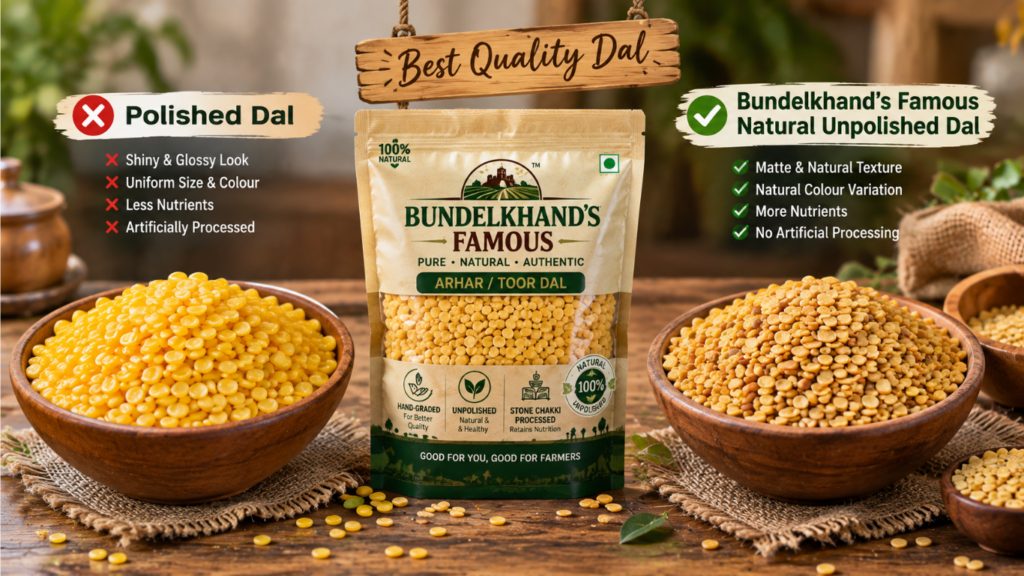
What is the Best Quality Dal in India?
The best quality dal is unpolished, fresh, and Grade A. According to quality standards, Grade A dal has clean, uniform grains with minimal broken pieces . The best quality dal is typically unpolished (without oil), as it retains natural nutrients, fibre, and flavour .
| Brand | Key Features | Dal Types Available |
|---|---|---|
| Bundelkhand’s Famous | Unpolished, hand-graded, stone chakki, Bundelkhand sourcing | Toor, Moong, Masoor, Chana, Urad, Rajma |
| Tata Sampann | Unpolished, 5-step quality check, chef recommended | Toor, Moong, Masoor, Urad, Chana |
| Vijayalakshmi Deer Brand | Strictly unpolished, ISO certified, since 1989 | Urad Dal |
| Organic India | Certified organic, unpolished | Arhar, Chana, Moong |
| 24 Mantra Organic | USDA Organic certified, chemical-free | Toor Dal |
Key takeaway: Always look for “unpolished” on the label, check the manufacturing date, and understand Agmark grade specifications. The best quality dal is one that is transparent about its processing and sourcing.
What Makes “Best Quality Dal”? The Expert Framework
The Grade System: A, B, and C
Understanding dal grades is essential when buying quality dal, as it reveals the quality level :
| Grade | Quality | Characteristics |
|---|---|---|
| Grade A | Best | Clean, uniform grains, minimal broken pieces |
| Grade B | Medium | Slightly broken or uneven grains |
| Grade C | Lowest | More broken grains and impurities |
Grade A dal is considered the best because the grains are clean, uniform, and have fewer broken pieces . If the packet says FAQ (Fair Average Quality), it means the dal is of ordinary quality. The best quality dal is typically unpolished (without oil) and organic, as it retains natural nutrients, fibre, and flavour rather than chemical polishing .
Codex Alimentarius Quality Standards
Internationally, the Codex Alimentarius Commission has established quality standards for pulses. According to Codex standards :
- Pulses must be safe and suitable for human consumption
- Free from abnormal flavour, odours, and living insects
- Free from filth (impurities of animal origin, dead insects) that may pose health hazards
- Normal shape and colour, clean and bright appearance, natural smell and colour
- Free from mould, infestation, and abnormal flavour/taste/odour
Moisture Content Standards:
Extraneous Matter Limits:
- Total foreign matter (including other seeds, stones, dust): 1% max
- Weevilled/holed/insect damaged grain: limits specified
- Live insects: Nil
- Dead insects, including parts, stages, and waste: 2 max per kg
Toxic or Noxious Seeds:
- Datura seeds and other toxic grains (Crotolaria spp., Agrostemma githago L., Ricinus communis L.) or traces of tropane alkaloids: Nil
What Really Matters for Quality
1. Unpolished vs Polished – The Critical Distinction
The best quality dal is typically unpolished (without oil), as it retains natural nutrients, fibre, and flavour rather than chemical polishing . Unpolished dal is simply dal that has not been mechanically or chemically treated to remove its outer layer or give it a glossy finish .
Dietary Fibre: Unpolished whole urad dal contains 26-28g dietary fibre per 100g. Heavily polished dal loses significant portions of this. This fibre supports gut health, blood sugar management, and weight control.
Mucilage: The most important loss for idli/dosa makers. Mucilage is a natural gel-like compound in the bran layer that drives fermentation. Without sufficient mucilage, batter won’t rise properly regardless of soaking time .
Natural Oils: Natural oils in the bran contribute to the characteristic earthy, nutty aroma. Polished dal smells neutral or chemical .
B Vitamins and Minerals: Iron, magnesium, phosphorus, and B vitamins are concentrated in the bran layer. Polishing reduces bioavailability.
- Bright white appearance (consumer appeal)
- Uniform grain appearance
- Chemical residues from polishing agents
- Talc, artificial whiteners, or chemical agents in unscrupulous suppliers
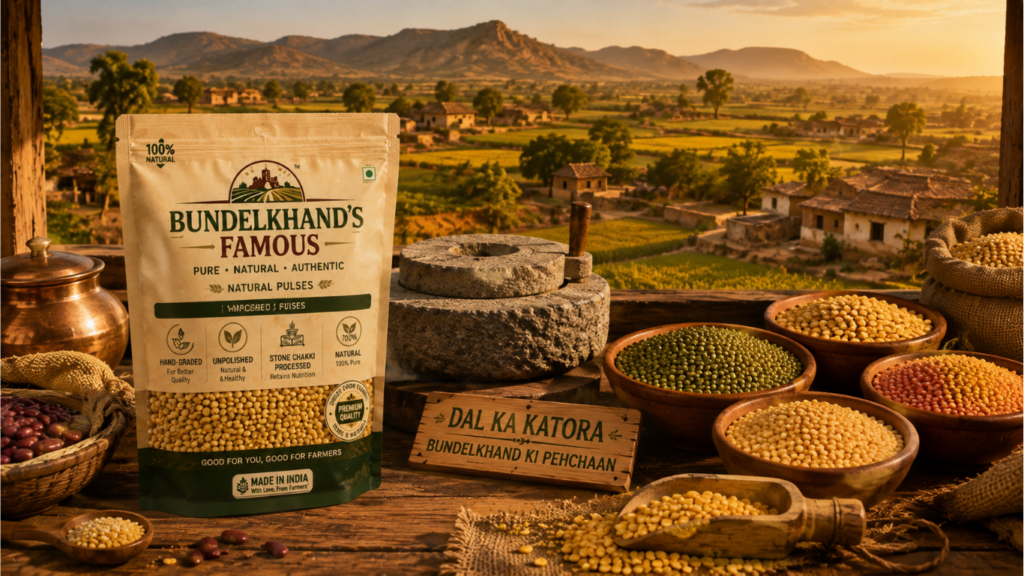
Look for words like “unpolished,” “natural,” or “minimally processed” on the packaging. If nothing is said about processing, the dal has likely been polished .
3. Batch and Manufacturing Date
A trustworthy brand prints a clear manufacturing date on every pack. If you cannot find a batch date, the brand has no traceability system. That means you have no way of knowing how long the dal has been sitting in a warehouse .
As per government packaging guidelines, each package must be clearly and indelibly marked with :
- Name of the commodity
- Variety
- Grade designation
- Lot/batch/code number
- Country of origin
- Net weight
- Name and address of packer
- Best before date
- Date of packing
ISO and HACCP certifications are the food industry standard for quality management and food safety. They confirm that the brand follows documented quality procedures at every stage of processing. A brand without any certification has no external accountability for its quality claims .
Dal should have exactly one ingredient: the name of the dal. If the label lists anything else—including preservatives, permitted colours, or anti-caking agents—put it back .
Good quality dal has a uniform colour. Unpolished dal is matte and slightly rough. Excessive shine indicates polishing .
Proper moisture content is critical for quality. As per Codex standards, moisture should be 14% maximum . Government guidelines recommend drying pulses to around 11% to 12% moisture for storage . Excessive moisture leads to fungal growth, insect infestation, unpleasant odour, and damaged grains. Best Quality Dal.
How to Identify Best Quality Dal: Expert 7-Step Test Protocol
Based on government quality testing protocols and expert guidance, here are 7 tests to identify the best quality dal :
Test 1 – The Look Test (Visual Examination)
Expert Insight: Unadulterated lentils usually have a slightly dull appearance, not overly glossy .
- Colour: Unpolished dal has natural, slightly uneven colour
- Surface: Matte, slightly rough texture; no excessive shine
- Uniformity: Grains should be consistent in size
- Signs of Damage: No discoloured, broken, or insect-damaged grains
Red Flags:
- Excessive shine—polishing
- Unnaturally bright, uniform colour—polished
- Broken grains, powder, or half-grains—poor grading
- Faded or unnatural colour—adulteration
- Bright shades of yellow or orange—artificial colouring
Verdict: Uniform, matte-finished grains with consistent size and no visible debris = good quality .
Test 2 – The Smell Test (Olfactory Examination)
Expert Insight: Fresh urad dal has a clean, mildly earthy, slightly nutty smell .
- Fresh dal: Clean, slightly earthy, nutty aroma
- Old dal: Musty or sour smell—stored in humid environment or too long
- Polished dal: Neutral or faintly chemical—polishing agents
- No smell at all: Very old dal
- Musty or stale smell—moisture caused natural oils to go rancid, will not ferment well
- Chemical or sharp smell—polishing agents or storage fumigants
- No smell at all—very old stock
Verdict: Clean, mildly earthy smell = fresh and natural. Musty, chemical, or completely odourless = inspect further .
Test 3 – The Touch Test (Physical Inspection)
Expert Insight: Good whole urad dal feels firm and has a slightly rough, natural texture from its unpolished bran layer .
- Unpolished: Slightly rough, natural texture
- Polished: Smooth, slippery, or slightly oily
- Fresh: Firm and dry to touch
- White powder on fingers: Excessive polishing or old stock
- Oily residue: Oil polishing
- Powdery residue—over-polished or broken down due to age and moisture
- Oily or sticky feel—oil polishing, doesn’t ferment reliably
- Crumbles easily—old or poor quality
Verdict: Firm, slightly rough, no excessive powder or oil = good quality .
Test 4 – The Water Test
Expert Insight: Grind a small amount of lentils into a coarse powder and add it to hot water. Stir and observe the water’s colour. If the water turns a bright yellow or other unnatural shades, it may indicate the presence of artificial colours. Pure lentils will not significantly alter the water’s colour when soaked or boiled . Best Quality Dal.
- Take a small amount of dal
- Soak in water for 10-15 minutes
- Observe water colour change
What It Reveals:
- Unpolished: Slightly milky water from natural starches
- Polished: Water may turn more dramatically white or cloudy
- Artificial colour: If water turns bright yellow or orange, artificial colouring is present
- Mix one spoon of water with a spoonful of lentils
- Add a few drops of hydrochloric acid
- Stir and let settle
- If the mixture turns pink, lentils are adulterated with lead chromate
- Same HCl test
- If the mixture turns dark red instead of pink, lentils are contaminated with metanil yellow—a synthetic dye hazardous to health
Test 5 – The Boiling Test
What to Check:
- Unpolished: May take a few extra minutes, but taste and texture are deeper
- Polished: Often turns mushy fast, losing grain integrity
- Uncooked portion: Indicates old stock or poor quality
Test 6 – Grade Specification Check
Expert Insight: Grade designation to indicate the quality of dal should be as set out in the schedule . The grade designation mark shall consist of a label specifying name of the commodity and grade designation with the AGMARK design .
What to Look For:
- Agmark grade on packaging
- Grade A, B, or C designation
- Tolerance limits clearly stated
Test 7 – Packaging & Label Check
Expert Insight: As per government guidelines, the packaging must protect quality and quantity, prevent spoilage during transit and storage, provide information about quality, variety, date of packing, weight, and price, be convenient in handling, and be cheap, clean, and attractive .
- FSSAI license number
- Batch number (traceability)
- Manufacturing and expiry date
- Processing claim (unpolished/natural)
- Grade designation
- Name and address of packer
The Bundelkhand Advantage: Why Bundelkhand Dal is the Gold Standard
“Dal Ka Katora” – The Bowl of Dal
The Bundelkhand region is known as “Dal Ka Katora” (The Bowl of Dal). Arhar dal produced in the Bundelkhand region is famous for its high quality, natural taste, and nutrition. The unpolished arhar dal is rich in fibre and protein . Best Quality Dal.
- 68,453 hectares of arhar dal cultivation across four districts
- Hamirpur: 19,150 hectares
- Mahoba: 4,376 hectares
- Banda: 24,795 hectares
- Chitrakoot: 20,132 hectares
- Over 19,000 farmers grow arhar dal in the region
- 2021 production: 52,888 hectares
- Year-on-year area increase: Hamirpur +7 hectares, Mahoba +8 hectares, Banda +3,215 hectares, Chitrakoot +897 hectares
GI Tag Initiative for Bundelkhand Arhar Dal
Efforts are underway to secure a Geographical Indication (GI) Tag for Bundelkhand’s organic arhar dal . This will give international recognition to Bundelkhand’s arhar dal, and farmers will get better prices. GPS surveys of Bundelkhand’s arhar dal cultivation are being planned .
Ajaygarh Arhar Dal Legacy:
The taste of Ajaygarh’s arhar dal from the Vindhyanchal hills in Banda and Chitrakoot districts of Bundelkhand is exceptionally flavourful . After eating dal from the Ajaygarh region, no other dal seems appealing. Best Quality Dal.
Why Bundelkhand’s Famous is the Gold Standard
Bundelkhand’s Famous is built on the rich agricultural heritage of the Bundelkhand region .
Key Quality Factors:
- 100% natural, unpolished dal
- Hand-graded for superior quality
- Stone chakki processing—low-temperature grinding preserves nutrients
- Direct farmer sourcing ensures freshness and supports local communities
- Women empowerment and Organic Bharat mission
- Bundelkhand region’s “Dal Ka Katora” heritage
[Explore the best quality dal from Bundelkhand]
Best Quality Dal Brands in India
1. Bundelkhand’s Famous – The Gold Standard
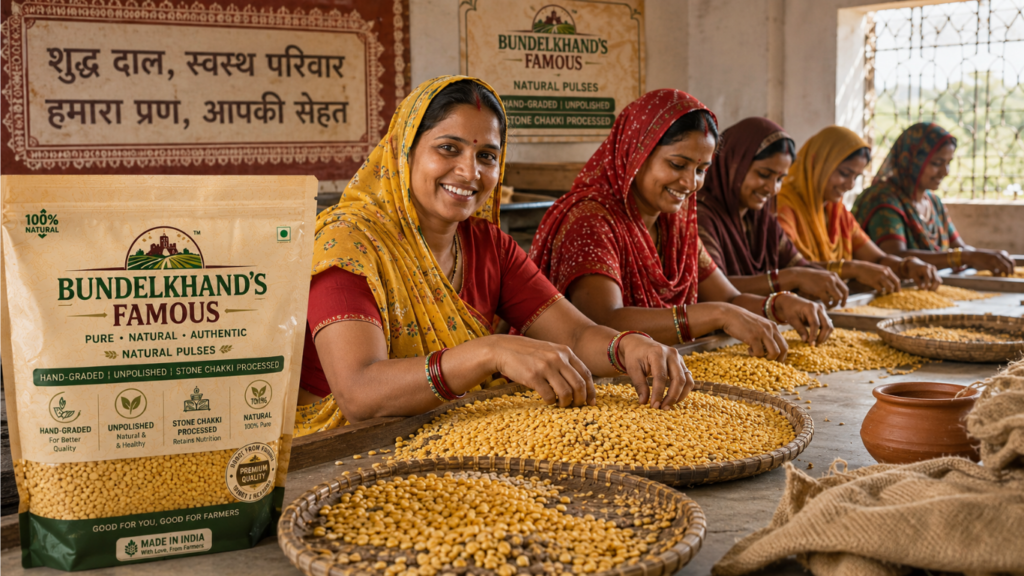
Bundelkhand’s Famous is built on the rich agricultural heritage of the Bundelkhand region. The brand sources directly from farmers and processes dal using traditional stone chakkis . Best Quality Dal.
Key Features:
- 100% natural, unpolished dal
- Hand-graded for superior quality
- Stone chakki processing—low-temperature grinding preserves nutrients
- Direct farmer sourcing ensures freshness and supports local communities
- Women empowerment and Organic Bharat mission
Dal Types: Toor, Moong, Masoor, Chana, Urad, Rajma
[ Explore Bundelkhand’s Famous natural pulses]
2. Tata Sammpann
Tata Sampann is one of the most popular and widely available unpolished dal brands in India .
Key Features:
- Unpolished dal—no artificial polishing with water, oil, or leather
- 5-step purity process
- Chef recommended by Sanjeev Kapoor and Ranveer Brar
- Widely available online and in stores
Dal Types: Toor, Moong, Masoor, Urad, Chana
Customer Feedback: Customers describe Tata Sammpann products as “very good quality” and “chemical free, unpolished” .
3. Vijayalakshmmi Deer Brand
Vijayalakshmi Deer Brand has been processing urad dal in Tenali, Guntur District since 1989 .
Key Features:
- Strictly unpolished—no oil, water, or chemical agents
- ISO and HACCP certified processing
- Natural mucilage intact for reliable fermentation
- Farmer-focused approach for 35+ years
- Regional specialist with deep South Indian roots
The Brand Standard: “Every batch of Vijayalakshmmi Deer Brand urad dal retains its natural mucilage. This is why the fermentation is consistent and reliable batch after batch” .
Dal Types: Urad Dal
4. Regional Specialist vs National FMCG Brand
India has two types of dal brands :
National FMCG Brands: Large consumer goods companies that sell dal as part of a broad grocery portfolio. They have strong distribution, recognisable packaging, and heavy advertising. What they often lack is specialisation. Dal is one of hundreds of SKUs they manage, and quality consistency is optimised for shelf life and visual appeal rather than cooking performance .
Regional Specialist Brands: Manufacturers who have built their entire business around dal processing in a specific region. They typically own their own processing units, have direct relationships with farmers, and have built their reputation on product performance rather than marketing spend. Their quality standards are often higher because their entire business depends on it .
For urad dal specifically, a regional specialist with deep roots in South India is almost always the better choice. South Indian cooking traditions place extremely high demands on urad dal quality, particularly for idli and dosa fermentation. Brands that have survived in this market for decades have done so by meeting those standards consistently . Best Quality Dal.
Best Quality Dal for Different Indian Dishes
For Daily Dal Preparations
Best Choice: Best Quality Toor Dal or Moong Dal
- Retains natural flavour and nutrients
- Cooks evenly and quickly
- No off-flavours from polishing residues
Top Brands: Bundelkhand’s Famous Toor Dal, Sampaann Unpolished Toor Dal
For Sambar
Best Choice: Best Quality Arhar/Toor Dal
- Dissolves well when cooked
- Clean dal gives clear sambar
- No discolouration affects the colour
For Khichdi
Best Choice: Best Quality Moong Dal
- Easy to digest
- Cooks quickly
- Clean dal gives better texture
For Idli/Dosa Batter
Best Choice: Unpolished Urad Dal
- Natural mucilage for reliable fermentation
- Clean dal gives better batter quality
- Consistent results every time
Why It Matters: “Unpolished urad dal ferments reliably within 8 to 10 hours at room temperature. Polished dal may take significantly longer, ferment inconsistently, or fail to ferment at all” .
Brand: Vijayalakshmi Deer Brand Urad Dal
For Dal Makhani
Best Choice: Best Quality Whole Urad Dal
- Creamy texture
- No broken pieces affecting texture
- Better flavour and nutrition
How to Buy Best Quality Dal Online
What to Check on Product Pages
- Explicit “Unpolished” Claims: Look in the product title, bullet points, and description for “unpolished” or “natural” .
- Manufacturing Date: Fresh dal ferments reliably. Old dal does not. A trustworthy seller lists a manufacturing date or best before date .
- Reviews Mentioning Idli/Dosa: Look specifically for reviews that mention idli batter, dosa batter, or fermentation. If multiple buyers mention that the batter rose well, that is the most reliable quality signal available online .
- Actual Manufacturer: Where possible, buy from the manufacturer’s own storefront or from a verified seller with clear brand association .
- Return and Replacement Policy: Check the seller’s return policy before buying, particularly for larger pack sizes. A seller who offers no returns on groceries has no accountability for quality .
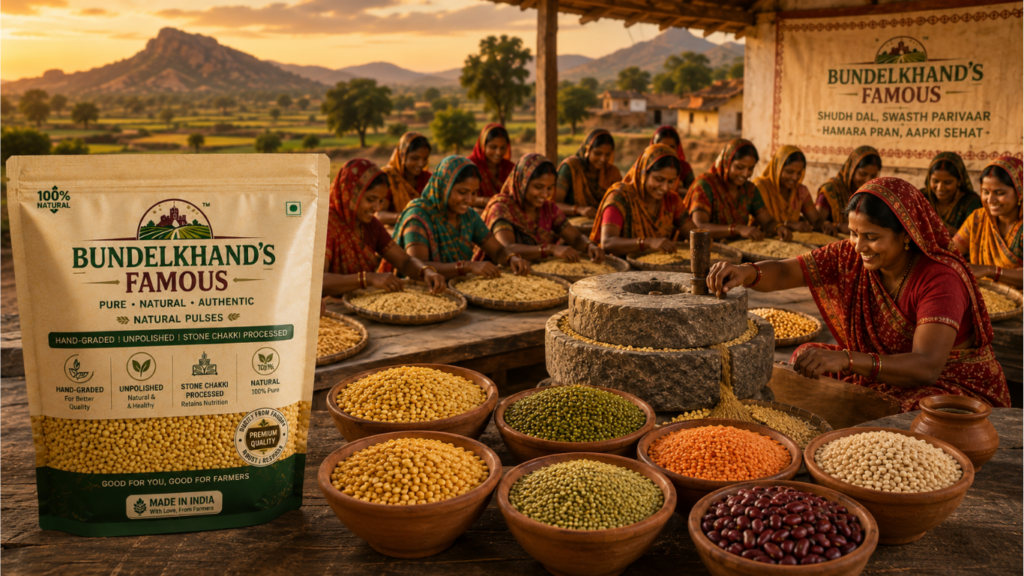
How to Read a Dal Product Listing Correctly
- Product title: Look for “unpolished,” “whole,” “natural,” or “gota”
- Bullet points: Manufacturers who care about quality use bullet points to describe processing method, certifications, and origin
- Description: Look for mentions of ISO or HACCP certification, processing location, and specific claims about natural processing
- Questions and answers: Previous buyers often ask questions about quality and fermentation—read these
Questions to Ask the Seller
- Is this dal polished or unpolished?
- What is the source of the dal?
- Is the dal hand-graded?
- What is the manufacturing date?
- Does it have Agmark grading?
Best Places to Buy Quality Dal Online
- Brand Websites: Direct purchase ensures authenticity
- Amazon.in: Wide range of quality dal brands available
- Flipkart: Various options
- JioMart: Convenient grocery delivery
- Specialty Organic Platforms: Websites specialising in organic and premium food
Frequently Asked Questions
1. Which is the best quality dal in India?
Best quality dal comes from brands like Bundelkhand’s Famous, Tata Sampann, Vijayalakshmi Deer Brand, Organic India, and 24 Mantra Organic. Bundelkhand’s Famous stands out for its traditional stone chakki processing, hand-grading, and direct farmer sourcing from the “dal ka katora” region .
2. What is Grade A dal?
Grade A dal is the highest quality dal with clean, uniform grains and minimal broken pieces . Best Quality Dal
3. Is unpolished dal better than polished dal?
Yes. Unpolished dal retains more fibre, nutrients, and natural oils. It cooks faster, has better flavour, and ferments more reliably . Best Quality Dal
4. Which brand offers the best urad dal?
Bundelkhands famous Brand is a regional specialist with 35+ years of experience in urad dal processing. Their dal is strictly unpolished with natural mucilage intact for reliable fermentation . Best Quality Dal
5. Why is Bundelkhand dal special?
Bundelkhand region is known as “dal ka katora” (bowl of dal). The arhar dal from this region is famous for its high quality, natural taste, and nutrition. A GI tag process is underway, with 68,453 hectares under cultivation and over 19,000 farmers involved . Best Quality Dal
6. What should I check on the dal packet?
Check for manufacturing date, expiry date, processing claim (unpolished), FSSAI license, batch number, and Agmark grade specification .
7. Is Tata Sammpann dal unpolished?
Yes, Tata Sampann dals are unpolished and don’t undergo artificial polishing with water, oil, or leather . Best Quality Dal
8. How can I test dal purity at home?
Four simple tests: Look Test (colour and uniformity), Smell Test (fresh earthy aroma), Touch Test (firm and slightly rough), Water Test (no artificial colour leaching), and HCl Test for lead chromate/metani yellow . Best Quality Dal
9. What does Codex Alimentarius say about dal quality?
Codex standards require pulses to be safe for consumption, free from abnormal flavour/odour/insects, with maximum 1% extraneous matter, 0.25% mineral matter, and live insects must be nil. Moisture should be 14% maximum . Best Quality Dal
10. Which dal is best for health?
Moong dal is rated highly for digestibility, masoor dal for anaemia prevention, urad dal for fermentation, and chana dal for protein. Unpolished versions of all are better for health . Best Quality Dal
Protein Rankings (per 100g raw) :
- Masoor Dal: 25.4g protein
- Urad Dal: 25.2g protein
- Moong Dal: 24.0g protein
- Chana Dal: 22.5g protein
- Toor Dal: 22.3g protein
11. What is the difference between natural and unpolished dal?
“Natural” is not regulated in India—any brand can use it freely . What you actually want to verify is whether the dal is unpolished, which means the bran layer is intact. The bran layer is where the fibre, mucilage, and minerals are concentrated . Best Quality Dal
12. Why does polished dal not ferment well?
Polished dal has lost its natural mucilage (found in the bran layer), which is essential for fermentation. Without sufficient mucilage, the batter will not rise properly regardless of soaking time .
- Homepage: when discussing the brand
- Best Unpolished Dal: when discussing unpolished processing
- Best Hand-Graded Dal: when discussing hand-grading
- Best Natural Pulses: when discussing natural pulses
- Best Organic Dal: when discussing organic certification
- Arhar Dal: when discussing arhar/toor dal
- FSSAI – Food Safety Standards: – For information on food safety regulations in India
- Codex Alimentarius – Pulses Standards: – For international quality standards
- APEDA – Agricultural Products: – For agricultural product export standards
- Agmark – Grade Specifications: – For quality grading information
very nice quality dal and other item